

With Canadian public schools spending an average of $18,120 per student, it’s striking that many non-profit independent schools deliver education at similar or only slightly higher costs. The growing shift toward these alternatives suggests that pouring more money into education doesn’t guarantee better results. And parents voting with their feet may reveal that efficiency, focus, and freedom from bureaucracy matter far more than the size of the budget.
How much does it cost to educate a Canadian child in the public school system? Well, if you take the total public school spending across Canada in 2022-2023 and divide that by the total number of students in public elementary and secondary schools, you’ll see where I got that $18,120 number.
Although naturally, it’s not quite that simple. If you break those numbers down by province, you’ll see quite the range. Here’s what those look like in the provinces for which data was available:
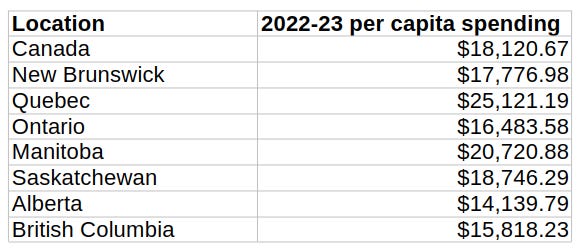
Quebec, as always, is an outlier, spending nearly double on each of their students than Alberta did on theirs. I have no clue what’s going on there. But then when did I ever understand Quebec?
Does more money translate to better results? Some time ago, I measured provincial spending against student outcomes and I found statistical evidence suggesting higher school spending predicted weaker educational outcomes.
Ideally, education shouldn’t be about the the price tag. A society, community, or family should identify the very best tools for guiding each child along his journey towards responsible adulthood and simply apply them. But here in the real world, teachers unions invariably demand more funding and finance ministry officials always prefer to pay less. Funding is something that’s impossible to ignore.
Perhaps it’s worth comparing public school funding with the costs of operating independent schools. To be sure, I’m not aware of any hard data that could demonstrate that private school graduates are, as a population, better equipped at handling adult life. But let me suggest the possibility that the significant growth in non-public enrollments is a reflection of parents’ assessments of quality.
Of course, we’ll need to keep important structural differences in mind. Public systems, for instance, enjoy enormous economies of scale. They’re able to negotiate favorable purchase agreements with vendors like text book publishers that far smaller private institutions could only dream of.1
On the other hand, private schools can, if they choose to, neatly sidestep the costs of huge administrative bureaucracies and expensive implementation of trendy luxury beliefs.
The bottom line is that we’re not comparing apples to apples. But that doesn’t mean there’s nothing to gain from doing some thinking about the topic.
I should note that for this discussion, I’m only going to look at independent schools that are registered with CRA as charities. That’s because those are the only schools whose spending data is easily available. But it’s also because the more expensive for-profit schools aren’t usually designed to save money.2
I pulled the 2023 “total expenditures” amounts from CRA charitable organization filings for around 125 independent elementary and secondary schools. I then tried to find enrollment numbers for as many of those institutions as possible.
Information can be hard to come by. For some reason, Ontario stopped publishing such data back in 2020, and I’m not aware of comparable resources for any other provinces. Of those 125 schools, I only found useful information for 25. Of those, ten were religious in character.
By far the biggest spender from this group is Calgary’s Webber Academy. Teaching their 1,017 students cost them $37,414,811 in 2023 - an average of $37,789 each. I’m sure there are expensive for-profit schools that spend more, but their financials aren’t publicly available. Total annual tuition costs for Webber fall between $21,000 and $25,800 - depending on the grade. Based on the yawning gap between their actual costs and what they charge for tuition, they obviously came by their non-profit status honestly.
The schools with the lowest budgets were part of the Manitoba Catholic Schools system. St. Boniface Diocesan High School spent just a touch more than $8,000 for each of their 253 students.
Overall, the average annual per-student cost among those 25 schools was $20,172.57, which is around ten percent higher than the national average for public school spending.
Does this mean that non-profit private school students are getting a better education? If they are, there’s no evidence that it’s the extra spending that’s making the difference. Does it mean that private school administrators are doing a substandard job building cost-efficient budgets? Hardly. Although I certainly couldn’t rule it out.
But we can say that rising levels of public spending aren’t leading to either improved outcomes or public confidence.
So given all that - and the fact growing numbers of parents seem to be abandoning public schools - is there a better alternative?
Well here’s an idea: why not publicly-fund private delivery of education? The federal government now funds a privately-delivered healthcare program (the new Canadian Dental Care Plan), why should provincial governments not do the same to meet parents’ educational needs?
After all, aren’t governments supposed to serve their citizens?
Keep reading:
Ranking Public Education Efficiency by Province

This post is the first of a series of “Rankings” where I - well - rank Canadian provinces against each other for their public policy successes and (dare we suggest) failures. Such comparisons can be a lot of fun, of course. But they can also teach us important lessons about what’s working and what isn’t.
Canadian Higher Education by the Numbers

I’ve published more than a few education-related posts here. I’ve written about measuring the return on your tuition dollar and on what’s driving the crazy growth in overall higher education spending. But I haven’t yet turned my data-powered, space-laser-vision against the true costs of academic aspirations on students themselves - and on what that says…
The Impact of K-12 Education Employment on Student Outcomes

Back in the summer of 2024, I ranked Canadian provinces for educational outcomes using my very own custom Education Success Index (ESI). The thinking was that an effective school system would produce successful graduates, so provinces with better schools should be able to point to the most successful populations. The index consisted of these five metric…
Although from what I’ve seen, small, non-profit private schools often purchase used textbooks at pennies on the dollar after being discarded by public schools. That offers the added benefit of avoiding a lot of the crazier ideological politicization found in newer editions.
Although I am certainly curious about whether those graduates actually outperform their public system and non-profit private school peers.
David, this is a topic that is close to my heart.
I have three school age grandchildren. My grandson attends a private school as he has some learning disabilities; his sister is in the public school stream. The particular private school specializes in dealing with learning disabilities and my grandson had to be tested by appropriate experts before becoming a student. My son and his family are (thankfully) able to afford the tuition cost for grandson.
My remaining granddaughter is in public school and also has learning disabilities. The public school system here in Calgary has accepted that she has problems [she also has been tested and was designated appropriately for needing assistance] and has designated additional funding for her school to allow an extra resource person to help her. Having said that, the extra funding has been received by the school but has not been utilized for the benefit of my granddaughter and has simply been chewed up by general school spending at the local school. The result is that granddaughter is really, really struggling at school.
My daughter and her husband do not have the resources to send granddaughter to private school but they have applied to send her to the same school as grandson. She qualifies - as determined by psychologist, etc. testing - but we have to wait to see if she makes it off the wait list. Then, daughter and son-in-law have to find the money which means that my wife and I have to assist. This will not be easy, not whatsoever, but my wife and I will beggar ourselves to assist granddaughter.
My point in this recitation is to recognize that there are a lot of kids with difficulties and parents and grandparents are doing all that they can but sometimes that isn't enough. But parents and grandparents keep trying.
To simply argue that provinces do or do not spend enough is an insufficient argument in my view; not irrelevant but insufficient. An important thing to do is to recognize that the movement over the last number of decades to bring all kids into the same classroom in the name of "fairness" and "inclusion" and such is insufficient and, in fact, often harmful. It seems to me that many children would benefit from specialized classrooms on either a full time or part-time basis and that would assist with some of the issues of classroom complexity.
So, yes, the overall spend is an issue but so is the way classrooms are organized. And, I am quite certain, there are many other factors that need to be considered.
If you want to blow your hair back, chart the inflation-adjusted spend per student in Ontario public schools against EQAO results for the last 25 years. Then, just for laughs, do a similar comparison of the number of teachers employed versus the number of students enrolled.
Lay on top of this the avalanche of evidence from post-secondary institutions that their freshman students are woefully unprepared, and it’s impossible to conclude anything other than this: spending more money and hiring more teachers has not led to improved outcomes—and might actually be making things worse.
To be fair, in the last decade, the issue of classroom complexity has become a legitimate concern. Between kids with learning disabilities and needs that formerly would have been accommodated in a special-ed classroom, kids with behavioral issues (some genetic, some environmental), kids with limited or no English/French language skills, and the negative impacts of the COVID remote learning experience, the average teacher is facing a classroom very different from those of a generation ago.
Even so, clearly we need a complete rethink. And delivering public education through private service providers should be on the table.