

Depending on how you look at it, the four largest federal government spending items will, together, total around $150 billion in the 2026-27 fiscal year. Here they are:

Federal government spending for 2026-27 on “early learning and child care” programs - at $9.2 billion - would slip neatly into the number five slot on that list. Although that $9.2 billion number is not quite correct, since an unknowable portion of the Canada Social Transfer is also spent on child care. Also, another $318 million will be provided specifically through the Indigenous Early Learning and Child Care Transformation Initiative.
All that makes child care among the largest budget items taxpayers face. It’ll definitely be worth exploring how all that money is spent and what concrete results we’re getting.
What Is the Funding Supposed to Accomplish?
Affordable child care is reasonably associated with increased income for mothers.1 It’s also possible (although by no means proven) that improved access to affordable child care could, population-wide, increase fertility rates.
As defined by the Canada-Wide Early Learning and Child Care (CWELCC) System, the primary goals of the government’s spending include lowering the costs parents pay and expanding the availability of regulated (licensed) child care spaces. Specifically, the program was expected to achieve a national average of $10 per child, per day rate by March 2026.
Well, hey! It’s March 2026 as we speak. Are we there yet?
I appears not. Statistics Canada reported that, in late 2025, half of all parents who use child care had difficulty finding a provider. 31 percent of parents who were not currently using child care claimed that their child was on a waitlist. Average monthly expenses for full-time centre-based child care across the country dropped from $663 in 2022 to $435 in 2025. That’s an improvement, but it’s still well above $10/day.
Does the CWELCC Program Serve the Right Families?
Across Canada, there are currently more than 600,000 children aged 0-5 enrolled in licensed child care programs. But that’s out of a total of around 2.2 million children in that age cohort.
What about the other three-quarters of Canadian families? Some of them send their kids to unlicensed care programs - which aren’t eligible for government subsidies. But most families without access to subsidized programs care for their children themselves.
In many cases, of course, that’s an ideal choice. And it happens to be the choice my wife and I made for all of our own kids when they were young. But more often than not, it’s the alternative forced on mothers who can’t find external care that fits their needs or budgets. And raising their own kids will invariably reduce the income that the caregiver - usually the mother - could have earned during those years.
How much of the $10+ billion in annual child care spending does the government direct to the three-quarters of Canadian families who aren’t served by subsidized care? Not one penny. Now it’s true that everyone is eligible for the Canada Child Benefit and its provincial equivalents. But child care-subsidized families are also included in “everyone”.
As we’ll see in just a minute, for structural reasons, it’s wealthier families who are more likely to benefit from CWELCC subsidies. That means lower-income families are more likely to be left without support, which further contributes to reduced income.
The obvious solution would be to redirect some or all of the funding directly to families. This wouldn’t be at all difficult to implement as part of the existing Canada Child Benefit - which would offer the added bonus of being income-tested.
Is the CWELCC Program Disproportionately Benefiting Wealthier Families?
For various reasons, the federal government decided not to incorporate income testing into the program’s eligibility requirements. As a result, wealthier families could well end up with more spaces than you’d expect given their proportion of the population. There are a number of possible reasons for that:
Higher income families are more likely to have the resources to monitor application windows closely, apply to many centres simultaneously, and take time off work to complete paperwork or attend interviews.
Higher income families are more likely to live in neighborhoods where there’s high centre density, newer or larger facilities, and more stable (i.e., better paid) staffing.
Higher income families are more likely to satisfy provider priorities for stable, full-time employment and predictable work schedules.
Higher income families are more likely to be able to find alternative solutions to tide them over while they’re signed up for waiting lists.
Is the CWELCC Program Itself Making Things Worse?
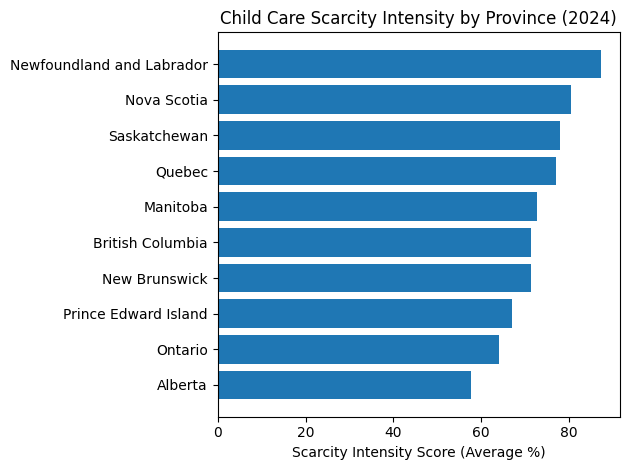
Statistics Canada data on centre-based child care providers in 2024 pointed to widespread waiting lists for care spaces existing side-by-side with available capacity. 46 percent of non-profit providers across the country reported that they were not currently at capacity, while 79.6 percent of the same providers had a waiting list.
Well which is it? Are there too many spots or too few?
What’s likely going on here is that at least some providers can’t find all the workers they need. They’re unable to fill their spaces, but it’s not because there aren’t parents lining up to get their kids in.
This chart averages the maximum-capacity and waiting-list rates across both the for-profit and non-profit sectors and presents them as a single composite scarcity intensity score:
Why is this happening?
The CWELCC program works by imposing fee caps on providers. Any revenue shortfalls providers experience due to the limits on what they can charge parents are meant to be offset by operating grants paid from the program. But economic conditions change. And the lag between real-world events and governments getting around to approving new limits can sometimes be long enough to prevent some providers from adjusting quickly enough.
It’s also possible that it’s not the cap itself that’s directly causing trouble, but that the promise of cheaper child care opportunities has itself driven demand higher. The resulting new demand for child care labour could have indirectly driven salaries beyond sustainable levels.
So tens of billions of dollars were spent, specific program goals were missed, big-picture plans for social change haven’t worked out and, instead, it’s likely that the program itself is at least partly to blame. And perhaps worst of all, CWELCC seems to be attracting precious little attention from media platforms and from the public.
Considering the vast funds underwriting this experiment, is it time for some serious oversight? Or perhaps this is just what we’ve come to expect from government programs.
Related:
Is Marriage the Strongest Predictor of Wealth in Canada?

Love, they say, is a many-splendored thing. But I can tell you with confidence that, in Canada at least, it also pays handsomely.
Where Did All the Kids Go?

There’s strange demographic stuff happening among school-aged kids in some of Canada’s murkier corners. Trigger alert: lots of numbers ahead.
How Does Canada Measure Poverty?

If a society hopes to manage welfare safety nets and economic policy intelligently then it’ll need clarity on who’s poor. Governments will often define poverty using some kind of poverty threshold representing the minimum costs of providing the basic needs for a given household type in a given location. Families earning less than that amount are conside…
Although there’s a much weaker statistical relationship between child care and future earnings for the children themselves.
Not at all convinced that state funded child care is a particularly good idea as with all such programs it encourages more bureaucracy, inefficiency and inequity. Why not consider methods that would allow parents to raise their own children rather than have the state do it. Such things as allowing a parent to stay at home through home care tax breaks and subsidies (not dissimilar to EI) as a start.
This is a great column David!
I love this conclusion: tens of billions of dollars spent; specific program goals missed; big-picture plans for social change that haven’t worked out; likelihood that the program itself is at least partly to blame; media platforms the public not paying attention — doesn’t that describe other big government programs in Canada, too?