

I’ve previously shown how CBC News programming - despite heavy public funding - is consumed by only a tiny share of television viewers and has a minimal presence on YouTube. I also explored data showing how podcasts by CBC and other Canadian media companies were barely visible on Spotify in Canada.
But I’ve never been able to quantify the cost and impact of government funding for entertainment and documentary television programming. Data included in the 2024-25 annual report from Canada Media Fund (CMF) can provide some new clarity.
First of all, recent Main Estimates documents from the Treasury Board indicate that post-COVID budgetary top-ups to CMF may be winding down and returning to pre-COVID levels.
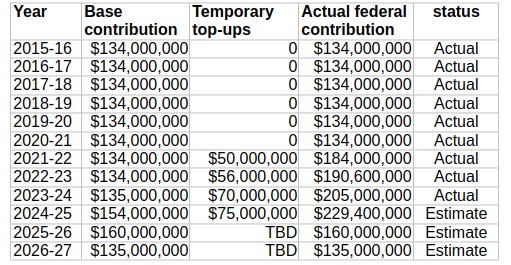
Besides those federal government amounts, CMF is also funded through broadcasting distribution undertakings (BDUs). BDUs are cable, satellite, and Internet Protocol Television (IPTV) operators who are licensed by the CRTC and required to contribute at least five percent of their broadcast revenues to Canadian content creation and production funds. Most (or all) of that money moves through the CMF and is redistributed to content producers - including the CBC.
One problem CMF faces is the ongoing collapse of BDU revenues. As Canadians continue to choose internet streaming options over traditional media providers, BDUs have less money to share.
CMF funding is awarded for the creation of content types including television, interactive digital media, and software games. Most of those funds (nearly $285 million in 2025-26 out of a total of $330 million) goes to television production.
Of those amounts, $50 million went directly to CBC productions, $13 million to Rogers, and $15 million to the French-language TVA. In 2025-26, more than 1,400 productions were supported at some stage between predevelopment and post-production.
The CMF annual report includes (on page 118) this list of the most-watched CMF-funded programs:
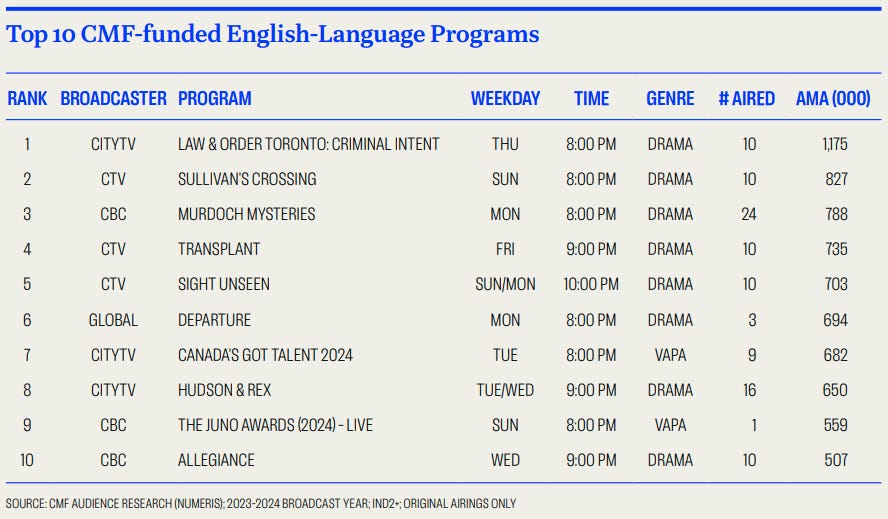
That list includes viewership measurements in terms of average minute audience (AMA). As you can see, Law and Order attracted nearly 1.2 million viewers, with the remaining nine shows attracting between a half a million and 827 thousand viewers. It can’t be said that those productions are ignored.
However, eight of those ten shows were in the drama category. According to the report (page 117), CMF-funded drama attracted only eight percent of all viewers in 2023-2024. 82 percent watched foreign programs instead, and 10 percent went with domestic but non CMF-funded programming.
Even if there are eyeballs on the funded programming, they’re still only a small proportion of Canadians who are watching TV. And those are a small percentage of all Canadians. (I’m not sure I still know anyone who even owns a TV!)
So even if CMF is largely fulfilling its mandate, given the context, does that mandate in its current form do enough for Canadians to justify the cost?
Here are some considerations:
Would the private sector have produced a Canadian edition of Law and Order without government intervention (and expense)?
Would the Canadian cultural environment be missing anything of substance had a Canadian Law and Order1 franchise never existed in the first place?
Has anyone defined - and measured - exactly what public good there is in television drama programming?
Could whatever social gains expected through such programming be delivered via other (less expensive) channels?
Entertainment is great. But should taxpayers be funding it? Are there no more pressing demands on our attention and funds?
Besides television and other video content, Canadian Heritage also provides $40 million dollars a year to the Canada Music Fund. According to the GC InfoBase Canadian Heritage page, the Fund’s current formal target is for the number of streams of “Canadian music”2 on the top 10,000 domestic streaming chart to reach 13 percent.
No matter how deserving and talented creators of contemporary Canadian music might be, paying them $40 million a year will never help reach that goal - or anything like it. Ever.
Tellingly, to the best of my knowledge, no actual results related to that target (from any year) have ever been posted to GC InfoBase. But even if they’d reached those goals, you know who would make up nearly every last music stream in that 13 percent? Canadian creators who achieved their success without any help from CMF - and, as often as not, from all the way back in the 60s and 70s.
There’s simply no way for even talented young musicians to guarantee attention and traction in today’s fragmented music market. Why waste $40 million a year to prove what we all already know?
Read on:
Does Democracy Need a Healthy Traditional News Media?

I often hear people saying that a "healthy news media industry enhances democracy”. But is there any objective way to measure what "healthy" means, what "enhancing democracy" means, and whether the two are actually correlated?
Could an Independent Publishing Industry Survive in Canada?

Over at his Substack, Kenneth Whyte has been excerpting a new book from his Sutherland House Publishing. Here’s the latest post:
How Many Canadians Actually Consume CBC's Digital Content?

Everyone in these parts knows that CBC plows through upwards of two billion dollars of public funding each year. And it’s certainly no secret that their “linear” (i.e., TV and radio) audience is collapsing even faster than their budget is growing.
Which, it should be noted, often recycles the same plots from other series in the franchise. So many of the stories aren’t even Canadian.
However that’s defined.
Compared to state involvement in other areas where it doesn't belong these numbers are rounding errors but I am opposed to all state funding and subsidization of the arts, which are essentially the taxing of people likely uninterested in the art of the recipient to subsidize those who are likely more capable of paying the full cost. I play in 3 and sometimes 4 community-based bands (concert and swing/jazz bands) and none receive a penny from government, and I pay dues for the pleasure..
I feel like the answer is, in a word, no.