

Voter apathy isn’t a new thing. There have always been Canadians who chose not to vote in elections. Through the 29 general elections in the years of the 20th Century, an average of 27 percent of us didn’t cast votes.
But it’s notable that the average number of eligible Canadians who can’t be bothered to participate is climbing. On average, in the eight elections contested since the election of November 27, 2000, 36 percent were no-shows. Even though last year’s Liberal victory attracted by far the most voters since the millennium began, 31 percent of us still sat it out.
Is the decline really about apathy and laziness or is there something else going on? As you might recall from my “Are Elections More Consequential Now Than a Generation Ago?” post from a while back, the policy gap between the Liberal and Conservative parties has grown considerably over the half century leading up to the 2021 election. Here’s how that change mapped out:
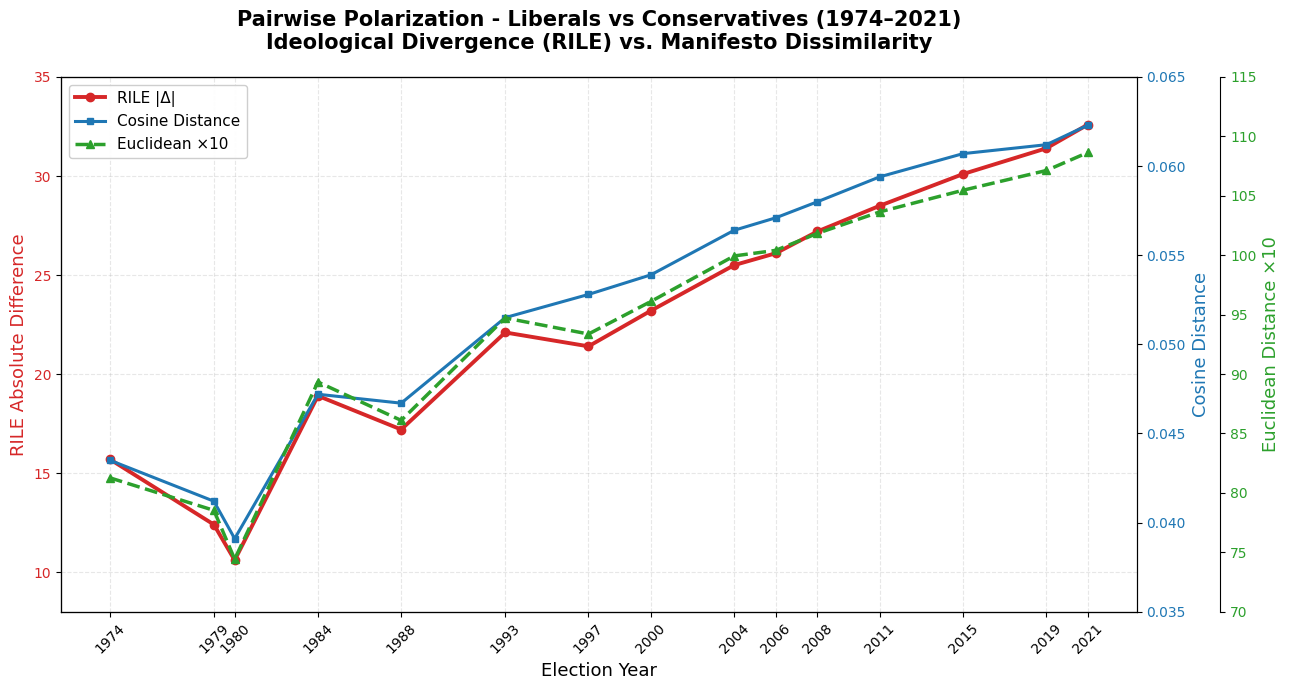
So it’s possible that, rather than laziness, some Canadians1 feel party polarization has left the political middle unrepresented. Depending on your definition of “the political middle”, there’s certainly solid evidence to support such conclusions. Both Liberals and Conservatives have shifted away from the center over the past decades.
Broadly speaking, such alienated Canadians are hardly unique. 45 percent of Americans currently identify as independents - more than at any time in history. And the intense unpopularity of most (all?) formerly mainstream parties in Europe appears to point towards significant political fragmentation.
So that’s where we seem to be right now. But how did we get here and, more importantly, where might we find ourselves next?
Before we go there however, it’s worth asking a more basic question: is low voter turnout a bad thing? After all, no democracy has ever actually collapsed primarily because people just stopped showing up for elections.
I think it’s reasonable to assume that lackluster voting patterns aren’t in and of themselves destructive, but they (1) are indications of serious trouble and (2) can lead to negative outcomes.
What Weak Voting Tells us About a Society
The loudest message we can take from the silence of millions of eligible voters is that they don’t seem to trust the system. Specifically, they don’t believe that their vote will translate into improved living conditions for themselves and their communities.
That could be because - as I’ve previously written - a single vote represents much less than a voter’s share of the population. If tiny First Nation bands can derail national projects; Quebec receives far more than its mathematical share of seats in Parliament and the Senate; and the Prime Minster’s office effectively unilaterally decides who will occupy thousands of the most powerful jobs in the country; then what value does a regular vote have?
The distaste for politics might also come from years of chaotic and expensive policy shifts. Spare a thought for those poor Liberal supporters who, in 2015, were assured that their votes would allow the party’s just and righteous (and expensive) immigration and climate policies to save the world from imminent destruction - only to discover in 2025 that it was all a ghastly mistake. If the folks in charge don’t trust their own passionately held (and recently discarded) assumptions, why should anyone else?
Perhaps, too, it’s the thought that the MP you’re officially voting for is little more than a robot who will reliably vote along party lines. It’s certainly true that genuine dialog and debate does sometimes happen in Parliamentary committees. But how much of that translates to policy? A cynic would suggest that legislation is effectively shaped and sealed long before it arrives in committee.
Don’t get me wrong: I’m not advocating against the value of voting. I’m just trying to understand why a third of us can’t be bothered.
How Weak Voting Can Damage a Society
While there may be no historical examples of democracies that imploded through simple disinterest, that doesn’t mean that bad things can’t come from poor voter turnouts.
Consider how just 30.1 percent of eligible voters brought the Liberals to power in 2025. The election was certainly fair and legal and the party has every right to exercise its power. But seven out of every ten Canadians now feel disenfranchised.
Now consider how only a tiny - and mostly anonymous - fragment of whichever party’s in charge has a meaningful say in how policy is designed and delivered. This is a process known as elite capture - which will often appear alongside crony capitalism. And voter apathy represents a big part of what makes it happen.
Canada hasn’t yet seen the worst abuses that are common following elite capture, but it’s a direction we shouldn’t be heading.
No one wants to solve the uncommitted voter problem more than Canada’s political parties. Whoever figures out how to reshape the narrative and swing even one in three of those no-shows to their side will probably gain power for a generation.
Splitting that atom will probably require some serious reforms to the way the political process currently works. And regardless of our particular political leanings, we all share an interest in finding a way forward.
Related:
The Hollow Emptiness of Canadian Electoral Representation

A couple of months back I wrote about how real-world political representation for Canadians can be deeply unequal. One vote does not have the same power in PEI as it does in BC. And, in any case, the individual MPs we elect are largely powerless to do anything meaningful on behalf of their constituents.
Should We All Enjoy Equal Representation?

My recent post “Is Canada's Federation Fair?” raised questions about the relationship between contributions to the public good and political representation. That post focused on the disconnect between Alberta’s financial assistance to the rest of the country in the form of equalization payments vs their inability to push back against attacks on their na…

Back in 2024, Angus Reid found that 36 percent of Canadians consider themselves “political orphans”, unable to find a political home.
Another reason could be that they person you vote for and elect can, for their own personal reasons, change your vote to a different party by crossing the floor.
We’re about to find out to our detriment should Carney get a majority exactly how destructive the elite thing can and will be to Canada.