

As you’ll probably recall from my recent post on measuring media bias in Canada, I’ve been having fun with a Media Cloud dataset containing 189,000 headlines from articles published between early 2023 and October 2026. Those headlines came from CBC, CTV News, Global News, the Globe and Mail, and the Toronto Star. For technical reasons, data from the National Post isn’t available.
I thought I’d expand my earlier analysis to address story selection bias. What is selection bias? No news publisher has the bandwidth to cover all of the millions of things that happen each day, so they’ll need to filter what they report. But the filtering choices editors make can tell us a lot about what they want us to read - and think.
So let’s see what mainstream news publishers (don’t) want us to know.
For some reason - even after removing duplicates - the archive contains far more articles from CTV News than any other outlet. We’ll need to keep that in mind. Here’s how the stories actually break down:

With the help of an AI model, I created a lexicon of some 600 words and phrases broken down into these categories:
Politics and government
Economy
Health
Society
World
Tech, culture, lifestyle
The goal was to use those words to measure how much attention media outlets devote to various topics. That information could help us understand what those outlets focus on and whether their choices reflect the interests of their readers.1
As it turns out, my lexicon doesn’t seem to be too far off the mark. An average of 82.5 percent of all 189,000 headlines contained matches for at least one of my keywords. Here’s how that looked when broken down by outlet:

Which topics seem to be largely ignored? Considering the size of the dataset, I was surprised how seldom the word “corrupt” appears. Fifty-four CTV headlines (out of 133,100) contain the word, the Toronto Star had 10, Global news 6, the Globe and Mail two, and CBC just one. “Ethics” showed up only incrementally more often.
But when I searched the headlines for indicators for half a dozen of the biggest specific scandals or events that hit the country in the past few years, I was shocked how little attention they received:
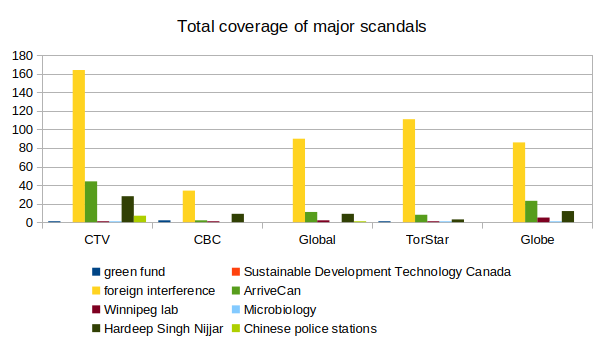
Just to refresh your memories, here are the incidents I picked:
Foreign interference in Canadian democracy. Explosive revelations about Chinese interference in federal elections led to the Hogue Commission and the report that followed.
Sustainable Development Technology Canada (the green fund scandal). The Auditor General’s June 2024 investigation found serious governance and conflict-of-interest failures at Sustainable Development Technology Canada (SDTC). Approximately $123 million in funding was associated with projects that should not have received funding under the applicable rules (included to recipients closely related to board members).
ArriveCAN contracting scandal. The Auditor General’s 2024 report estimated the total expenditure on what should have been simple piece of software amounted to approximately $59.5 million (although inadequate financial records mean we’ll never know exactly). There was also evidence that that GC Strategies, a major contractor, had been involved in helping establish requirements used in a subsequent procurement process.
The Winnipeg National Microbiology Laboratory security controversy. CSIS assessed that an employee of the lab had intentionally transferred scientific knowledge and materials to China to benefit Chinese interests.
Chinese overseas police stations and intimidation of Canadian residents. Beginning in 2023, the RCMP publicly acknowledged investigating alleged Chinese overseas police stations operating in Canada. The allegations concerned facilities associated with Chinese public-security authorities, including organizations in the Greater Toronto Area and Montreal. It’s assumed that these facilities were being used to monitor, intimidate or coerce Chinese nationals living in Canada.
In September 2023, Prime Minister Trudeau told Parliament that Canadian security agencies were investigating credible allegations of a potential connection between agents of the Indian government and the June 2023 murder of Canadian citizen Hardeep Singh Nijjar. India rejected Canada’s allegations and retaliated diplomatically.
Those should all have been huge stories, but they were more or less ignored.
Even foreign interference - which obviously got the most attention - took up less than three-quarters of one percent of the Globe and Mail’s archive. And the Globe had, by far, the strongest coverage (when measured as a proportion of their total articles).
Similarly, the Globe did the most to cover the ArriveCan scandal. But even that came in at an anemic two-tenths of a percent - or one article out of every 500. By contrast, CTV News focused on ArriveCan for only 3.3 out of every 10,000 articles (0.000330579).
Sure, you can argue that business considerations force those outlets to focus on topics that will attract clicks and advertisers. But that’s no longer true. Between them, those five news publishers receive billions of dollars each year in Parliamentary allocations, subsidies, grants, and tax credits. To support their claims of eligibility for those bailouts, media executives solemnly swore that they’re providing a public service in the national interest. Yet they also seem to feel there’s no national interest in sharing such huge stories with their readers.
This chart represents the density percentages of some broader topics that you’d think would be of greater interest to Canadian readers:
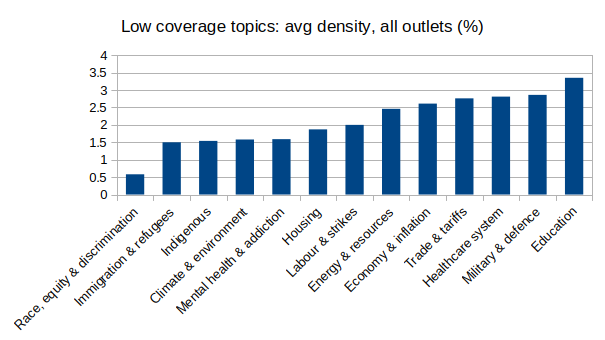
It’s true that the trade/tariffs topic didn’t generate a lot of noise before the 2024 U.S. election cycle. Nevertheless, it’s been top-of-mind pretty much constantly since the summer of 2024. And there doesn’t seem to be much excuse at all for the minimal attention housing and healthcare are getting.
I should note that the sheer number of CTV articles does skew those averages. The average healthcare topic density would be a lot lower if we removed the CTV results, and trade/tariffs would show up more.
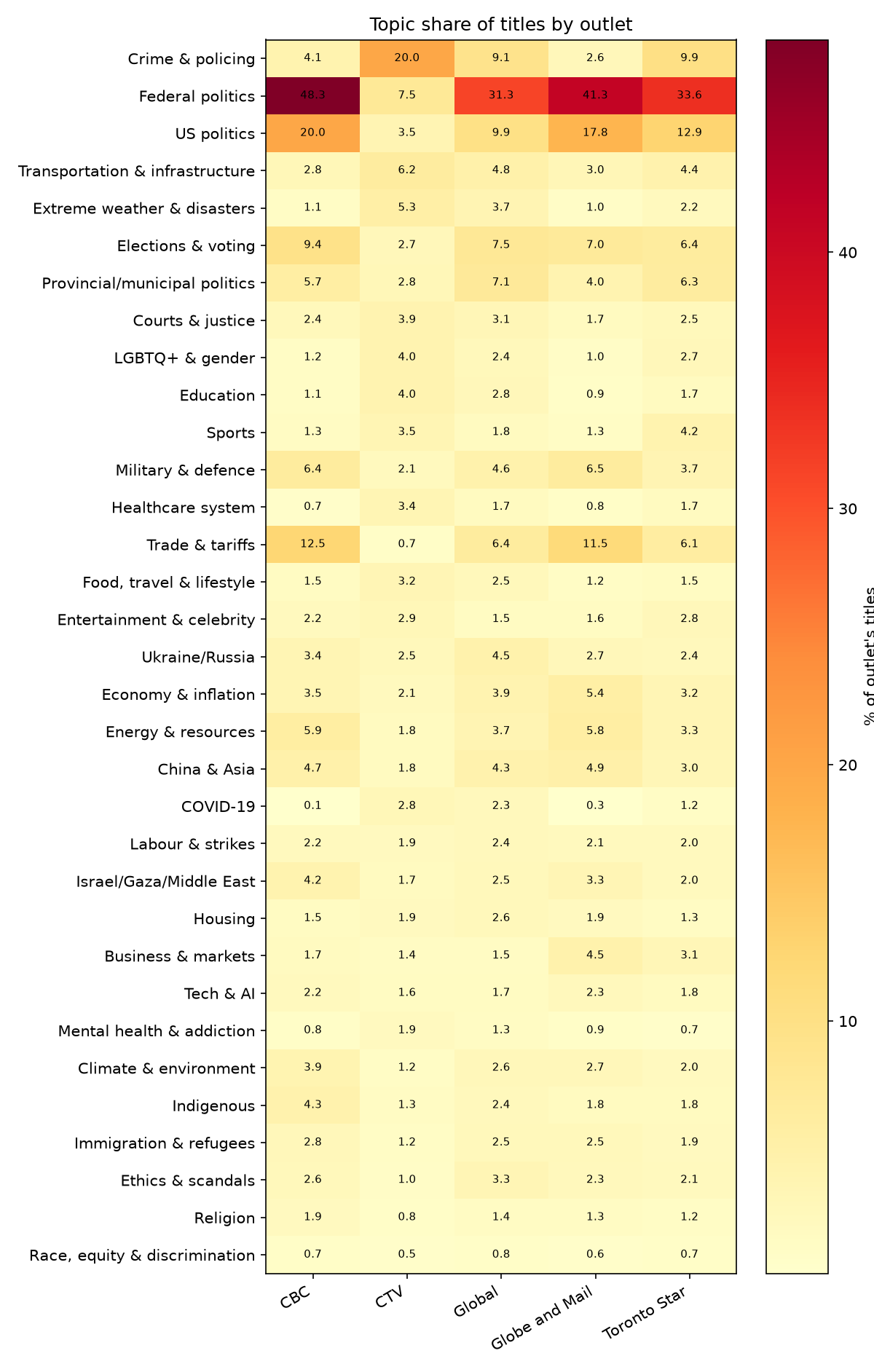
I’ll finish up with this heat map giving us a visual representation of each media outlet’s share of the major topics I searched for. The “hotter” the color, the higher percentage of total articles a topic represents in an outlet’s total library.
The End of Institutional Trust?

A delicate and unspoken contract between governments and their people seems to be breaking. Justified or not, millions of citizens in Western countries are convinced that their governments are driven by incentives unconnected from the public good. With their wealth, communities, and lifestyles crumbling around them, individuals increasingly see themselv…
How Many Canadians Actually Consume CBC's Digital Content?

Everyone in these parts knows that CBC plows through upwards of two billion dollars of public funding each year. And it’s certainly no secret that their “linear” (i.e., TV and radio) audience is collapsing even faster than their budget is growing.
There's No Bias at CBC News, You Say? Well, OK...

It’s been nearly a year since I last wrote about the CBC. In the intervening months, the Prescott memo on bias at the BBC was released, whose stunning allegations of systemic journalistic malpractice “inspired” multiple senior officials to leave the corporation. Given how the institutional bias driving problems at the BBC is undoubtedly widely shared by…
And those readers are also, though lavish taxpayer-funded subsidies, media company benefactors.
Aside from media, I can't figure out why the opposition hasn't gone back to the Winnipeg labs and SDTC issues. The government's refusal to provide the requested material constituted contempt of Parliament and violated the fundamental function of our legislative assembly. It may be a “new” government but these two issues are hiding things that will stain many serving government members when they see daylight. Outside of government these would normally result in dismissals, lawsuits, and criminal charges.
Given that the most corrupt facet in the deranged dominion is the state funding of "approved" media, all else flows accordingly. When the Liberal PM says before an election where the opposition have stated that they will defund the media, that the CBC gets an extra 150 million if the Liberals return to power and the corporate "approved" media will continue sucking on the LPC mandated public teat, is there an actual uncorrupted democracy in Canada when the only "free press" is a cottage industry of conservative online sites slated for state censorship in various Bills working through parliament?