

My previous efforts to analyze bias in Canada’s mainstream media showed strong evidence of left-leaning institutional viewpoint bias, public-sector framing, and government-source dependency. But the research had its limits.
For one thing, I only examined reporting from CBC. And even that covered only 300 or so stories from the CBC’s Top Stories RSS feed. There was also a potential limitation from depending on the black-box assessments of AI models. There was definitely value in that research, but it would be nice to improve the quality of our evidence.
Which is where the Media Cloud project becomes useful. Media Source monitors 180,481 live feeds from 34,620 news sources from around the world. Their archive currently holds the full contents of nearly two billion articles.
The service allows us to search full article contents from any combination of the news sources available in the archive. We’re able to use Boolean logic to filter results by the presence - or absence - of complex mixes of words or phrases. Such analysis uses traditional and straightforward software tools rather than AI models.
Queries return statistics representing the number and density of articles matching our search terms. Ideally, this will give us a sense of what Canadian media publishers want us to know.
UPDATE:
A reader comment has raised an important point: if reporting is guided by the truth, then why should we expect criticism to be equally distributed?
To which I replied that measuring reporting this way can still provide important insights. After all, a journalist’s core responsibility isn’t to persuade readers to adopt a favored position (even if, traditionally, that’s been an appropriate role for op-ed page pages).
If a media outlet claims to be neutral, then I think we should expect that their criticism should be balanced - with a decided tilt against whoever currently sits in government. After all, they’re the only ones who can be held responsible for any current public policy disasters.
And if a media outlet wants to serve a population that’s largely - more or less - split down the middle politically, then any noticeable divergence from that balance suggests that they’ve come untethered from the public they claim to serve.
My first experiments involved queries covering articles since late 2021 published by CBC, CTV News, Global News, the Globe and Mail, and the Toronto Star. For some reason, Media Cloud hasn’t successfully pulled National Post stories since 2023, so that wasn’t a useful source.
I used words and phrases with framing that’s both negative (“authoritarian”, “extremist”, etc.) and positive (“principled”, “successful”, etc.) to query either “Poilievre” or a combination of “Carney” and “Trudeau”. The goal was to see whether one side was more frequently associated with negative (or positive) framing than the other side.
Unexpectedly, there were far more matches for Poilievre for both positive and negative coded-words. This graph shows represents those number:
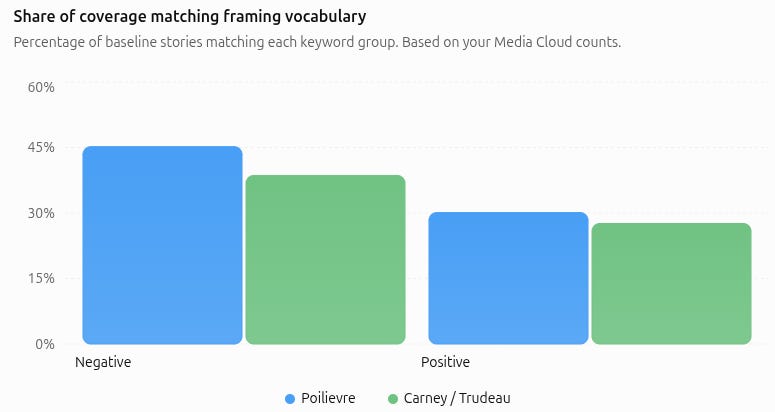
This reveals a potential weakness of my methodology. It’s possible, for example, that I’m getting false positives from articles that quote external sources using my framing language that don’t necessarily represent the publications’ own editorial positions.
Nevertheless, there was a very slight hint of an anti-right bias in those numbers: Poilievre’s ratio of negative to positive matches was 1.50, while the equivalent Carney/Trudeau ratio was just 1.40. But if that was all I got from the data, I wouldn’t have bothered you with this whole business.
Instead, I decided to focus exclusively on headlines - which are helpfully included in Media Cloud results. Whatever content an article might have, the headline absolutely reflects the editorial narrative.
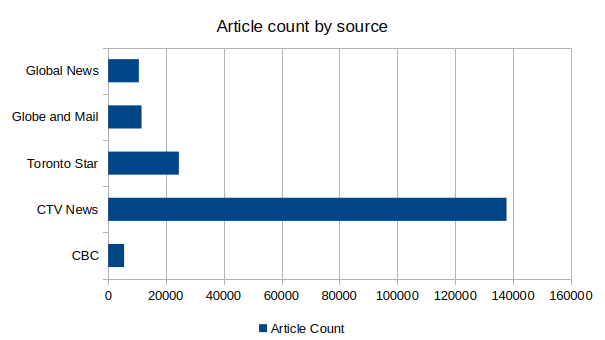
To get that done, I queried for all articles from any of the same five news outlets (CBC, CTV, Global, Globe and Mail, and Toronto Star) whose content contains “poilievre”, “trudeau”, or “carney”. That gave me a very nice sample of 189,939 articles from the last five years. Here’s the breakdown by publisher:
I then identified headlines containing language that was positive or negative-coded. Then I filtered for only those headlines that discussed one of the three political leaders.
I manually scanned through some of the results to confirm that they made sense. While there were definitely a few problems, by and large, the classification worked. Here are some examples of Poilievre headlines from CTV that the software identified as negative framing:
Roxham road: Poilievre call to close ‘reckless’ says immigration minister
Poilievre’s office silent over MP’s photo with controversial message
‘Irresponsible populist nonsense’: Mental health minister calls out Poilievre’s comments on safe drug supply programs
There’s nothing intrinsically wrong with any of those, by the way. By definition, most of what news organizations do involves being negative. What my research is looking for is rates of bias to understand whether the negativity is applied in a neutral way.
Here’s how the negative framing results looked (organized by media outlet):
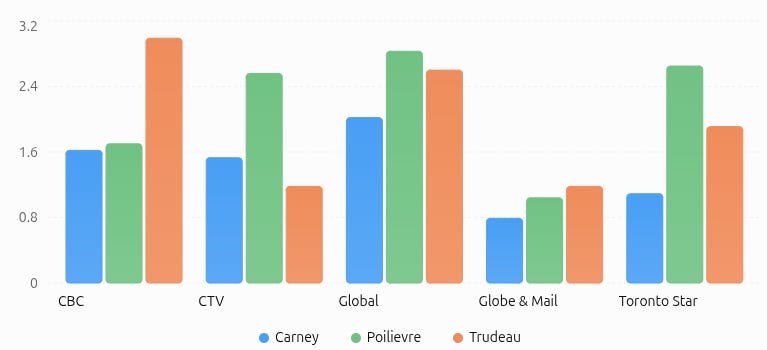
As you can see, Poilievre has a higher negative-keyword rate than Carney at all five outlets. What’s perhaps unexpected though, is that except for CTV, Trudeau suffered much higher negatives than his successor.
Here are the results from the perspective of positive framing. The “missing” values from CBC and CTV just mean that there weren’t any matching headlines for Trudeau (CBC) or Carney and Poilievre (CTV).
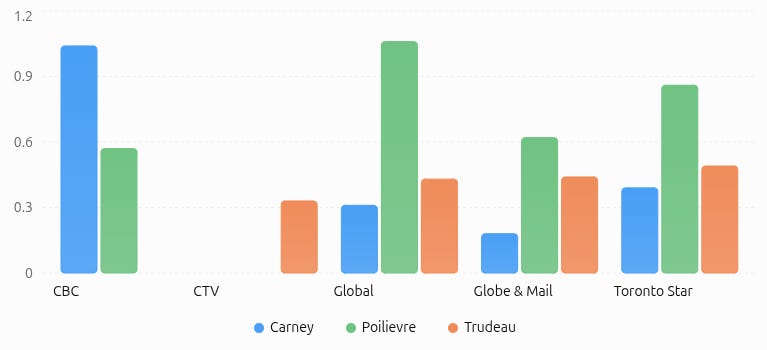
It’s definitely notable that Poilievre scored the highest positives at Global, the Globe and Mail, and the Toronto Star. Perhaps that’s due in part to the fact that, as opposition leader, he isn’t held responsible for government failures. It could also reflect the kinds of stories being published about him, including political strategy, leadership, policy proposals and campaign coverage.
Can we now say that there’s obvious left-leaning bias at Canada’s largest media publishers? That’s probably a reasonable - although conditional - conclusion. But what we can’t say is that the bias is anywhere near strong enough to dominate the news Canadians consume.
A Deeper Dive Into Bias at CBC News

My piece last month on the official claim of editorial neutrality at CBC News attracted some serious attention. While the ensuing conversation (stretching well beyond Substack all the way to X and LinkedIn) was sometimes heated, it was overwhelmingly respectful and productive. Two thumbs up for us.
There's No Bias at CBC News, You Say? Well, OK...

It’s been nearly a year since I last wrote about the CBC. In the intervening months, the Prescott memo on bias at the BBC was released, whose stunning allegations of systemic journalistic malpractice “inspired” multiple senior officials to leave the corporation. Given how the institutional bias driving problems at the BBC is undoubtedly widely shared by…
Living With Media Bias

Sometimes there’s no easy way past a problem. I’ve suggested as much in the context of public healthcare delivery in Canada. Rather than tying ourselves into expensive knots looking for solutions that aren’t there, perhaps we’re better off accepting imperfection and making the best of what we have.
You disappoint me, David. Judging by your rationalizations, there appears to be an underlying assumption that the subjects of news reporting are equally deserving of the same number of positive and negative viewpoints regardless of their performance, and anything else is just bias.
Following up on the "persuasion”role… It's well known that media sources have their individual left/right biases, so one would expect to see accordingly taller or shorter bars across individual media sources. Therefore to get a good quality perspective of the overall media landscape you'd need to include all of the popular media. In that sense, the absence of Post Media from your analysis (not your fault, I understand) creates an inherent inaccuracy in the overall picture.