

It’s been nearly a year since I last wrote about the CBC. In the intervening months, the Prescott memo on bias at the BBC was released, whose stunning allegations of systemic journalistic malpractice “inspired” multiple senior officials to leave the corporation. Given how the institutional bias driving problems at the BBC is undoubtedly widely shared by CBC employees, I’d be surprised if there weren’t similar flaws embedded inside the stuff we’re being fed here in Canada.
Apparently, besides receiving nearly two billion dollars1 annually in direct and indirect government funding, CBC also employs around a third of all of Canada’s full time journalists. So taxpayers have a legitimate interest in knowing what we’re getting out of the deal.
Naturally, corporate president Marie-Philippe Bouchard has solemnly denied the existence of any bias in CBC reporting. But I’d be more comfortable seeing some evidence of that with my own eyes. Given that I personally can easily go multiple months without watching any CBC programming or even visiting their website, “my own eyes” will require some creative redefinition.
So this time around I collected the titles and descriptions from nearly 300 stories that were randomly chosen from the CBC Top Stories RSS feed from the first half of 2025. You can view the results for yourself here. I then used AI tools to analyze the data for possible bias (how events are interpreted) and agendas (which events are selected). I also looked for:
Institutional viewpoint bias
Public-sector framing
Cultural-identity prioritization
Government-source dependency
Social-progressive emphasis
Here’s what I discovered.
Story Selection Bias
Millions of things happen every day. And many thousands of those might be of interest to Canadians. Naturally, no news publisher has the bandwidth to cover all of them, so deciding which stories to include in anyone’s Top Story feed will involve a lot of filtering. To give us a sense of what filtering standards are used at the CBC, let’s break down coverage by topic.
Of the 300 stories covered by my data, around 30 percent - month after month - focused on Donald Trump and U.S.- Canada relations. Another 12-15 percent related to Gaza and the Israel-Palestine conflict. Domestic politics - including election coverage - took up another 12 percent, Indigenous issues attracted 9 percent, climate and the environment grabbed 8 percent, and gender identity, health-care worker assaults, immigrant suffering, and crime attracted around 4 percent each.
Now here’s a partial list of significant stories from the target time frame (the first half of 2025) that weren’t meaningfully represented in my sample of CBC’s Top Stories:
Housing affordability crisis barely appears (one of the top voter concerns in actual 2025 polls).
Immigration levels and labour-market impact.
Crime-rate increases or policing controversies (unless tied to Indigenous or racialized victims).
Private-sector investment success stories.
Any sustained positive coverage of the oil/gas sector (even when prices are high).
Critical examination of public-sector growth or pension liabilities.
Chinese interference or CCP influence in Canada (despite ongoing inquiries in real life).
The rest of the known galaxy (besides Gaza and the U.S.)
Interpretation Bias
There’s an obvious pattern of favoring certain identity narratives. The Indigenous are always framed as victims of historic injustice, Palestinian and Gazan actions are overwhelmingly sympathetic, while anything done by Israelis is “aggression”. Transgender representation in uniformly affirmative while dissent is bigotry.
By contrast, stories critical of immigration policy, sympathetic to Israeli/Jewish perspectives, or skeptical of gender medicine are virtually non-existent in this sample.
That’s not to say that, in the real world, injustice doesn’t exist. It surely does. But a neutral and objective news service should be able to present important stories using a neutral and objective voice. That obviously doesn’t happen at the CBC.
Consider these obvious examples:
“Trump claims there are only ‘2 genders.’ Historians say that’s never been true” - here’s an overt editorial contradiction in the headline itself.
“Trump bans transgender female athletes from women’s sports” which is framed as an attack rather than a policy debate.
And your choice of wording counts more than you might realize. Verbs like “slams”, “blasts”, and “warns” are used almost exclusively describing the actions of conservative figures like Trump, Poilievre, or Danielle Smith, while “experts say”, “historians say”, and “doctors say” are repeatedly used to rebut conservative policy.
Similarly, Palestinian casualties are invariably “killed“ by Israeli forces - using the active voice - while Israeli casualties, when mentioned at all, are described using the passive voice.
Institutional Viewpoint Bias
A primary - perhaps the primary job - of a serious journalist is to challenge the government’s narrative. Because if journalists don’t even try to hold public officials to account, then no one else can. Even the valuable work of the Auditor General or the Parliamentary Budget Officer will be wasted, because there will be no one to amplify their claims of wrongdoing. And Canadians will have no way of hearing the bad news.
So it can’t be a good sign when around 62 percent of domestic political stories published by the nation’s public broadcaster either quote government (federal or provincial) sources as the primary voice, or are framed around government announcements, reports, funding promises, or inquiries.
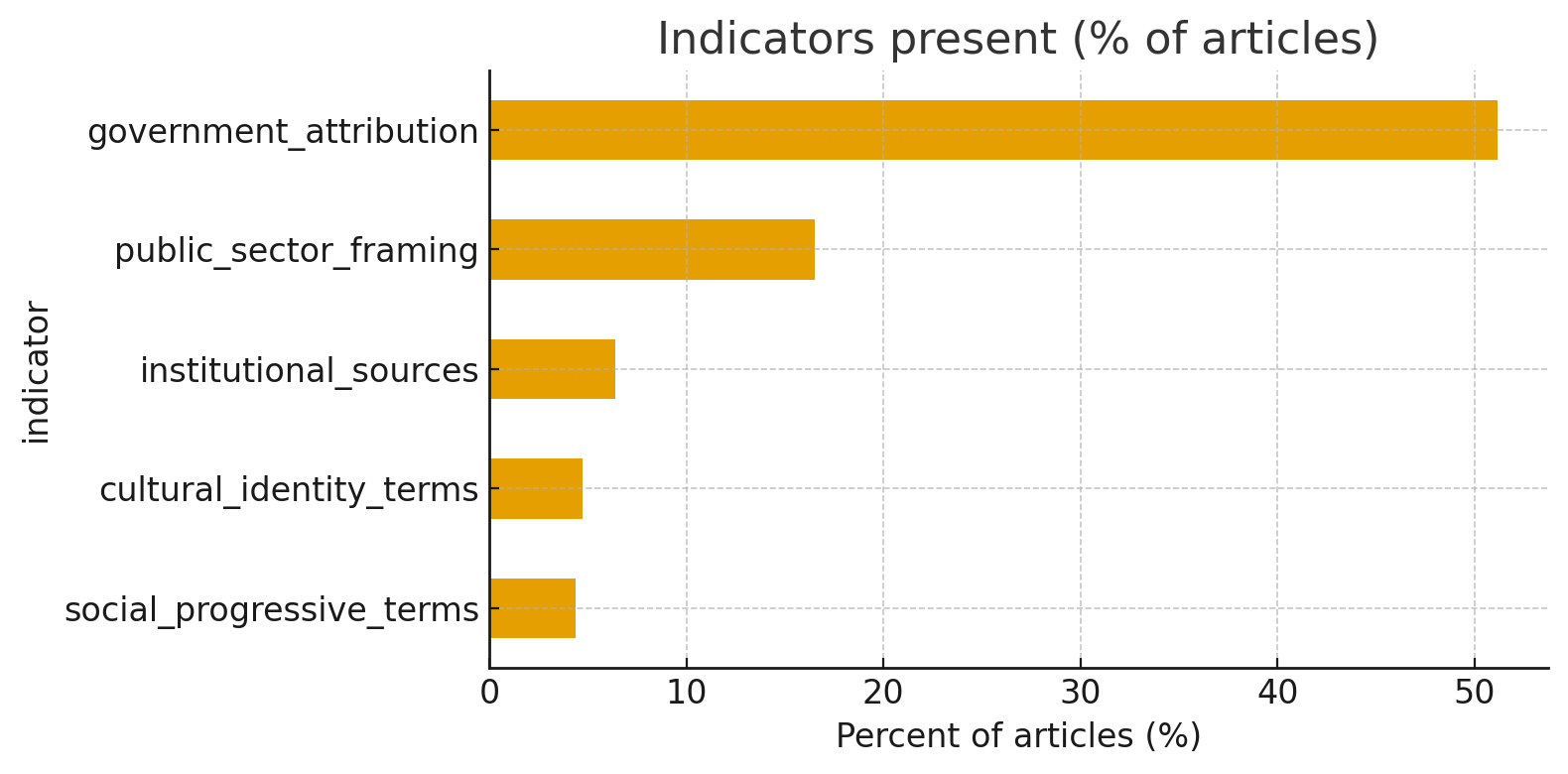
In other words, a majority of what the CBC does involves providing stenography services for their paymasters.
Here are just a few examples:
“Federal government apologizes for ‘profound harm’ of Dundas Harbour relocations”
“Jordan’s Principle funding… being extended through 2026: Indigenous Services”
“Liberal government announces dental care expansion the day before expected election call”
Agencies like the Bank of Canada, Indigenous Services Canada, and Transportation Safety Board are routinely presented as authoritative and neutral. By contrast, opposition or industry critiques are usually presented as secondary (“…but critics say”) or are simply invisible. Overall, private-sector actors like airlines, oil companies, or developers are far more likely to be criticized.
All this is classic institutional bias: the state and its agencies are the default lens through which reality is filtered.
Not unlike the horrors going on at the BBC, much of this bias is likely unconscious. I’m sure that presenting this evidence to CBC editors and managers would evoke little more than blank stares. This stuff flies way below the radar.
But as one of the AI tools I used concluded:
In short, this 2025 CBC RSS sample shows a very strong and consistent left-progressive institutional bias both in story selection (agenda) and in framing (interpretation). The outlet functions less as a neutral public broadcaster and more as an amplifier of government, public-sector, and social-progressive narratives, with particular hostility reserved for Donald Trump, Canadian conservatives, and anything that could be construed as “right-wing misinformation.”
And here’s the bottom line from a second tool:
The data reveals a consistent editorial worldview where legitimate change flows from institutions downward, identity group membership is newsworthy, and systemic intervention is the default solution framework.
You might also enjoy:
Evaluating Federal Arts Funding

Now I’ll be the first to admit that I’m an incurable cultural philistine. Or at least an incurably free market cultural philistine. I believe that the finest art and literature should serve - or even inspire - organic consumer demand. Public funding for the arts introduces perverse incentives. And besides, do we really want government deciding what we’l…
Does Democracy Need a Healthy Traditional News Media?

I often hear people saying that a "healthy news media industry enhances democracy”. But is there any objective way to measure what "healthy" means, what "enhancing democracy" means, and whether the two are actually correlated?
Is Updating a Few Thousand Readers Worth a Half Million Taxpayer Dollars?

Plenty has been written about the many difficulties faced by legacy news media operations. You might even recall reading about the troubled CBC and the Liberal government’s ill-fated Online News Act in these very pages. Traditional subscription and broadcast models are drying up, and on-line ad-based revenues are in sharp decline.
Between the many often-ignored sources of funding that I itemize here, and the new funding announced in the recent budget, that old “$1.4 billion” number you hear all the time is badly outdated.
I grew up in a household where the cbc was on the radio frequently. As an adult I too for many years had the cbc as a default news source. It was around 2010 when I started to listen less and become aware of their active suppression (avoidance?) of stories they (or their paymasters) didn’t want discussed. I hardly listen anymore. They seem to cover a narrow range of stories, and rarely ask the follow up questions which I would expect.
Here in BC for a long time they avoided news stories about cost of housing and anything on foreign ownership issues when housing prices were completely dis-associating from local levels of affordability. You would think someone would be interested in ‘following the money’. That’s when I realized something rotten was going on at CBC Vancouver news room that was a deliberate avoidance. It was also the time when anyone asking about foreign money in real estate was labeled as racist as an attempt to avoid the topic.
I was someone who used to default to the cbc website for local news, and still do check it for headlines. Once I saw a story at lunch, and when I wanted to show a friend in the evening it was already gone. Google found it but the story link was gone from the cbc news page. Already archived at 7pm when the story had just appeared at 9 am that morning. Meanwhile other stories would sit on the website for many days.
It’s the stories they don’t cover (that need to be covered) that are most concerning. Democracy can’t work without independent scrutiny and the accountability that occurs from putting a spotlight on political decisions. Regardless of political party.
It’s not just the CBC either to be fair. The corporate media clearly has their own bias on various issues also.
Keep up the good research and reporting.
Outstanding work David. Thank you for this! It provides a strong analytical context for what the vast majority who read ALL sources of Canadian news have known by observation and anecdotally for a long, long time.