

My piece last month on the official claim of editorial neutrality at CBC News attracted some serious attention. While the ensuing conversation (stretching well beyond Substack all the way to X and LinkedIn) was sometimes heated, it was overwhelmingly respectful and productive. Two thumbs up for us.
I should also note that Brodie Fenlon, the General Manager and Editor in Chief of CBC News himself reached out to discuss my research with me. While the conversation itself was private, I can say that it was most enjoyable. Mr. Fenlon is both genuinely open to criticism and eager to make the organization he leads as effective and responsive as possible.

One valid question I heard from multiple comments to The Audit (and elsewhere) concerned the value of relying on the “black box” results of AI model analyses. Because that’s not something I can outright dismiss, I thought I’d see if taking a second look at my data might help.
As you’ll likely recall, I used a random selection of headlines and descriptions from around 300 “Top Stories” from CBC’s RSS feed from a six month period. I then asked a few different AI models to assess the selection for various categories of bias.
Based on the AI responses, the first category my original article addressed was story selection bias. Multiple AI models suggested that the feed was heavily weighted away from many issues key attracting Canadians’ attention, and skewed instead towards stories that better fit a left-leaning political narrative.
In the weeks since, I decided to see if I could flesh that out a bit better to confirm that the AI observations were a good fit with the actual data. I began by examining the dataset itself. I quickly discovered (and removed) a handful of repeated entries.
Then I manually classified most of the remaining 281 headline/description pairs by topic. I ignored around 95 of the stories that didn’t seem to fit into any classification that would be interesting to this study. “IN PHOTOS | Canadian Geographic’s Canadian Photos of the Year chase the light” was one example.
I then (mostly) manually classified the other 186 stories using nine topics. Here’s how those broke down:
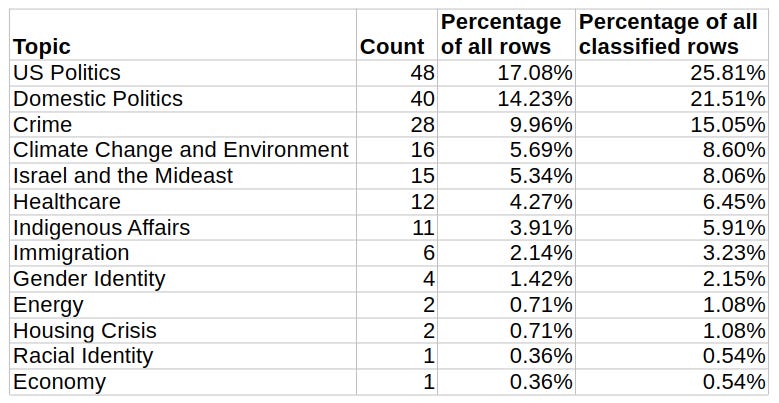
That’s not all that different from the estimates I got from AI. And there was, in fact, virtually no attention paid to many genuine top-of-mind topics, including:
Housing affordability crisis barely appears
Immigration levels and labour-market impact.
Crime-rate increases or policing controversies (unless tied to Indigenous or racialized victims).
Critical examination of public-sector growth or pension liabilities.
Chinese interference or CCP influence in Canada
The second area where my AI-based findings were challenged was over framing bias. Specifically, should we blindly trust the at-scale assessment of a machine on a matter that’s so subtle and nuanced?
That, too, is a fair question. So I identified around ten strong examples of framing bias. But just ten? That’s just three percent of the total set.
Well no one is claiming that bias drips from every single word and image published by the CBC. But if there’s bias in even three percent of the total, then that seems to tell us something important about the organization’s editorial standards and processes.
Naturally, it makes sense to highlight at least some of those examples so you can judge them for yourselves.
Alberta doctors push back on provincial COVID-19 task force report - A task force created by the UCP government to review the province’s pandemic response has issued its final report and while it is currently being reviewed by the province Alberta doctors are pushing back saying it contains misinformation and poses a threat to public health.
The editors here are telling a story about the “push back” rather than the report itself, which is interesting (although it’s possible there were also stories covering the report directly). And the phrases “misinformation” and “threat to public health” both suggest that the task force was ill-informed and a dangerous. It’s obviously not the job of a neutral news report to frame its description that way.
2-year-old Palestinian girl killed in her home by Israeli military - Israeli forces shot a two-year-old girl in the head in her West Bank home on Saturday while she was eating dinner with her family according to health officials and family members.
The active voice here (“killed”) strongly implies that Israeli forces broke into the girl’s home and intentionally executed her. That language leaves no conceptual room for what even 30 seconds of independent research demonstrates: the girl was tragically hit by a stray bullet. Even something like “…by stray Israeli military bullet” would have been an improvement.
Residential school denialism: what is it and how to recognize it - Residential school denialism does not deny the existence of the school system but rather downplays excuses or misrepresents facts surrounding the harms caused by it experts say.
First of all, “experts” is doing an awful lot of heavy lifting there. In fact, there are a great many “experts” who disagree with the unmarked graves narrative. The wording here leaves them marginalized. Worse, though, is how the language implicitly dismisses the fact that, after years of digging, there is still no direct evidence of unmarked graves and systemic killings associated with any residential school. (Who’s a denialist now?)
Income inequality hit record high at start of 2025 Statistics Canada says
Framing the numbers quoted in the article itself as indicators of income inequality is one of multiple possible interpretations. But the alarmist language and lack of context (Canada actually has among the lowest Gini Coefficient rates for OECD countries) suggests there’s a non-neutral agenda at play.
Can the ZEV mandate survive political pressure and industry objections?
This headline frames all non-industry opposition to the (now largely abandoned) electric vehicle mandate as political, as though there were no economic, social, or even environmental arguments being made.
Iowa lawmakers vote to remove gender identity protections from civil rights code - Iowa lawmakers on Thursday became the first in the nation to approve legislation that removes gender identity protections from the state’s civil rights code. That’s despite massive protests by opponents who say it could expose transgender people to discrimination in numerous areas of life.
The headline itself is perfectly accurate. But the phrasing “despite massive protests by opponents” in the description is a problem. I looked it up. The Des Moines Register estimated the crowd at around 2,000 more than normal weekday attendance in the Capital building. In that context, “massive” is hardly a neutral adjective.
I’m not suggesting that there’s an active covert conspiracy at the CBC (and other media outlets) to skew the news in the service of some political goal. If anything, their editors and copy writers would probably be genuinely shocked to be accused of such behavior.
But I do believe that there’s at least a strong appearance of bias. Whether it’s the product of clumsy miscommunication or a deeply embedded and subtle institutional culture, its perpetuation does no one any good.
Here’s more you might enjoy:
How Modern Governments Communicate

Once upon a time long, long ago, a government minister or ministry official with something to say would invite one or more reporters in for a conversation. This was often called an “interview” or perhaps a “press conference.” The reporters, still basking in the warmth of the minister’s regal beneficence, would rush to file their reports. The government’…

There's No Bias at CBC News, You Say? Well, OK...

It’s been nearly a year since I last wrote about the CBC. In the intervening months, the Prescott memo on bias at the BBC was released, whose stunning allegations of systemic journalistic malpractice “inspired” multiple senior officials to leave the corporation. Given how the institutional bias driving problems at the BBC is undoubtedly widely shared by…
Any time I read something that cites unnamed “experts”, I automatically translate that as "someone from Facebook".
The silence on public sector growth is especially glaring. I checked the Public Accounts (the government's annual financial report) and found that personnel spending hit $71.1 billion last year. That is a $1.5 billion increase in just 12 months. The numbers are sitting in the parliamentary record, but they rarely make the news.