

What can migration patterns teach us about the economic and social environments that provinces offer their residents?
The first thing to know is that clear migration patterns do exist. Decade after decade, Canadians have consistently and noticeably moved in one direction: westward. This chart - based on Statistics Canada estimates since 1990 - shows net inbound migration for Canada’s four largest provinces:
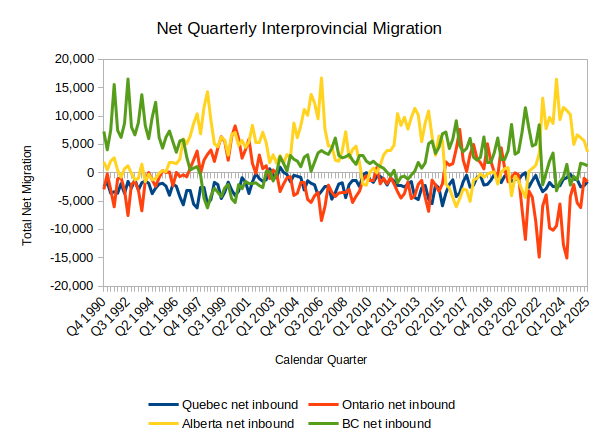
Cumulatively, through those 35 years, Quebec lost more than 300,000 residents to interprovincial migration while Ontario shed 214,000 of their own. A large majority of those losses probably ended up in either Alberta or BC, which attracted net internal migrants totaling 552,000 and 381,0000 respectively.
As you should be able to see from the graph, people left Quebec in significant numbers in nearly every quarter since 1990. Ontario, by contrast, enjoyed some popularity between 1997 and 2002, and again between 2016 and 2020. Since 2020, Ontario has been struggling, losing as many as 25,000 people in a single quarter.
There’s also something of an inverse relationship between Alberta and BC. There’s a measurable negative correlation where oil sands and other energy booms sparked migration to Alberta in sync with lower performance in BC. Then, when oil-price crashes hit Alberta between 2015-2017, BC seemed to absorb the difference.
That’s the demographic reality. But the obvious question is “why?” What are Ontario and Quebec consistently doing wrong that makes Alberta and BC such attractive alternatives?
You wouldn’t be wrong to point to jobs. But Statistics Canada reports that employment opportunities account for just 42.5 percent of all interprovincial moves. What else gets Canadians itchy? Housing affordability would be a big one, and Alberta has a definite advantage there. Lower taxes, the general cost living, quality-of-life and lifestyle factors also play roles.
Why were migration rates for just Ontario hit quite so hard in the wake of the pandemic? Historically, Ontario’s - and specifically Toronto’s - key selling point has always been its labour market. Once the remote work surge made that anchor largely disappear, crazy housing costs became a pure liability with no offsetting job-market premium.
Besides bragging rights, are higher provincial populations actually a good thing? Using some broad assumptions, Quebec’s population loss over the years could translate to around four billion dollars in lost revenue each year. Here’s how that might break down:

Those are obviously just estimates. We’re assuming that most outbound migrants are working-age, which will increase income tax losses. Healthcare and education delivery expenses often represent fixed costs, so fewer people might not always translate to lower costs.
Besides economic impacts, the ongoing population drain should have resulted in fewer Quebec members of Parliament. However, the Liberal government’s Preserving Provincial Representation in the House of Commons Act of June 2022 froze Quebec’s representation no matter how far its population might drop.
All things considered though, provinces have an interest in maintaining their population levels. But - despite the fact that at least some of the incentives driving the exodus are the result of discretionary policy choices - this is a goal that’s proven difficult to achieve.
More reading:
Ranking Government Efficiency by Province

I know labour productivity isn’t a topic that’ll reliably fill seats at the local Cineplex. If anything, it brings back unpleasant memories of Soviet-era news feeds extolling the many “glorious accomplishments” of the “heroes of socialist labour.” But productivity is an important tool for measuring government effectiveness. And, when you consider how be…
Ranking Public Education Efficiency by Province

This post is the first of a series of “Rankings” where I - well - rank Canadian provinces against each other for their public policy successes and (dare we suggest) failures. Such comparisons can be a lot of fun, of course. But they can also teach us important lessons about what’s working and what isn’t.
Are We Winning the Patient-to-Doctor Ratio War?

The fact that millions of Canadians lack primary healthcare providers is a big deal. The grand promise of universal healthcare rings hollow for families forced to spend six hours waiting in a hospital emergency room for a simple ear infection diagnosis.
Having been born in Alberta and lived in Quebec and Ontario, the attractiveness of Alberta is second to none (no bias here of course :) But the experience in the bigger cities leaves something to be desired. As Calgary and Edmonton grow, I do wonder what will happen.