

I recently wrote about how Mark Carney’s Liberal government has so far largely failed to honour its commitment to reduce the size of the federal civil service workforce. But Carney’s government made other promises both before and since their election back in April, 2025. I figure that fifteen months or so is long enough to take stock of what’s been done.
Reducing Spending
The Liberals promised to “throttle government spending growth by scaling it back from nine per cent to two per cent.” The problem is that there’s no way to be sure what Carney had in mind with “spending growth.” Or, for that matter, with “nine percent” and “two percent.”
Consider how spending in the:
Compensation of employees
Use of goods and services
Consumption of fixed capital
Interest
Subsidies
Grants - expense
Social benefits
and Other expense
…categories1 grew 9.62 percent between Q2 2025 and Q1 2026 - the period following the election. Spending in those same categories grew just 0.43 percent over the five quarters leading up to that election. That doesn’t sound anything like the original plan does it?
Using the total expenditure numbers from the same Statistics Canada dataset gives us roughly the same spending growth picture: 0.58 percent over the year+ leading up to the election, and 9.25 percent since.
Similarly, Canada’s net financial worth was reported as -$550 billion in Q1 2024, -$564 billion in Q1 2025, -$515 billion in Q2 2025, and -$538 in Q1 2026. That translates to 2.59 percent deeper debt in the period leading up to the election vs 4.51 percent more dept in the quarters since - with a significant drop in between.
The bottom line is that I have absolutely no idea what the Liberals’ promise actually was, but I am pretty sure they haven’t kept it.
Pro tip: if you ever need to formulate a meaningless policy commitment, use details that are just vague enough to sound cool but are, in fact, utterly unintelligible.
External Consultants
Those Liberal promises included reducing the use of consultants in federal government work. Why, after all, should we employ 370,000 in-house workers while out-sourcing much of the work they were hired to perform?
How’s that working out so far? To find out, I downloaded the details of all federal contracts from 2024, 2025 and the first three months of 2026. I then aggregated all contracts from those years that were awarded to any of the big international consulting and accounting firms, including: McKinsey & Company, Boston Consulting Group (BCG), Deloitte, PricewaterhouseCoopers, Ernst & Young, and KPMG. (Disclaimer: I have a son who works for Deloitte…but then who doesn’t?)
Here’s what all that spending looked like month by month:
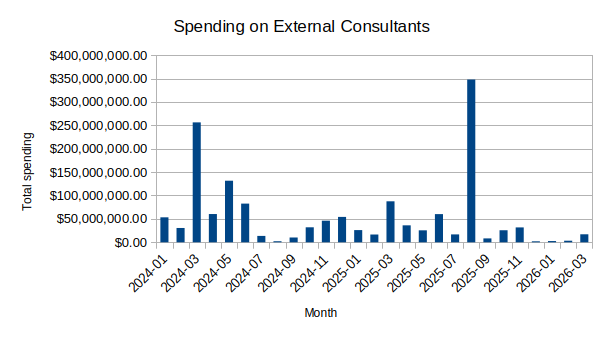
That huge jump in August 2025 is the result of two large contracts procured by Department of National Defence worth, between then, $335 million. The contracts went to a joint venture involving PricewaterhouseCoopers, Si Systems, and Accenture. The work is described as involving “information technology and telecommunications consultants.”
Between January 2024 and April 2025, the average total monthly value of outsourced contracts was $58,716,078. Between May 2025 and March 2026 - since the April 2025 election in other words - that average dropped to $49,216,166. That’s a significant decline, but the practice is far from abandoned.
We’ve got no choice but to wait for new data releases to see whether things are turning round. But right now, there’s not a lot of evidence that the Liberal government is making much effort to meet their commitments…whatever they were.
Tracking Government Policies Over Time

Some years back, I took the key promises from two federal budgets (Stephen Harper’s 2011 document and Justin Trudeau’s first budget from 2016 ) and then applied publicly-available datasets to measure their successes and failures. That article was recently
How Resilient Are Canadian Provinces?

Suppose one fine day the federal government was unable to show up for work. Perhaps it wasn’t feeling well. Or maybe it had borrowed so much money that it maxed out its line of credit, defaulted on its interest payments, and just couldn’t pay its bills. What then?
Canadian Parliamentary Budgets and the Real World

People plan. Governments plan. In either case, those plans tend to be known as budgets. But have you ever wondered how well the plans contained in a government budget translate to real-world goodness?
These are all metrics in Statistics Canada’s Statement of Government Operations table.
Thanks for looking into this David. Mainstream media should be doing at least the basics here. Too bad it doesn’t.
Another word salad with not enough data to support your opinion. Putting words down based on undiscovered evidence seems like it belongs in the fiction file. Pot kettle black? I don’t know but I guess you, like op-ed writers, gotta do something.