

Before we get going, I have a quick follow-up to my Canadian Politics and Your Mental Health post. I wrote:
Respondents were asked to rate their mental health in relation to their peers where “1” indicates excellent mental health and “5” indicates poor mental health. A total of 3,878 from the far right responded and 3,263 from the far left. The average of all responses on the right was 2.02 (standard deviation: 0.876859) and from the left, 2.32 (0.926268).
All that’s based on the 2021 survey. But I just discovered data from the Consortium on Electoral Democracy’s 2024 Democracy Checkup - which covers much of the same ground as the CES surveys. So, three years later, those numbers have shifted a bit. Both groups saw a decline in self-assessed mental health from 2021 to 2024, but the left cohort declined a bit more and the gap between cohorts widened even further.
Specifically, the self-reported mental health of those on the left worsened by around 1.94 percent while the right worsened by just 0.94 percent. The gap between the two groups increased by about 9 percent. The disturbing trend from 2021 sure looks real.
A second product of that earlier post was a question in the comments section: what about people - like libertarians - who don’t fit so neatly on the right-left spectrum? Does the Canadian Election Study data have anything to say about them?
First, we should define exactly what a libertarian might be. The academic figure most often associated with libertarians is the Nobel laureate economist, Milton Friedman. So that’ll be as good a place as any to find a working definition.
As a rule, Friedman believed that governments should engage only in activities that the market cannot do effectively on its own. For Friedman, those activities would be limited to:
Protecting individual freedom and property rights through contract enforcement, fraud prevention, and institutions of law and order.
Providing national defense.
Providing basic infrastructure like roads.
That’s about it. It’s true that, for instance, Friedman believed governments should fund basic education, but government should never provide it. In other words, he would have strongly preferred something like a voucher model through which parents get to choose which private-sector schools they prefer for their kids.
Now based on those principles, we should be able to identify libertarians from their responses to the survey. There were five spending-related questions in particular for which I figured any card-carrying libertarian would select “spend less” from among the options.
Indeed, as you can see from this table, between 5 and 45 percent of all respondents did go with reduced spending:
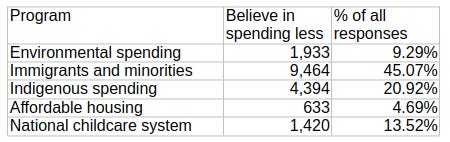
The problem was that there were exactly zero from that group that remained consistent across all five questions. However for some reason, when I removed the affordable housing question, there were 246 people left in the cohort.
I understood the question (“How much should the federal government spend on affordable housing?”) to mean “should the government spend more to subsidize the construction of affordable housing?” To which my answer would be a resounding “Heck, no!”
But perhaps some of the respondents took it to mean “should the government top up the social support net for at-risk families?” In fact, even Milton Friedman believed in governments supporting the truly poor - although he preferred that support should come from a “negative tax” rather than delivered through government programs. So I guess it’s reasonable to exclude affordable housing from my cohort eligibility.
When I added the “The government should leave it entirely to the private sector to create jobs” question to the profile, there were just 26 lonely libertarians left in our group. (And - in case you’re keeping score at home - only 18 of those reported their mental health as either “good” or “fair”.)
At this point, the question isn’t “where should Canadian libertarians fit on the political spectrum?” but “are there any Canadian libertarians (who answer surveys) at all?”
Should Canadians Have an Ongoing Say in How They're Governed?

For as long as I can remember, I’ve assumed that direct democracy can’t work. Isn’t it too impractical and unwieldy? But like many long-held assumptions, perhaps it’s due for another look.
Why Aren't Federal Affordable Housing Initiatives Designed to Build Affordable Housing?

I recently came across a fascinating piece analyzing why publicly-funded affordable housing projects cost so much more in Chicago than in Houston. Much of the problem came down to the criteria used by the Illinois Housing Development Authority (IHDA) to allocate tax credits:
Shaping Government Spending Choices to Reflect Taxpayer Preferences

Technically, the word “democracy” means “rule of the people”. But we all know that the ability to throw the bums out every few years is a poor substitute for “rule”. And as I’ve already demonstrated, the last set of bums you sent to Ottawa are 19 times more likely than not to simply vote along party lines. So who they are as individuals barely even matt…
In my federal riding, about 250 people voted for the Libertarian candidate, so unfortunately, you may be right.
So, you’re a libertarian?
Finish your undergraduate and then pick a political ideology suited to the real world. Cmon in; the water’s great.