

I’ve been reading a lot about risks associated with what’s claimed to be an increasingly unsafe commercial trucking industry. Some high-profile events in the U.S. - alongside our own Humboldt tragedy from 2018 - have attracted plenty of public concern.
A lot of the attention has focused on claims that more and more unqualified drivers - and immigrant drivers in particular - are operating heavy equipment. That, and the possibility that safety regulations are routinely ignored by rogue trucking companies, are apparently contributing to higher road carnage.
Well I have no access to data that identifies dangerous drivers by their residency status and I have no eye-witness insights into industry trends. But road carnage? That I can measure.
In fact I have multiple data sources, so we can even compensate for the fact that each of them is measuring subtly different things. The first source is the online version of Transport Canada’s National Collision Database. The chart below represents fatalities caused by collisions involving a “truck tractor” (and school buses).
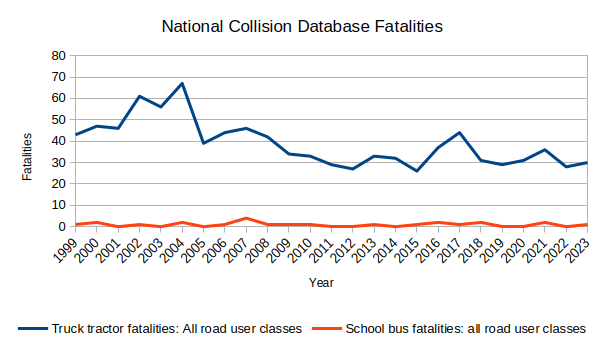
As you can see for yourself, the decline in the number of truck-involved deaths has been fairly steady since 2004. When you consider that Canada’s population grew by more than a third between 2000 and 2025 - and urban traffic congestion along with it - anything even close to steady fatality numbers would have to be considered a victory.
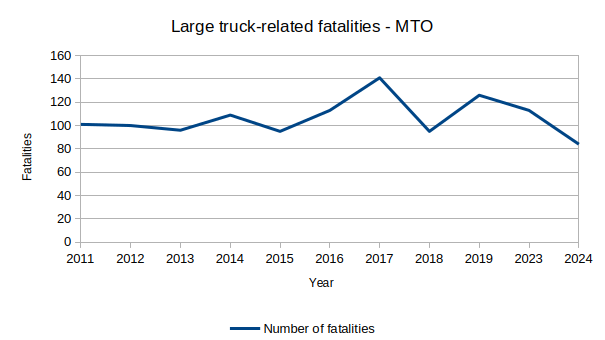
My second resource is the Ontario Road Safely Annual Report published by Ministry of Transportation Ontario. Here are the total province-wide fatalities for each year between 2011 and 2024. Once again, accounting for population growth, the fatality numbers clearly aren’t rising.
Finally, Statistics Canada publishes cause of death data that’ll also be useful here. Sure, those numbers won’t be perfect. Coroners do sometimes guess when documenting a death because it’s often not at all obvious what really killed a person.
But a dying patient just brought in by ambulance from an accident scene presents a whole lot less ambiguity. I don’t think we really have to worry that hundreds of crash victims are annually reclassified as COVID deaths.
As you can see, these Statistics Canada raw numbers are a bit higher than those from Transport Canada. And the “pedestrian injured in collision with car, pick-up truck of van” metric is just there for comparison sake. But the overall downward trends are, if anything, even more clear in this data. Canada’s highways, simply put, are safer than ever.
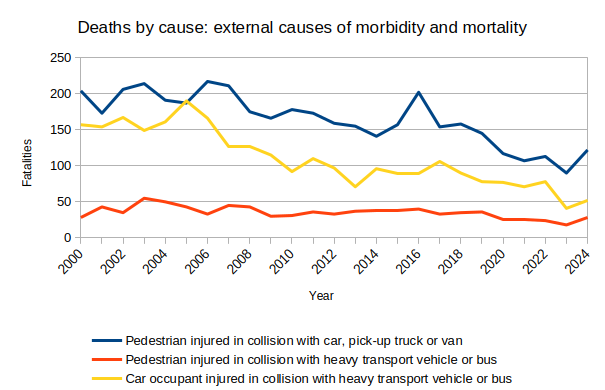
In fact, deaths caused by all categories of motor vehicle accidents have noticeably declined throughout this century. According to Statistics Canada, 2,582 people were killed in motor vehicle accidents in 2001, which represented a rate of 8.3 per 100,000. By 2024 the raw number had fallen to 1,853 which, due to population growth, was just 4.5 per 100,000.
All of which - taken together - strongly suggests that Canada’s pedestrians and drivers are not facing Mad Max road conditions out there. Which is good news, right?
Read on:
What if Better Healthcare Just Isn't Possible?

Canadians never tire of talking about healthcare, and I’m as guilty as anyone: the Audit is only 25 posts old and this is already the fourth post whose primary subject involves public health spending. Anytime we’re stuck waiting for a medical appointment or lab result, it’s always “We never used to have delays like this!” Invariably, that’ll be followed…
Is Marriage the Strongest Predictor of Wealth in Canada?

Love, they say, is a many-splendored thing. But I can tell you with confidence that, in Canada at least, it also pays handsomely.
Do Indigenous Canadians Benefit From Government Support?

Aside from payments for pensions and benefits through Employment and Social Development Canada and for interest payments on our debt, Canada spends more on indigenous matters than anything else.
Interesting stats but they're only covering the resulting deaths, and only those recorded as related to the particular vehicles.
The real stats will be in the rise of rolled trucks, trucks hitting bridges, trucks going the wrong way on the road, trucks grossly overloaded, trucks grossly compromised with multiple safety factors - like
missing tires, broken hinge bolts, drivers wearing flipflops or driving barefooted, drivers grossly over safe driving time limits, broken axels, open trailer doors, unsecured loads, trucks wobbling between lanes eventually either causing or being the accident scene...
I could go on and I'm sure countless people could supply more data.
Because it is data - it's just not recorded.
And the major data NEVER recorded is the race of the driver.
Something so conveniently rejected as to boggle the mind of any sane person handing out licenses.
The deaths are only one part of the stats.
I get that you have to use the data at hand, but fatalities maybe aren't necessarily the best metric. Passenger vehicles are simply safer than they used to be, for a few key reasons: universal adoption of life-saving technology like airbags; seatbelt usage is almost universal; and increased mass. On the latter, the average passenger vehicle is 200 kgs heavier than those of 25 years ago, and much of that added mass helps strengthen the frame and body "cage" that shields us from things like an 18 wheeler trying to share the front seat.
That said, as usual thanks for proving that anecdotes aren't data.