

I used to joke about how lotteries were a tax on people with a poor grasp of the principles governing statistics. Now it seems that legalized online sports gambling is a tax on people who are vulnerable to addiction disorders. And it’s no joke.
It doesn’t take much effort to find insightful discussions describing how online sports gambling is damaging both individuals and sports events themselves. This recent piece in The Free Press is a great place to start. But it’s a lot harder to find evidence that Canadian governments - busy legalizing sports gambling opportunities - have done much to minimize the harm.
First, some numbers. nation-wide revenues from all gambling industries in Canada had been fairly stable between the mid 1990’s and the COVID disruption in 2020. But as you can see from the chart, something definitely changed in 2022 that was much more than a “normal” post-COVID recovery.
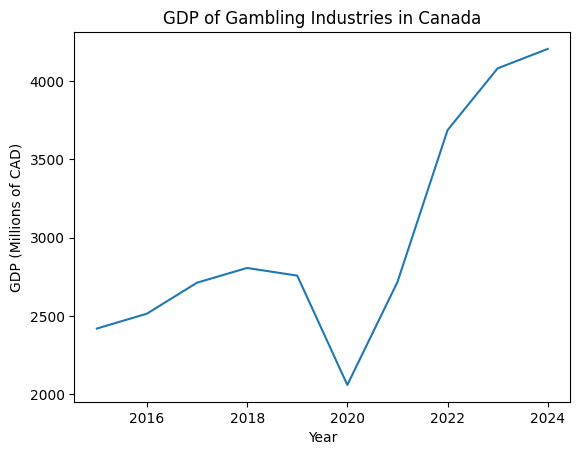
Two regulatory changes likely sparked that growth:
The 2021 legalization of single-event sports betting (Bill C-218, the Safe and Regulated Sports Betting Act)
Ontario’s launch of regulated online gaming in April 2022 through iGaming Ontario (a subsidiary of the Alcohol and Gaming Commission of Ontario)
In fact, since 2022, revenue growth in the sector was much faster in Ontario than (nearly) any other province:
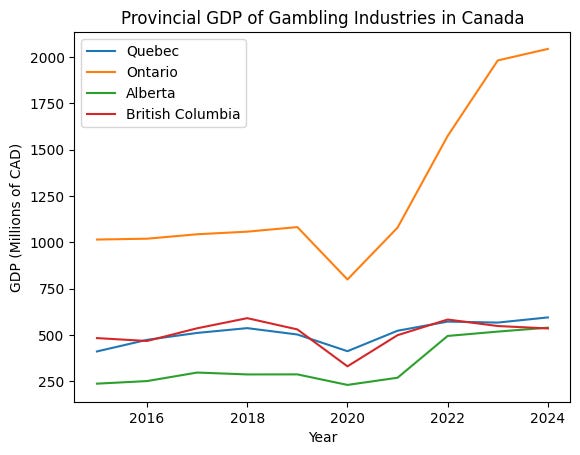
Ontario saw 101.38 percent growth in their gambling industry GDP between 2015 and 2024, more than double Quebec’s growth and nearly 10 times the growth in BC. Only Alberta saw a greater rate of growth: 127.43 percent.
If anything, Alberta has tightened its online gambling laws in recent years. So why are they seeing so much income from the industry? Understanding this might take us somewhere interesting.
If you examine industry statistics, you’ll see that employment numbers have mostly been falling since long before COVID. There were 40,448 Canadians working for the gambling industry in 2015 but just 38,063 by 2024 - a six percent decline. That combination of rising business volumes and declining employment suggests a general shift from bricks-and-mortar operations to labour- and capital-efficient online activities.
By contrast, Alberta’s employment levels in the sector have remained basically stable: going from a peak of 6,200 in 2019, through COVID declines, and back up to 6,137 in 2024. This could reflect stronger ongoing performance for physical gambling venues like casinos and VLTs - which could possibly also explain the increasing business activity.
Now let’s look at Ontario where employment in the industry since 2017 has dropped by 20 percent. Proportionally, Ontario’s industry productivity may not have grown as dramatically as in Alberta, but the raw numbers are far more attractive. That’s because - requiring so little labour - they come with higher profit margins. But also because they generate so much income for the provincial government.
Thanks to online deregulation, this is an industry that won’t provide much employment. But much like the case with the Liquor Control Board of Ontario, the income is just too attractive to resist.
How about the consequences? In the U.S., where online sports gambling has been legal for longer and where the problem has been more seriously studied, here’s what seems to be true:
Approximately 2-5% of sports bettors develop a gambling problem
Sports betting addiction accounts for about 15-20% of all gambling disorder cases
Around 3 million Americans are addicted to sports betting
Online sports betting accounts for nearly 70% of sports betting addiction cases
Sports betting addiction increases the risk of criminal behavior by about 25%, due to financial desperation
In addition, research has identified what are known as “dark patterns” (design elements that subtly push users toward undesirable or harmful behavior) specifically in online gambling platforms. These include:
Harder-to-find controls for setting limits
Urgency prompts
Default high bet values
Friction in closing accounts
Complex bonus terms tied to continued play
AI and personalization features are linked in research to changes in gambling behavior. Algorithms can tailor promotions based on real-time behavior, such as offering bonus credit when someone is about to quit or has just lost. Such interventions can change a player’s perception of risk and betting frequency.
Closer to home, a Statistics Canada study published in 2022 - before the impact of the Safe and Regulated Sports Betting Act could be measured - found that:
1.6 percent (304,400) of past-year gamblers were at a moderate-to-severe risk of problems related to gambling
The number of gambling activities played increased the risk for gambling-related problems
7.9 percent of Canadians (15 and older) engaged in sports betting in 2018
That gives us a helpful baseline snapshot of gambling in Canada before the introduction of legalized online platforms. Although we still have no idea how things are working out at street-level.
As it turns out, neither the federal government’s Safe and Regulated Sports Betting legislation nor Ontario's deregulation in 2022 came with any controls over potentially addictive user experience features in “regulated” online gaming platforms. Not only is it hard to identify any relevant safeguards built into the risky legislation, but, as far as I can tell, there doesn’t seem to be any serious ongoing research into the consequences.
And if all that sounds a familiar to you, perhaps it’s because we recently saw the same process playing out in the context of the legalization of cannabis.
Cannabis Legalization Is Starting to Look Like a Really Dumb Idea

Back in March 2024, I wrote about some early indications that Canada’s legalization of cannabis was, on balance, causing more harm than good. Well it looks like we’ve now moved past “early indications” and entered the “nervously searching for the exit” stage.
Do Government Controls Over Alcohol Sales Work?

The Government of Ontario created the Liquor Control Board of Ontario (LCBO) all the way back in 1927. The Crown corporation represented a first step away from prohibition: alcohol sales were now legal, but tightly controlled by government regulation.
Ranking Provinces by Mental Wellbeing

Is there a part of the country where people are measurably happier? Is it possible to identify what’s working so we can emulate it elsewhere? Perhaps some Statistics Canada data can help move this important conversation along.
Which gender statistically has more problems with gambling?
Seems to fit the pattern of picking and choosing who to protect and who to ignore.
Nobody is more addicted to gambling than government. The original argument was that gambling was a social ill, and therefore government needed to regulate it to protect the vulnerable and keep organized crime out and to generate the revenue to treat problem gamblers. That quickly morphed into a lottery or casino ad every fifteen minutes on the tv, and now steady rotating ads for sports gambling and casinos on your iPhone. I recall reading back in the eighties that the Ontario government’s “ handle” - their cut - from horse racing alone was a billion dollars a year. Online and casino gambling has cannibalized much of that, and horse racing is now subsidized and depends on slot machine parlours for survival. Meanwhile, lotteries, slots and online casinos generate $1.5 bbl or thereabouts a year in no tax revenue (though, really, gambling kind of is a tax on the stupid). Also, it is only a matter of time until gambling ruins professional sports.