

There’s a lot hanging on the way you manage a Canadian registered charity. If nothing else, many billions of dollars in potential tax payments are avoided when funds are donated to charities. Smart tax lawyers and accountants regularly work within the rules to do things whose rationale may not be so obvious to the rest of us.
As I’ve written, the government does make many of the details driving charity financing available to us. But there’s also a great deal that’s invisible. For me, one mystery involves at least some of the vast sums that are commonly transferred between registered charities each year. Why don’t charities use the resources they’ve been given to execute their mandates themselves rather than outsourcing it to others?
In some cases, the reasons are obvious. CanadaHelps.org, for example, distributed more than $775 million to other Canadian charities in 2024. But, considering their mandate, that’s exactly what you’d expect them to do. After all, they exist to help their website users find and donate to charities. As someone who’s been using the service for many years, I appreciate the convenience - especially having to deal with only a single tax receipt at the end of the year.
But what about, say, The Mastercard Foundation (TMF) who, in 2024, transferred $552 million to “qualified donees” (and another $305 million to non-qualified donees)? Did you know that TMF has long term investments worth $72 billion that, in 2024, they spent more than $2.2 billion in total, and $1.2 billion on charitable activities? Just in terms of operational size, the charity would easily rank in the top ten Canadian cities.
TMF exists due to something of an historic anomaly. As the name suggests, the foundation was created through a one-time donation of assets from the U.S. company, MasterCard Inc. There may have been charitable intentions involved, but the original deal was primarily meant to benefit the company’s tax liabilities. Due to peculiarities of Canadian charity tax law, the foundation was created exclusively here, rather than in the U.S.
There is currently no legal relationship between MasterCard Inc. and TMF. Canadian government tax revenues are not reduced through the charity’s activities and, it should be noted, TMF receives no government funding. Although it’s hard to get a precise number, I suspect that the majority of TMF donations are directed at non-Canadian organizations. Still, there’s no doubt that many hundreds of millions of dollars remain here in Canada.
Which raises in interesting side point. Considering the scale of spending by TMF - along with what’s spent by many hundreds of TMF’s wealthy peers - it’s probably fair to say that private charities have a meaningful impact on many high-profile social problems. TMF, for example, supports many of the same indigenous groups and “diversity-identified” populations as do our governments.
Is the impact of those private donations taken into account when governments map out their own support for overlapping programs? Is actual need and program effectiveness in a strategic context the only consideration used for planning?
In any case, some of the huge numbers I’m seeing in charity-to-charity transfers are still curious. To be sure, although I have no clue why the Princess Margaret Cancer Foundation saw fit to donate $152,676,086 to University Health Network in 2024, I’m fairly confident that there’s nothing dark going on.
But there are many other cases that aren’t so easy to dismiss. One possible explanation that came to mind would involve CRA’s disbursement quota for charities. The quota requires charities to, each year, spend a certain percentage of any assets1 in their possession rather than simply accumulating wealth. The threshold is 3.5 percent of the average value of unused property up to $1 million, and five percent on the portion that exceeds $1 million.
Consistently failing to meet the spending threshold could eventually lead to the loss of an organization’s charitable status - and exposure to tax liabilities. So perhaps some of the movement of funds back and forth between charities is nothing more than organizations generating fake charitable activity to meet their disbursement quotas.
To find out, I examined 2024 filings for 22,615 Canadian charities who reported at least some charitable spending and transfers to qualified donees. Three-quarters of those spent more than six percent of the value of their assets in charitable activities.
However, 4,769 organizations spent less than five percent of their asset valuation, and 3,806 spent less than 3.5 percent. 25 percent of the sub-3.5 percent spenders own more than four million dollars in assets.2 Allowing for the fact that I don’t have access to precise asset valuations, there nevertheless do seem to be more than a few charities who should be upping their game.
I’m assuming that many organizations feel pressured to keep their spending in line with quota requirements and, the more assets you own, the greater the pressure you’d feel. Therefore, if transfers between charities often represent “fake” charitable activity, you’d expect to see more of it among organizations with larger gaps between their spending and their declared assets.
However, when I tested my assumption, I found absolutely no correlation between large gaps and more transfers. That, as far as I can tell, means that organizations with larger gaps are no more likely to engage in transfers than other organizations.
To show you just how clear that conclusion is, I plotted the relationship. If there was a lot of such fake activity, there would be something like a straight line from the bottom-left corner of the graph to the upper-right. I don’t know about you, but that’s not what I’m seeing:
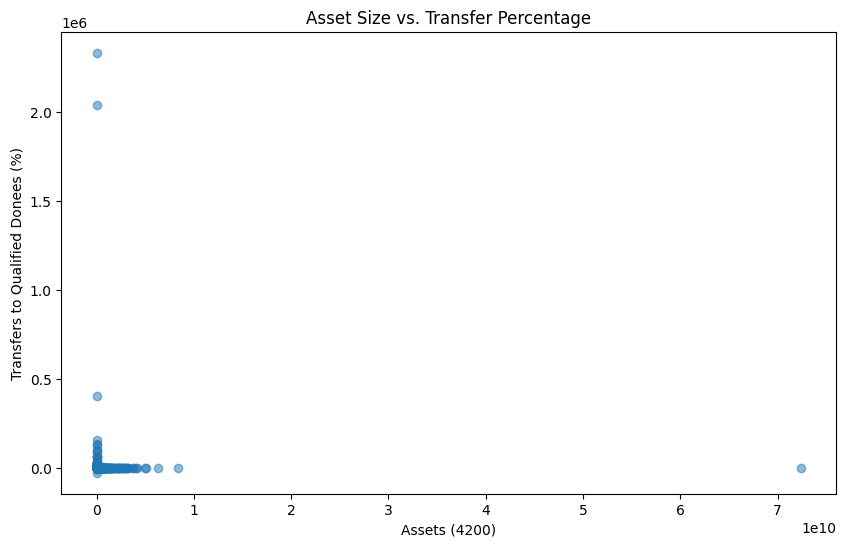
So I guess it’s unlikely that charity-to-charity transfers are masking dishonest quota-avoidance on a large scale. But there are definitely enough curious transfers going on that warrant a closer look.
To be honest, I’m not quite sure exactly what form such a closer look might take. But there’s an awful lot at stake, including the very real possibility that government funding is being misdirected to organized crime gangs and terrorist groups - both here and abroad. So why not tighten up the system just a bit?3
A Glimpse Into Ottawa's Professional Lobbyist Industry

There are currently more than 7,000 professional lobbyists listed in the Canadian government’s lobbyist registry. Since 2009, records containing the details of nearly 300,000 meetings between lobbyists and government officials have been entered into the official database.
Importing American-Style Charity Activism

In the U.S., the Tides Foundation (controlled, in turn, by the Tides Network) is well known for funding left-leaning causes using what some call dark money. The money is “dark” in the sense that grants coming from Tides do not reveal which donor directed the funds. Tides has no legal requirement to disclose its donors’ identities.
Technically, CRA looks at the average asset value over the preceding 24 months rather than the current value.
Even a hospital or school board that owns valuable real estate and equipment would normally spend far more than 3.5 percent of their asset value on charitable activities (like saving lives and educating kids).
“What?” I hear you asking. “Is the radical libertarian Clinton actually advocating for more regulations?” Well, perhaps just this once.
I really appreciate a researcher willing to test a hypothesis and post the negative results. Thank you.
A law or constitutional amendment banning peace time deficits would go a long way in cleaning up the state-funded "NGO" grift and vote-buying in general and perhaps delay or prevent the imminent end-stage democracy (Alexander Tytler) transition from bankrupt welfare state to tyranny. Today's Keynesians only follow half of his thesis anyway. That would take all the fun out of politics so in the deranged dominion we'll just carry on until we can't.