

As of the 2023-2024 academic year, there were 5,155,386 students enrolled in K-12 public schools across Canada. Statistics Canada reports that total direct government funding for those students came to $96.6 billion that year. Simple arithmetic tells us that each student’s education cost taxpayers $18,724.
Here’s how those numbers varied by province (where data was available):
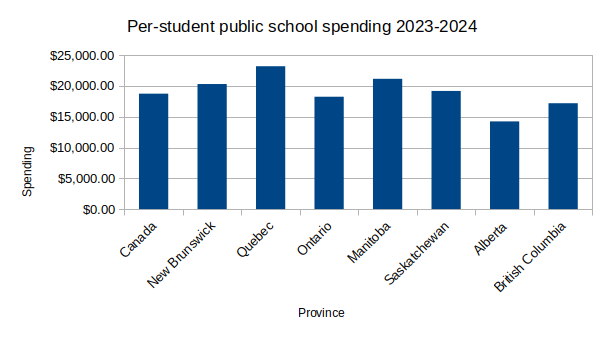
Those numbers aren’t quite so straightforward. Teaching children in full-time special education programs will obviously cost more than mainstreamed kids.1 And those direct expenses don’t include the costs of provincial Ministry of Education programs run in support of K-12 education.
According to Ontario Ministry of Education financial filings, for example, such programs would include “Responsive Education Programs”, “Funding to External Partners”, “Official Languages Projects”, and the “Education Quality and Accountability Office”. The 2024-2025 cost of those programs came to around $736 million.
If you add those expenses to Ontario’s total, the per-student spending will rise from $18,246 to $18,599. Those aren’t perfect numbers but - as the saying goes - they’re close enough for data.
Now let’s use that figure for a simple thought experiment.
What’s currently missing in public education? If you ask teachers, teachers unions, and many parents, the primary problem is that schools are underfunded. Teachers claim that there aren’t nearly enough teachers and front-line support staff. Right now, the average Ontario elementary school employs one full time equivalent (FTE) teacher and, at most, one educational assistant (EA) per class.2
So let’s see how much government money is already available. Based on the Ontario average we just saw, every group of 30 students receives around $557,970 (that’s $18,599 times 30).
That should be enough for two FTE teachers earning a handsome $150,000 each and five EAs earning $50,000 each. Seven adults for 30 kids would be a dream for any school.
In the context of the current average Ontario full-time teaching salary of $73,300, let’s pay our two teachers a more modest $100,000 each and drop a couple of EAs. That’ll still give us five adults and leave $207,000 unspent. That money could easily cover the equivalent of:
The class’s share of capital, administration, and busing expenses
The class’s share of the Ontario’s Special Education Fund ($3.71 billion in 2024-2025) - which would be just over $50,000
Teachers’ health benefits and pension contributions
Problem solved.
Ok. I’m sure it wouldn’t be quite that simple. But the thought experiment does raise the question: why do governments not allocate funding that way? Why do there appear to be so many non-classroom priorities?
Some might argue that cutting “administration” programs like the $29 million spent annually by Ontario's Education Quality and Accountability Office (EQAO) would leave us without insights into educational outcome trends.
I would argue that EQAO provides precious little value: there’s not enough public-facing data to provide any system-wide insights, and changes to the “standardized” tests make meaningful over-time comparisons impossible.
Ditto for the millions spent annually on curriculum development.
In other words, most stakeholders insist that students need more in-class support and there’s more than enough money already in the system to fund it. So why does no one rejig the system and make it happen?
Understanding Education Policy in Ontario

Through my property taxes, I pay a lot of money each year to support Toronto District School Board (TDSB) operations. Approximately $1,600, to be a bit more precise. I also live and work around TDSB graduates. You might say I’ve got skin in the game.
Another Look At the Vanishing Public School Student

I know this is something I first addressed back in mid-2024. But there’s delicious new data available, so it’s time for another look.
Does Provincial Curriculum Policy Really Make a Difference?

A few months back I wrote about some research I’d done trying to identify the official curricula used by Ontario public schools. My efforts proved to be unsuccessful when it came to Ontario’s Ministry of Education: they just weren’t in a mood to share
Although, as I’ve shown, running rural school boards often comes out a lot cheaper.
Average class sizes currently range between 20 and 25 students
No matter how much is spent on education it’ll never be enough according to teachers unions across the country. Their sole solution to improving the education system lays in hiring more teachers (which might not be a bad thing if more were interested in teaching as opposed to indoctrinating) and increase their wages.