

We can be forgiven for assuming that the Canadian government exists to spit out legislation that’s poorly planned, overtly political, and often legally dubious.
I say “poorly planned” because, more often than not, hindsight shows us that the policy was a miserable failure. If you’ve been reading The Audit for a while and that sounds familiar, it’s because so much of what I write about here involves comparing policy goals to real-world outcomes. Here are just a few examples representing many billions of dollars of ineffective government spending:


And I say “overtly political” because a government’s working agenda is unavoidably designed with electoral survival in mind at least as much as the national interest.
Still, all that’s not to suggest that no one in Ottawa cares about Canada and Canadians. In fact, Parliamentary and Senate committees often host genuine and even intelligent bi-partisan debate over the value and legality of pending legislation. The system is designed to ensure that meaningful amendments are applied to bills before they hit the streets.
What I’d like to talk about here is the question of how much all that good-faith debate actually impacts the laws that Parliament eventually passes. Specifically, I’m going to measure how much of an influence official reports tabled in Parliament by committees had on the legislative outcome.
To make this happen, I compiled data representing laws passed during Parliament’s 44th session (Monday, November 22, 2021 to Monday, January 6, 2025). There were, in total, 60 government bills introduced in the House of Commons that achieved Royal assent (i.e., became law) during that session.
As far as I can tell, of those 60 bills, committee reports existed for only 37 of them. It’s reasonable to assume that the other 23 bills passed with little or no input from committees. In some cases, that’s because the bills were simple and uncontroversial. In addition, committees might have debated some of the others but, for whatever reason, failed to submit their report.
I asked two separate AI models to compare three documents related to each of the 37 bills in question:
The official text of the bill’s first reading
The official committee report relating to the bill
The official text of the final law on receiving Royal assent
The scope and nature of any changes between first reading and Royal assent - and how much those changes aligned with the committee’s recommendations - should tell us how much of an impact committee debates have on our laws.
The AI models assigned each bill a score between one and ten, where one to three represented some minimal technical amendments, four to seven suggested there were moderate substantive changes, and eight to ten suggested that the committee report sparked major restructuring or a policy shift.
There was a significant gap between the two responses: one model gave me an average score of 6.46 while the other averaged 2.85. If I apply those scores to all 60 laws from the 44th Parliament - which makes sense when you consider that committees had no measurable impact on the 23 bills for which there weren’t reports - then those scores would drop to 3.99 and 1.76 respectively.
I wouldn’t take those precise numbers too seriously. After all, they’re the products of unsupervised AI assessments. But I think they do allow us to make a very general observation that the value of committee work is limited.
Let’s dive down for a bit more detail. Government bills in their original, first reading state seldom arrive in their final state. By the time they reached Royal assent, the texts of these 37 bills had, on average, 3,283 added words, 3,280 deleted words, and a text change rate (TCR) of 2.32.1
Our 37 committee reports contained an average of 34.84 “legislative amendment units” (LAUs). Each unit represents a single instruction to modify, add, or delete something in the current bill’s text.
Is there a statistically significant relationship between those two numbers. In other words, can we safely say that the more amendment instructions filed in a report the more clauses of the bill’s final version are changed?
As you can see from the scatter plot below, there is indeed a visible correlation between TCR scores and change rates. That single outlier at the top-right of the chart influenced the statistical effect, but the overall significance was still there even when I removed the outlier.
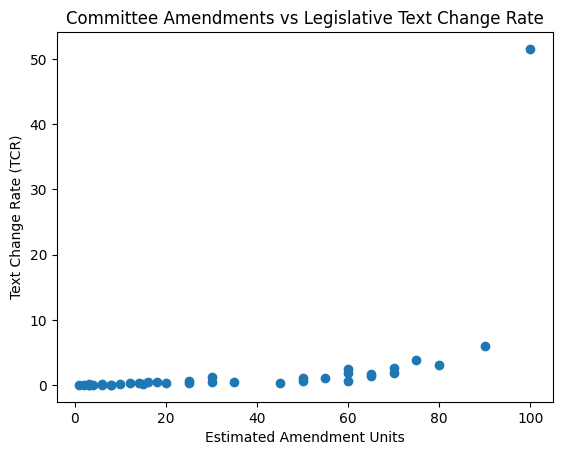
Of course, that doesn’t prove that the final version of a bill necessarily reflected the committee’s preferences. But it does strongly suggest the possibility.
So in the final analysis, we can justifiably conclude that the work done by Parliamentary committees has a relatively minimal impact on the big-picture legislative process. At the same time, we can assume that, when committees actually do execute the hard work resulting in formal reports, they’re making a difference.
What should change? I’m no expert in the inner workings of Parliament, but my suspicion is that there’s a serious conflict between a government’s legislative aspirations and overwhelming forces of institutional inertia (and incompetence) standing in its way.
Out of frustration, powerful Parliamentary leaders might be aggressively stewarding bills between readings to the point that there’s not enough time for proper analysis in committee.
The problem is, at root, mostly political. Governments chronically under perform and compensate by removing important guardrails.
One obvious solution? Refocus on just those few areas where government can make a positive difference and get out of the business of micromanaging what can’t and shouldn’t be managed at any level of detail.
TCR is measured by adding together the count of words added with words removed and dividing that by total words of the first reading version. The higher the TCR score, the greater the scope of the changes to the bill along its journey to law.
It would be more insightful to evaluate the impact of a bill, perhaps noting the difference between how many received assent and how many show some implementation or change in actions?
Lost in the fog of the mindless tribalism of party politics is the reality of end-stage democracy a la Tytler and the prescience of H.G. Wells' increasingly obvious parallels of the citizen to state in the Eloi and Morlocks respectively. The notion of limited government is foreign to Canadians now with a state (at all levels) that represents 44% of the economy and an increasingly infantilized citizenry that have outsourced so many adult responsibilities to the state that politics is now just an extension of the schoolyard where the bullies are in charge.
"When you see that in order to produce, you need to obtain permission from men who produce nothing—when you see that money is flowing to those who deal, not in goods, but in favors—when you see that men get richer by graft and by pull than by work, and your laws don’t protect you against them, but protect them against you—when you see corruption being rewarded and honesty becoming a self-sacrifice—you may know that your society is doomed."
Ayn Rand; Atlas Shrugged, 1957