

If you’re like me you’ve probably heard the claim that administrators are consuming ever-growing proportions of education and healthcare budgets. That’s certainly a recurring theme from the U.S. In fact, some years back even I wrote about how administration spending in U.S. public education budgets was negatively correlated to educational outcomes.
But tracking down the data you’d need to figure out what’s actually happening in Canada is hard. I gave it a shot a while back for the specific context of Canadian universities with mixed results. And there is data out there1 suggesting that spending on administration in at least the education sector is growing dangerously.
However I thought it might just be possible to tease useful numbers from Statistics Canada data to help us understand employment trends in both the education and healthcare sectors. Since no one approach will give us a perfect representation of the situation on the ground, I decided to use three distinct methodologies. Either way, the data that came out the other end wasn’t what I was expecting.
Analyzing Employment by Industry Data
I derived total sector employment for the education (educational services) industry from the Statistics Canada labour force characteristics table and total healthcare employment by adding together the ambulatory healthcare, hospitals, and nursing numbers from the employment by industry table.
To get an estimate of how many of those workers were involved in administration, I subtracted the health or education “occupations except management” numbers from this table.
Those numbers are definitely not perfect matches. After all, subtracting just management roles leaves out layers and layers of coordinators, supervisors, team leads, and administrative staff who are also not directly involved in the delivery of education or healthcare. But I believe what we have can give us enough to let us catch long-term hiring trends.
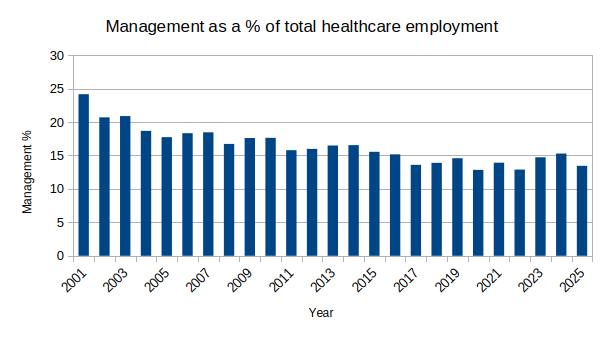
So what did I find? Well, when it comes to the healthcare industry since 2001, the management share of total employment has steadily dropped from nearly 25 percent to just 13 percent. Now it’s highly unlikely that 25 percent of healthcare workers were ever classified as “management”. But it’s the ratio I’m after here.
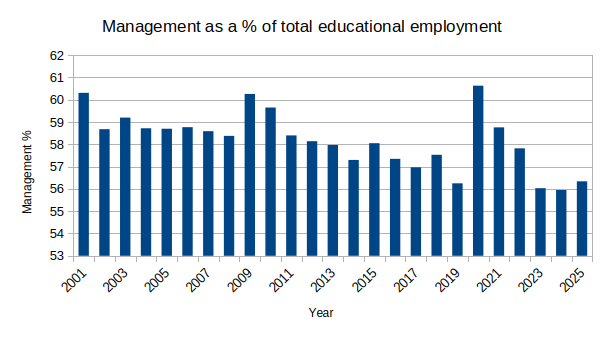
And the proportional management decline for all levels of education (from elementary to university) was nearly as dramatic, falling from 60 percent in 2001 to 56 percent last year. Again, there’s no way that management ever occupied anything like 60 percent of all educational workers. But here’s how the trend looked:
One thing that’s absolutely clear is that, if anything, there are fewer per-capita managers in both educational and healthcare sectors now than a quarter century ago. That doesn’t mean operational costs and efficiency have necessarily improved. But it does suggest that there’s no obvious evidence of administration bloat within the system.
Analyzing Labour Force Survey Microdata
Using Statistics Canada’s microdata resource allows us to dive a bit deeper into the data by creating custom subcategories. To do that, I took the total size of the education (or healthcare) workforce and, from that cohort, identified workers whose job roles suggested support or administration duties. I then calculated the proportion of the total populated by that subset.
Since the microdata collection only covers the past 20 years, I was only able to track changes since 2006. When I visualized the data, it was obvious that there have been no dramatic changes.
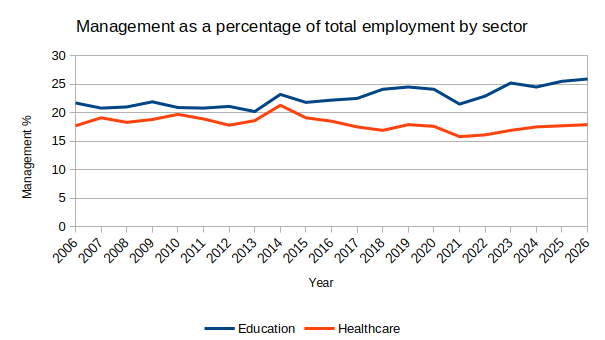
There was a modest five percent increase in the proportion of administration workers in the education sector and virtually no change at all in healthcare.
University Employment vs Enrolment
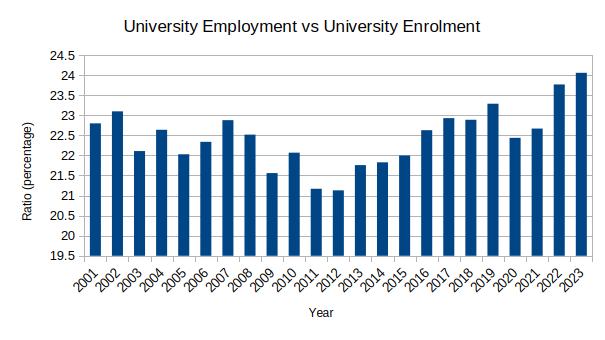
Finally, I used two data tables from Statistics Canada to track the ratio of total university employment against university enrolment. The result, as you can see for yourself, shows negligible change between employees making up 21.13 percent of the enrolment number at its lowest, and 24.06 at its highest.
All three of those methodologies indicate that there’s been no significant growth in administration overhead in education or healthcare workplaces.2 If we’re looking to explain and correct institutional failures in those sectors, perhaps this isn’t where we should focus our attention.
A subscriber of The Audit helpfully brought this source to my attention.
Although, as I’ve written, that’s not necessarily the case with executives in the federal civil service. And the higher education data I referenced earlier suggests spending is growing disproportionally.
I've spent a good deal of time recently looking at the Ontario budget recently. Something that jumped out to me is that healthcare funding has massively increased under Doug Ford, even though popular wisdom is that he's been cutting it. The reason is that we're in a fertility crisis, where Canada is getting older both in terms of the number of seniors and the proportion of the population that are seniors. It's tempting to assume that are healthcare systems are falling apart from inefficiencies, but in reality, this is an inevitable part of having such an old population. No politician has the courage to say this, but taxes have to go up if we want to continue to have universal healthcare.
I am a retired educator (BC). I have sat on curriculum committees (1990's) and I have a reasonable idea of how much it costs for these committees - travel, accommodation, meals, substitute teachers back home. I have experienced how the government people at the table skew the focus of a discipline to reflect the ideology of the few. Then there is the cost of workshopping the teachers in the new curriculum, supporting the implementation in the districts, the new texts etc., etc. I read somewhere that some universities are offering remedial programs in reading and writing for their first year students.
Your comment on healthcare is disconcerting but reflecting on it, it might be the case.