

After a decade of explosive (and damaging) growth, Canada’s immigration rates seem to be cooling off just a bit. Once the crisis is hopefully truly behind us, one of the things that’ll eventually have to be redefined will be our national immigration policy. We’ll need to figure out what our immigration-related goals should be and how we can achieve them.
I’ll leave coming up with exact annual numbers and avoiding second-order problems (like housing accessibility) for a different discussion. Here, I’m going to focus on which specific immigration programs will be the most effective at achieving our national goals.
Historically, we’ve granted landed immigrant or permanent resident status to applicants through programs that included:
Canadian Experience Class which targets temporary foreign workers or international graduates who have worked in Canada in skilled occupations within certain target occupations
Business programs which are aimed at entrepreneurs, investors, and self-employed individuals who intend to start or manage businesses in Canada, make substantial investments
Skilled worker and skilled trades
Various provincial/territorial nominee programs
Statistics Canada data exists for tracking immigrant outcomes using some excellent metrics, including:
Median employment income
Median self-employment income
Incidence of investment income
Incidence of social assistance
There are obviously other considerations that can also help inform immigration policies. But tracking the financial outcomes of various groups can give is a sense of how well individual immigration programs work in terms of economic integration and costs to society. For this post, I looked at the experiences of the 26,805 immigrants who received permanent status in 2013 and for whom records were available for the 2023 tax year.
I looked for insights relating to both admission programs and pre-status experience in Canada. Here’s what I found.
Which Admissions Programs Deliver the Greatest Integration?
Long story short: if Canadian policy intends to maximize new immigrants’ economic integration and success as measured by income, wealth-building, and independence from social assistance, the evidence strongly supports the superior long-term outcomes achieved by former temporary residents coming in through the Canadian Experience Class (CEC).
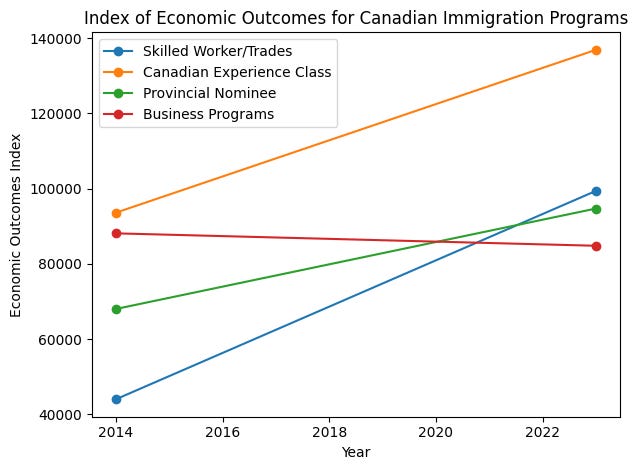
Specifically, CEC participants had by far the best median employment income ($89,400 in 2023), the lowest use of social assistance (just 0.6 percent of the cohort), steadily climbing incidence of investment income (peaking at 51.7 percent in 2023), and a solid median self-employment income ($5,800).
That result supports the intuitive assumption that previous in-country experience can ease in immigrant’s path to success. They know what they’re getting into and what it’ll take to win.
That’s not to say that the skilled workers/trades and provincial nominees were failures. Far from it. Their median combined employment and self-employment incomes were both in the $70,000 range and less than two percent of both groups relied on social assistance. But the CEC cohort clearly outperformed.
Business program participants scored the lowest in employment income, but that’s likely because, by definition, they’re supposed to be building their own businesses rather than working for someone else. Their particularly high median self-employment income ($10,800 - twice any other group) bears out this likelihood.
However, those numbers should be used with caution. That’s because there were so few people in the business program cohort to start with (just a couple dozen in total). In fact, if the program is really that poorly used1, perhaps it’s not worth the investment in the first place.
Here are index scores that represent all four outcome metrics tracked over time for participants in each admission program. It’s obvious that the Canadian Experience Class performs consistently well.
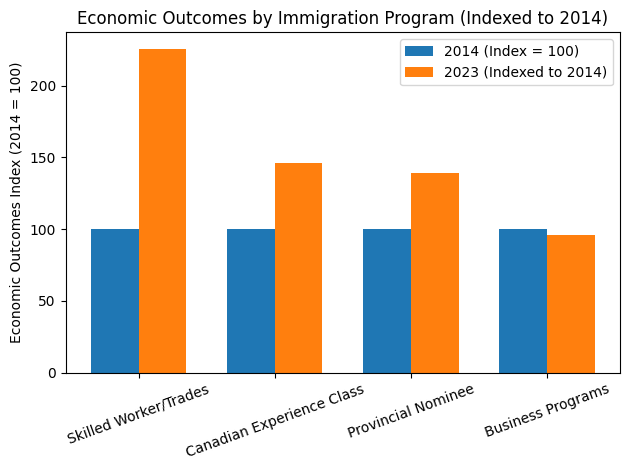
And here’s a view of those same index scores, but indexed to their 2014 levels to focus on growth over time. The Skilled Worker/Trades program participants may not get the highest raw scores but, over time, they do an excellent job building their performance.
Which Pre-Admission Experiences Delivers the Greatest Integration?
This one is pretty straightforward. When comparing experience, regardless of the specific program used, immigrants whose prior experience in Canada consisted of a work permit easily outperformed those who originally came on study permits.
No matter which admissions program was used for access, people who had previously spent time working in Canada made for a better economic fit once they became permanent.
It’s possible that this suggests there are indirect benefits to the Temporary Foreign Worker Program (TFWP). Although they would need to be well understood and carefully weighed against the known harms the TFWP can cause to local job markets.
But regardless of the numbers we’re seeing here, it’s critical that government doesn’t (once again) dive blindly into a re-calibration of our immigration system without first understanding what’s worked well in the past and what dumb mistakes we should avoid like the plague.
Keep reading:
The Hidden and Tragic Costs of Housing and Immigration Policies

We've discussed the housing crisis before. That would include the destabilizing combination of housing availability - in particular a weak supply of new construction - and the immigration-driven population growth.
What Drives Canada's Immigration Policies?

Popular opposition to indiscriminate immigration has been significant and growing in many Western countries. Few in Canada deny our need for more skilled workers, and I think most of us are happy we’re providing a sanctuary for refugees escaping verifiable violence and oppression. We’re also likely united in our support for decent, hard working economic immigrants looking for better lives. But a half million new Canadians a year is widely seen as irresponsible.
Is the Temporary Foreign Worker Program Being Abused?

Are there jobs that Canadians just won’t do? There appears to be credible evidence that there are. But is the Temporary Foreign Worker Program (TFWP) in its current form the most effective tool to address labour shortfalls? In the context of some systemic opportunities for the exploitation of some foreign workers and of serious unemployment here at home…
It seems that only 85 people used it in 2022.
The data on the Canadian Experience Class is strong. You noted their median income reached $89,400. This explains why the government defends this program so hard during Question Period. But the Order Paper tells a different story. The Order Paper is the official list of written questions MPs ask ministers. It is currently filled with queries about backlogs for these specific workers. We know they succeed economically, but Ottawa still struggles to process their paperwork on time.