

Canada’s service industries are in the middle of a massive and (possibly) uncontrollable disruption. And very few people are even aware of it.
The trend driving the disruption is known as private equity roll-up. “Private equity” simply refers to investors with a taste for using capital to buy existing businesses. The “roll-up” part of the deal happens when investors purchase multiple businesses in a single industry, consolidate their operations, capitalize on their assets, and then sell what’s left at a profit.
Industries that are particularly attractive targets are often:
Highly fragmented, traditionally consisting of many small independent owners
Focused on providing essential (non-discretionary) services to recurring customers
Heavy in owner-operators nearing retirement with no succession plan
Industries that are undergoing the greatest change include:
Dentists, chiropractors, optometrists, and accountants
Plumbing, heating and air-conditioning contractors
Veterinarians
Self-storage warehouses
Funeral homes
Regulations restrict outside ownership of businesses in some of those sectors. So private equity firms will often buy up the real estate, brand, back-office, and non-clinical assets while a professional nominally holds the clinical licence.
How significant is this trend? The following chart uses Statistics Canada counts of business counts in more than a thousand industry categories. I used counts for common private equity targeted sectors from 2015 and 2025 to track changes.
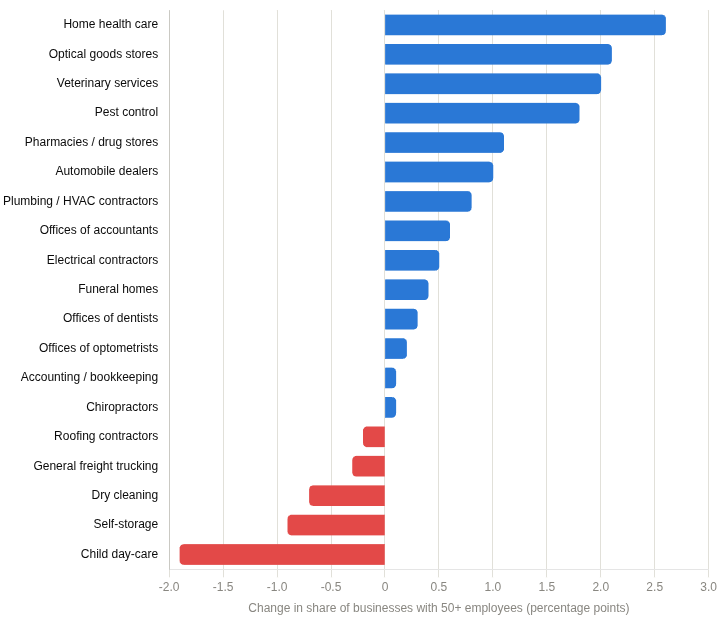
As you can see, over those ten years, the numbers of businesses with 50 or more employees (as a share of total businesses) increased by two percent or more for home health care, optical goods, and veterinary services. Overall, there was clearly a statistical trend away from smaller businesses (less than 10 employees) and visible growth in larger companies - meaning existing clinics are likely getting bigger rather than lots of new small ones opening.
However that’s far from the whole story. The problem is that those Statistics Canada datasets only report numbers of registered businesses, while ignoring indirect ownership. Since a single private equity firm could own dozens or even hundreds of distinct companies within a sector, we’re obviously not yet getting the full picture.
I’ll use Dentalcorp to illustrate what I mean. As of 2024, Dentalcorp owned 550 dental practices across Canada and was in advanced negotiations with 160 more. Their clinics account for over 5.7 million patient visits annually. Last year, Dentalcorp itself was acquired by the U.S. private equity firm GTCR.
One reason all that activity didn’t have more of an impact on our Statistics Canada data was because Dentalcorp still owns less than five percent of the Canadian oral care market - and each of the hundreds of offices they control still exists legally as standalone businesses. But the trend we’re seeing will - for better or worse - obviously change the dental care Canadian’s receive in coming years.
The number of Canadian veterinary clinics under corporate ownership has apparently grown from around 13 percent in 2021 to as high as 25 percent in 2025. Typically, corporate players in Canada’s vet clinic industry - like VetStrategy and VCA Canada - are owned by foreign investors.
Consolidation among optometrists’ clinics is happening, but by way of a different model. For the most part, it’s been practitioners themselves (supported by foreign minority partners) who’ve been building a collective - the FYihealth group - consisting of 370 locations across the country.
As of March 2025, StorageVault Canada - Canada’s largest self-storage company with a $1.73 billion market cap - owned and operated around 250 storage locations - with more coming on line all the time. Overall, Statistics Canada reported 503 self-storage sites in 2015, and 855 in 2025.
The main reason StorageVault - despite its industry dominance - doesn’t show up as a major “consolidator” in Statistics Canada data is that each (nominally independent) centre will usually require only a few human beings on staff.
The truth is that those trends represent nothing more than the free market responding to opportunities and optimizing operational positions. An argument could be made that governments have no business interfering. However, such macro-scale changes can carry some real economic risks.
Research in the U.S. into private equity ownership of healthcare providers found that such business models often led to increased consumer costs and reduced quality of care. That’s partly because markets with less competition offer fewer real alternatives, forcing customers to stick with what’s available and reducing providers’ incentives to improve. But it’s also a reflection of how - specifically - private equity firms manage their businesses.
There’s also the risk that investors would be more likely to close “underperforming” branches in their portfolios. The branches most likely to underperform from an investment perspective would be those serving smaller and rural communities. This, in an environment were there are few or no private practitioners, could lead to service deserts.
Practitioners themselves can, when working for large consolidators, lose bargaining power. It wouldn’t surprise anyone to see workers in regions where one or two investor groups dominate the market experience disappointing pay and conditions, with little leverage to demand more.
Consider, too, how deeply some large Canadian pension funds - including CPPIB and the Ontario Teachers’ fund - are invested in private equity operations. When decisions that would maximize investment return threaten the services regular Canadians rely on, which consideration should win?
Should competition regulators intervene? Under current legal frameworks, they’re currently unable to do anything. That’s because the Competition Act only requires notification for mergers where the target’s Canadian assets or revenue exceed roughly C$93 million. That’s rare for scenarios where individual roll-up bolt-ons involve single vet clinics, dental practices, or dry cleaners.
But this is something that could benefit from some more official attention.
Terms and Conditions: How Canadian Banks Override Their Customers' Property Rights

You know those “I have read and agree to the terms and conditions described in this document” boxes we all click before opening new accounts? Well it turns out that there’s actually stuff in those documents. And in the case of Canadian banks, that stuff could one day come back and bite us.
Mandated Diversity Reporting and Perverse Incentives

It’s been a while since my last post. I’m afraid I was occupied earning a living. The thought of my tender children anxiously worrying about their next meal simply overcame me. Although, since my youngest is 17 and is perfectly capable of ordering Uber Eats on his own, I’ll acknowledge I wasn’t all that overcome.
The Problem of Corporate Tax Rates

Are Canadian corporations paying their share? Well, what is their share? And before we go there, just how much are Canadian corporations paying?
I first noticed this with veterinarian businesses. Ask anyone with a pet about skyrocketing costs of care.
Your article is nicely laid out. Each of us should be paying attention to these type of business shifts and how they impact our communities.