

I’ve written a fair amount about trends in violent crime and about crime in general. But there’s a related topic I haven’t touched: missing persons. So, inspired by a reader comment to a previous post, I’ll try to make up for that gap here.
The get the basic facts, we’re going to use 2025 data from the National Centre for Missing Persons and Unidentified Remains (NCMPUR).
It seems that most cases are resolved quickly. According to the NCMPUR ‘Fast Fact Sheet”:
“Only 540 (1%) of people who went missing in 2025 were still missing on the day the data for this report was extracted (February 2nd, 2026).”
As of the end of 2025, there were 8,329 unresolved cases on file from all previous years combined.
The fact is, Canada doesn’t have a single “missing persons” problem. Rather, there are multiple missing person profiles that are largely unrelated to each other.
Missing Adults
Based on the NCMPUR data, the causes for adults going missing are by far (76.2 percent) most likely to be categorized as either “unknown” or “other”. Although 14.8 percent are listed as runaways and 8.3 percent have “wandered off” - I’d guess those are mostly dementia patients.
The remaining categories mostly involve abduction and human trafficking. The fact that those categories account for such a tiny proportion of the total suggests that a criminal connection is rare.1
Missing Children
By contrast, the overwhelming majority (70.34 percent) of missing children are classified as runaways. I’d guess that none of those are suffering from dementia.
It’s noteworthy that only 119 missing children cases across the country in 2025 were associated with parental abduction of one kind or another.
There were 18,649 males in the adult database, against just 14,935 females. Among children, however, there were 13,985 boys against 20,204 girls. I’m not sure exactly how to explain those differences.
Missing Indigenous People
For context, only five percent of Canadians identify as Indigenous. Yet, NCMPUR data reveals that:
“13% of all missing adults in 2025 were Indigenous and 58% of all missing Indigenous adults were female” while “21% of missing children in 2025 were Indigenous and 69% of all missing Indigenous children were female.”
For technical reasons, those numbers might understate the problem: because of reporting inaccuracies, the disparity may actually be higher.
Looking at those numbers by province reflects that disparity. The provinces with the highest Indigenous population density also clearly suffer most of the missing persons cases:
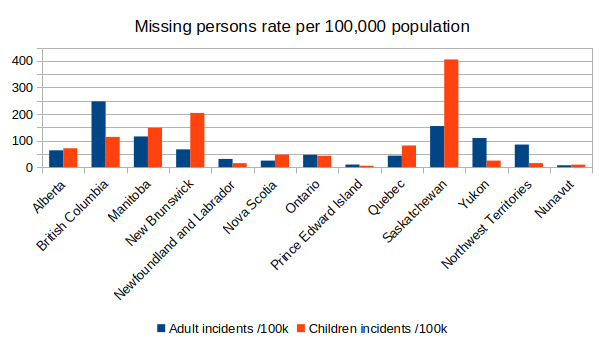
Part of the Indigenous/non-Indigenous gap in missing children can be explained by the fact that around 25 percent of the Indigenous population is under 14 years of age. In other words, there are relatively more children in the overall pool. It’s also possible that some individuals ran away more than once and are thus counted multiple times in the data.
But that’s obviously not the whole story.2
A more important factor is that Indigenous children are substantially overrepresented in Canada’s child welfare system. Children in foster care or other placements are more likely to have fragile relationships with caregivers, run away, and experience repeated disruptions to living arrangements and schooling.
For some extra perspective, we can compare Canada’s experiences with peer countries. Based on the data we’ve seen, Canada’s overall missing persons rate is around 163 per 100,000. The U.S. rate (at least as of 2021) was 149.5.
The U.K. opens 353,000 files of missing persons are opened every year, although they only report around 180,000 missing persons each year. The higher number would translate to a rate of 504 per 100,000 against a low-estimate rate of 257. Either way, Canada seems to be “competitive” internationally.
Of course, those numbers are estimates: reporting standards change over time and from one jurisdiction to another.
While any single broken family represents a tragedy, I’m not sure the big-picture numbers in Canada point to a national crisis. Where that is obviously not the case is within Indigenous communities. But I’m far from the first to suspect that those missing persons are a symptom of deeper problems in need of attention.

Of course it is possible that some of the events classified as “other” or “unknown” are actually the result of criminal activity. But I don’t think we would be justified in assuming that to be the case from a statistical perspective.
The conclusions of the National Inquiry into Missing and Murdered Indigenous Women and Girls should not be ignored.