

There’s no question that murder rates in Canada have been dropping since the mid 1970s. And, as you can see, that decline has been mostly steady:
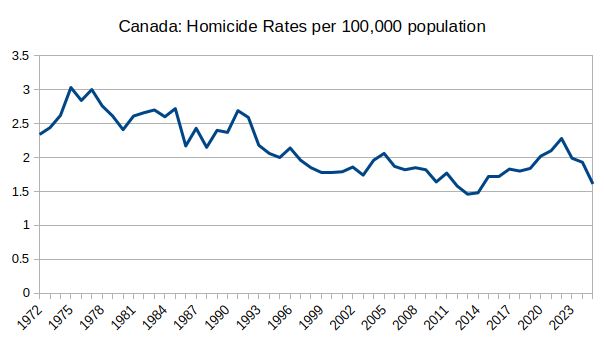
It would be counter-intuitive to blame the virus itself for that obvious bump in COVID-era murders. Instead, the most likely cause was the impact of disruptive lockdowns. (Although, to be fair, rates had already been rising before 2020.)
Note that the ten-year murder average in Canada leading up to 2020 was 601.3 per year. Between 2020 and 2023, the average jumped to 813.75. That suggests lockdown policies were indirectly responsible for around 850 extra murders.
The decline in murder rates has, in fact, been fairly steady. The rate in 1998 was 1.85/100k compared with just 1.61/100k in 2025. And yet, during those same years, violent crime rates overall haven’t fallen. This chart compares homicide and aggravated assault1 rates:
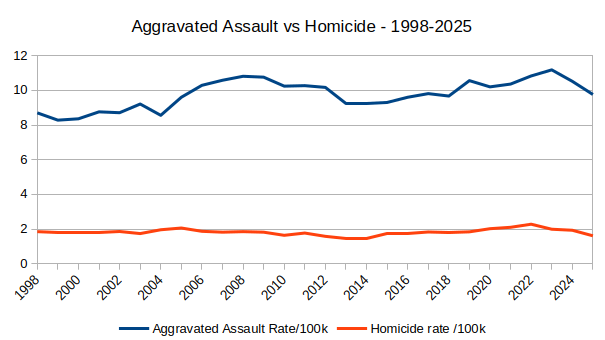
Specifically: comparing 1998 to 2025, the homicide rate dropped by 12.97 percent, while the aggravated assault rate increased by 12.18 percent.
I can’t easily imagine a universe where education and changing social standards convince a statistically significant number of people that murder is inexcusable but wounding, maiming, and disfiguring your victims isn’t nearly so bad. So how can we explain the fact that there are fewer murders at the same time and in the same populations as increasing violent assaults?
I suspect that improvements in emergency trauma care could explain at least part of the contradiction. There is some evidence to support that theory. A national study of 78,807 patients treated for major injuries at Canadian trauma centres between 2006 and 2012 found that risk-adjusted in-hospital mortality fell from 12.1 percent to 9.9 percent.
In other words, there are still just as many angry psychopaths out there, but thanks to medical advances, their victims are less likely to die.
I’m sure that’s not the last word on this issue. To be more confident, we’d need to account for a number of possible population-level trends, including changes in:
Weapon use
Populations most exposed to violence
Recording, reporting and classification policies
Gang and organized-crime violence
Alcohol and drug markets
Demographics (are there now relatively fewer young people than before?)
Incarceration and repeat offending
But one thing that doesn’t seem to explain the disconnect is that Canada is somehow becoming a happier and more polite place. If that were the case, then we’d also expect to see few cases of aggravated assault. The same would apply to evolving approaches to policing.
What if Canada's Police Can't Keep Us Safe?

Gun control is a bit of a political third rail in Canada. Even dropping vague hints that you might consider expanded gun ownership will spell the quick and complete end to your dreams of public office. Fortunately, I have no political ambitions so, Bill C-63 notwithstanding, I can say whatever I like.
Geo-locating Violent Crime in Canada

A recent report claimed that violent crime - not including murder rates - in Canada is actually worse than in the U.S. And even American murders are mostly heavily concentrated in gang-infested neighborhoods - “Just 2% of counties account for approximately 54% of all murders”
Police vs the Courts

This is one of those posts that start out as one thing and end up somewhere entirely different.
In Canadian law, aggravated assault is the most serious form of non-fatal assault. It’s defined by the infliction of wounding, maiming, disfiguring, or endangering life.
I pulled Statistics Canada's Table 35-10-0177-01 to check the emergency trauma care hypothesis. If medical advances were turning lethal assaults into non-fatal outcomes, incidents with intent to kill would appear in police records as attempted murder under Section 239 of the Criminal Code. Instead, the national attempted murder rate fell from 2.24 per 100,000 in 2020 to 1.65 in 2025, mirroring the decline in homicides. The divergence in non-fatal assault figures is administrative: in January 2018, police services revised their Uniform Crime Reporting standard, classifying reports as founded unless positive proof indicates otherwise.
Are there age standardized statistics? If not, while trauma care seems most likely, I wonder about Stephen Punwasi's missing persons thesis. Have those rates changed over time?
https://x.com/StephenPunwasi/status/1889520033618886721?a=OBWf6jid90DtmB3Y8jA&s=20