

A recent report claimed that violent crime - not including murder rates - in Canada is actually worse than in the U.S. And even American murders are mostly heavily concentrated in gang-infested neighborhoods - “Just 2% of counties account for approximately 54% of all murders”. Overall, the claim goes, most Americans enjoy safer lives than we do.
The report acknowledges that Statistics Canada’s “victims of police-reported violent crime” metric (which reported 1,183 violent crimes per 100,000 in 2024) is not covering exactly what’s measured by the FBI Crime Data Explorer (which reported just 359.1 per 100,000) - so comparing those numbers won’t be all that useful.
In fact, finding reliable cross-border crime data that provides genuine apples-to-apples comparisons isn’t at all straightforward. And on reflection, it may just not be worth the effort. But while I was poking around through that Canadian data, I did notice something interesting.
After nearly a decade of declines ending in 2018, the crime rate across Canada has been steadily rising ever since.1 As of 2024, the rate was 1,183 violent crimes for every 100,000 people. But how vulnerable you might be will largely depend on where you live.
Perhaps surprisingly, big cities aren’t nearly so bad. Rates in Toronto and Vancouver are well below the national average, and Montreal is right on the average. But as you can see from the chart, smaller centres like Drummondville, Chilliwack, and Lethbridge are far more dangerous places. And Saskatchewan and Manitoba are by far the worst among provinces.
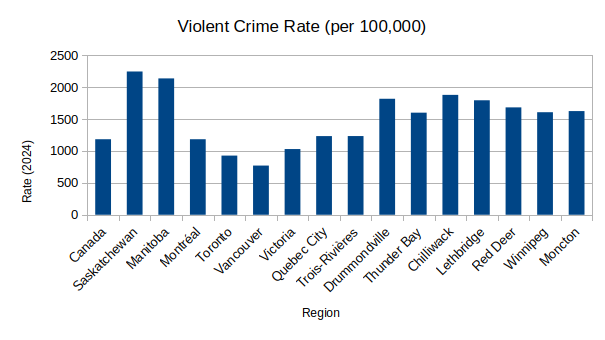
This isn’t exactly breaking news. Statistics Canada has already noted the trend:
“In 2024, police services serving a mostly rural population represented 14% of the population of the provinces, but for 22% of violent crimes, 17% of property crimes, 27% of Criminal Code traffic offences and 23% of other Criminal Code violations recorded in the provinces.”
In fact, the “violent Crime Severity Index in rural areas is almost 50% higher than in urban areas”. And indigenous people - who are more likely to live outside of urban centers - are significantly overrepresented both as victims and accused in violent crime statistics.
Why should this be? There are a few theories you’ll see discussed. But each of them is weakened by the existence of strong counter-examples.2
I’m not being cynical or ironic when I say that I honestly have no idea what’s behind these crime numbers. Or, more accurately, I have no idea why there are more rural than urban criminals.
What should we do? Cleaning out Chinese and other foreign criminal gang activity from every layer of society (including government) wouldn’t be bad place to start. Beyond that, I can only say that I’m pretty confident blindly throwing more government subsidies and benefits at the problem won’t help.
Which is not a trend repeated in the U.S.
Demonstrably, poverty - as an example - doesn’t always lead to crime. And the same can be said for social disruption and “colonization”.
Mass immigration.
Simple as.
My city (and neighborhood) is now seeing regular shootings, rapes and stabbings by Africans and Pakistanis in a way we never did before.
Add an ever-rising number of unstable homeless vagrants to the mix and…