

Having a personal stake in something creates bias. Judges are expected to recuse themselves from cases involving family members because they can hardly remain objective. Ownership in a business (like, oh I don’t know, Brookfield?) will influence your related policy choices. And we know that sports gambling has already led to athletes illegally adapting their performances.
So what happens to the objectivity of governments drunk (and stoned) on revenue from taxes on liquor, drugs, and gambling?
How drunk? Well that’ll depend on exactly how deeply invested they are. In Ontario, here’s how things stood in 2024-5:
The Liquor Control Board of Ontario (LCBO) - with its control over the province’s retail liquor industry - transferred $2.13 billion to the Province.
The beer, wine and spirits tax generated another $530 million.
Ontario Lottery and Gaming Corporation - which regulates casinos and lotteries - sent more than two billion dollars to the Province.
iGaming Ontario - responsible for online gambling - provided $181 million, which was up 24 percent from the year before. And a more recent report pegs the government’s total one-year share at more than $800 million.
Ontario Cannabis Retail Corporation on its own generated around $35 million, but Ontario’s share of federal cannabis excise duty added another $390 million.
The tobacco tax brought in $693 million (although that’s been declining for decades due to falling consumption).
All that added up to roughly six billion dollars, or around 2.7 percent of Ontario’s total annual revenue.
Could a government whose hands are dug so deep into those cookie jars be trusted to make the right decisions impacting consumption? Ontario’s cancelling of its promised Gambling Research Exchange Ontario didn’t inspire confidence.
A strong argument can be made that increasing tax rates to raise the price of harmful substances will encourage people to consume less. That seems to have worked for smoking. The problem is that the principle simply doesn’t apply elsewhere.
By the nature of the product, online gamblers and lottery players will never see any government-mandated price increases. So there’s no practical disincentive at work.
And alcohol? Despite decades of heavy excise taxes, alcohol consumption has been rising in every province. So even if the original thinking behind the extra taxes was to reduce drinking, it’s obviously not working:
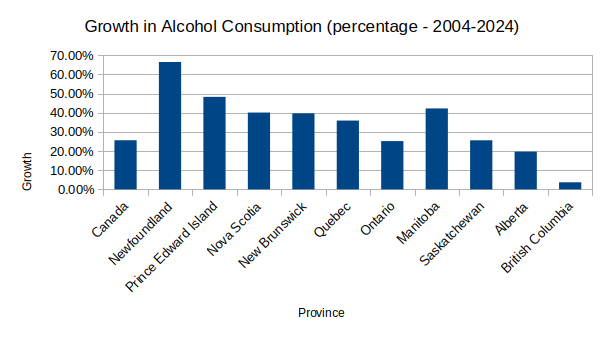
Despite the fact that government policy officials must realize that there’s no social benefit justifying their taxes, they’re still happy to impose heavy consumer costs on alcohol sales. How heavy? That’ll depend on where you live. Here are the per capita earnings from alcohol sales directed to provincial authorities (like Ontario’s LCBO):
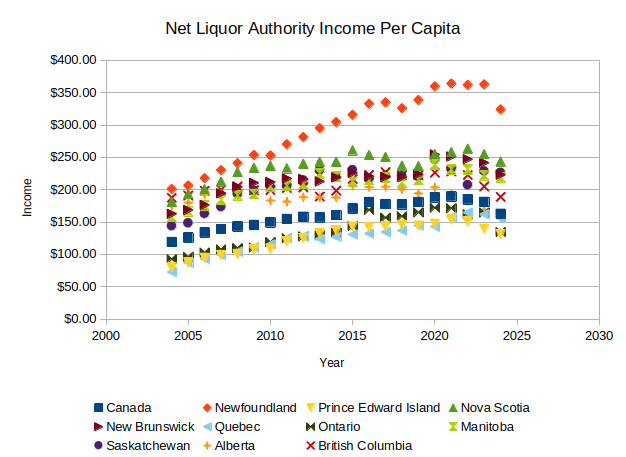
Overall, Canada-wide liquor authority earnings increased between 2004 and 2024 by 36.7 percent. That’s a significantly faster rate of increase than actual alcohol consumption, which increased by just 25.63 percent.
Which is just another way of spelling “tax grab”.
Do Government Controls Over Alcohol Sales Work?

The Government of Ontario created the Liquor Control Board of Ontario (LCBO) all the way back in 1927. The Crown corporation represented a first step away from prohibition: alcohol sales were now legal, but tightly controlled by government regulation.
How Canadian Governments Promote Online Sports Gambling

I used to joke about how lotteries were a tax on people with a poor grasp of the principles governing statistics. Now it seems that legalized online sports gambling is a tax on people who are vulnerable to addiction disorders. And it’s no joke.
Who Regulates the Regulators?

Some of us tend to be deeply suspicious of government regulatory frameworks. There’s generally a non-zero chance they’ll fail to solve the problems they’re targeting and a 100 percent chance they’ll impose expensive restrictions on the free execution of business and life.
Another problem is that higher taxes on the legal product drives people to the illegal tax-free market. This has certainly been the case for tobacco, where some countries, including Canada, are estimated to see 50% illegal sales. We really don’t know the true volume of tobacco use in the country, but we only measure part of it. Ditto for cannabis, where the legal stuff struggles to replace the illegal. In both cases, some argue that the higher cost of the legal stuff reflects better quality control and therefore lower risk to the consumer, but it seems the customers are willing to accept the risk (if any) in exchange for lower prices. And yes, the government established price is a money grab, well beyond the true cost of regulating the manufacture and distribution.
Revenue from gambling taxes is derived from a very disturbing source. In my opinion all ads for gambling, similar to any form of advertising for tobacco, should be banned on the grounds that gambling is a malicious vice dangerous to mental health and financial well being.