

Kids today…
Actually this isn’t going to one of those posts. Although I can assure you I’ve got more than one of ‘em trapped inside and screaming to come out. Instead, we’re going to talk about some disturbing mental health trends.
A recent report described how around a third of University of California Berkeley law students were claiming accommodation for psychological disabilities. I won’t challenge the need for reasonable accommodation. But the sheer numbers of young people facing mental health challenges are surprising. What’s behind such climbing statistics?
In fact, IPEDS (Integrated Postsecondary Education Data System) data from the U.S. suggests that the “percentage of students with disabilities is inversely related to how elite the higher education setting is”:
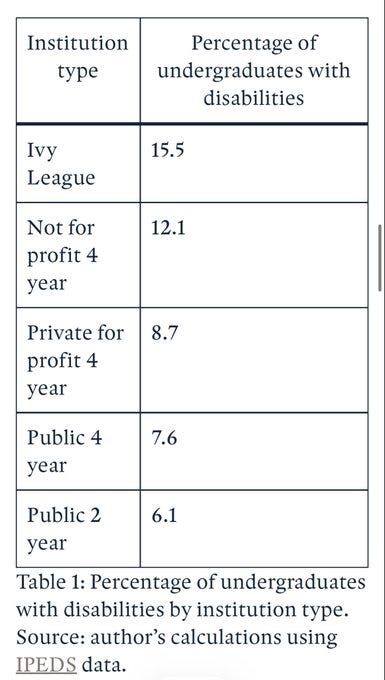
Weird.
Results from the 2021 Canadian Election Study raise similar questions, but aren’t nearly so dramatic. Only 6.7 percent of the general population self-reported as having poor mental health compared to other people their age. But that number jumped to 10.2 percent among students.
Since the 2025 Canadian Election Study (CES) results were just released, we might be able to update our knowledge of what’s going on.
As you might recall from my previous post, back in 2021, 18,073 people placed themselves on a scale where:
“0 means the (political) left and 10 means the right, where would you place yourself on this scale?”
I categorized those submitting between zero and three as “far-left” and those between six and ten as “far-right.” All told, 29.4 percent of respondents were far-right against just 26.1 percent who self-identified as far-left.
By 2025, that had reversed: 27.6 percent leaned left vs 26.1 on the other side. Since I don’t do political punditry, I have no clue what - if anything - that means.
But what I can see is that the previous snapshot showing more self-described mental illness on the political left is now an ongoing trend. Back in 2021, the average right-leaners scored their mental health as 2.02 (where one is “Excellent” and four is “Poor”. left-leaners were a statistically-significant 0.3 points less healthy, at 2.32.
In 2025, those on the right had remained exactly where they were, while those on the left had even worse mental health, averaging 2.36.
That was interesting a few months ago and it’s interesting now. But I suspect the bigger story has nothing to do with politics and - as they seem to have discovered at Berkeley - more to do with age. Young people seem a lot more susceptible to mental illness.
This is a widely documented swing across the Western World. But what the new CES data shows us about Canada is that those whose occupation was reported as “student” suffered such illness at 10.2 percent in 2021 vs a whopping 14.8 percent in 2025. Although I should note that, for some reason, there were considerably fewer people (just 209 in 2025 vs 1,161) answering that question than four years previous.
For context, among all individuals aged 18-25, those reporting poor mental health dropped from 16.3 percent to 14.2 percent in the years since 2021. And those between 26 and 30 with serious mental health concerns fell from 15.4 percent to 12.4 percent.
Trends notwithstanding, all of those are very high numbers. Especially when compered with the 2.3 percent reported in 2025 by individuals listing their occupation as retired.
Are there policy solutions for this problem? Should we be assessing K-12 and post secondary educational systems for complicity? Is it smartphones and screens in general?
I honestly don’t know. And I’m pretty sure no one else does either.1 But I can say that any government intervention restricting digital access will unavoidably end badly for privacy, data security, and free speech. And any attempt to regulate public school teachers and university professors will be overwhelmingly opposed by unions and other entrenched interests.
Besides the suffering caused by mental illness, there are larger demographic consequences in play. The CES 2025 data shows that fertility rates for those who reported poor mental health were significantly lower than national averages.
While around 59 percent of all respondents had one or more children, only 37 percent of those reporting poor mental health had even one child, and only 15 percent had more than two (considered necessary for population replacement.
We might as well also look at the same data through the lens of political leanings. Among those identifying as far left, just 47 percent had at least one child. But 64 percent of those on the far right were parents.
So not only do your mental health and your politics clearly predict your fertility, but (healthy) conservatives are in a better position to both produce and raise future generations of Canadians.
The Canada Health Act May Already Be Dead

I recently came across an argument that the two publicly traded companies, George Weston Limited and its subsidiary Loblaw Companies Limited are becoming so dominant in so many critical sectors - and collaborating so closely with various levels of government - that they’ve become something of a threat to the social order.
The Assault on Professional Competence

According to Statistics Canada, there are nearly 250,000 professional engineers in Canada, along with 350,000 nurses (and allied health professionals), 120,000 physicians (and veterinarians), 105,000 lawyers, and 92,000 therapists.
Ranking Provinces by Mental Wellbeing

Is there a part of the country where people are measurably happier? Is it possible to identify what’s working so we can emulate it elsewhere? Perhaps some Statistics Canada data can help move this important conversation along.
And yes, I am very aware of the good work being done by Jonathan Haidt.
My experience with 22 and 19 year old daughters has been that concepts like trauma and violence are used very loosely by their peers and influencers like educators, who espouse the view that any kind of adversity should be dealt with by retreating to a safe space and or obtaining professional intervention. This sort of learned fragility leads to a lack of resiliency and coping skills, which begets poor mental health outcomes (real or imagined).
Like you, I don't claim to "know" but will toss out a few possibilities:
- Unlike today's kids (as a grandparent it is appalling to me) how free my generation was to not be continually under parental supervision and protection, reflecting a low trust society impeding social development. This alone may be a reason behind increased screen time and social media.
- institutionalized Gender Dysphoria promotion and enabling, including irreversible medical procedures on pre and early teens.
- lack of critical thinking and history in education and instead, cultural Marxism.
- increasing sense of economic hopelessness of a K shaped economy and regulatory stasis, likely gleaned through parents.