

It’s said that spending time in a meat processing plant reduces the likelihood that you’ll eat hot dogs any time soon. Perhaps a look at the way things work in Canadian city councils can have a similar impact on how we think about our local governments.
Take a close look at this image taken the other day in a residential neighborhood in Toronto:
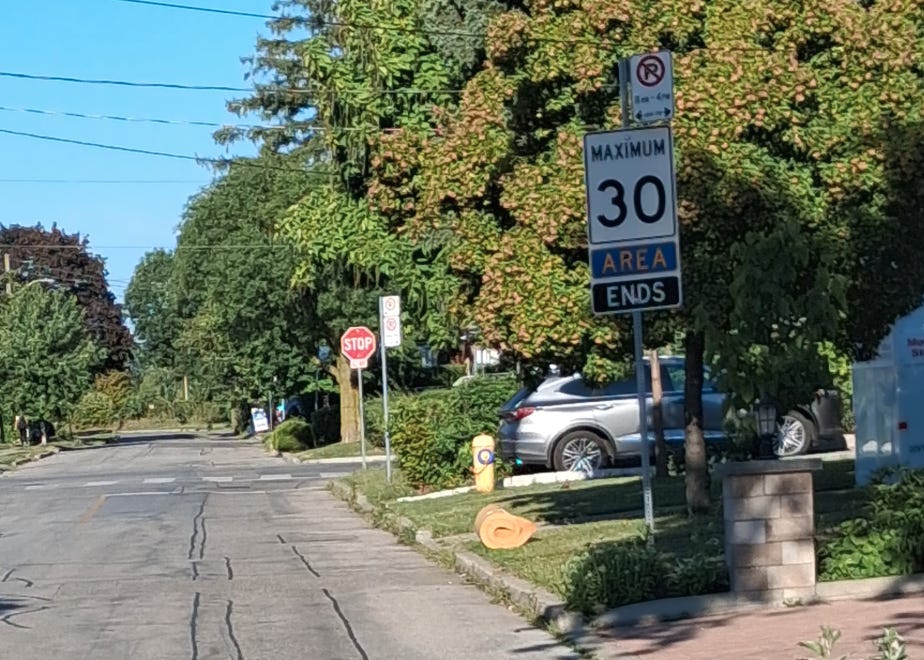
That sign marking the end of the reduced speed zone is just 150 feet from the stop sign. Given that the unposted city limit is 50 km/h, one can’t help wondering:
Whether the laws of physics would even allow such quick acceleration for normal vehicles.
Whether Tesla drivers (who have the hardware to possibly pull it off) would ever want to drive that way.
What city planners were trying to accomplish with the grand effort.
For full context, there’s another “MAXIMUM 30 AREA BEGINS” sign just 150 feet after the stop sign…and just 250 feet before the road veers sharply left, followed soon thereafter by another stop sign.
It gets worse. Think about this picture, taken just a few blocks from the first;
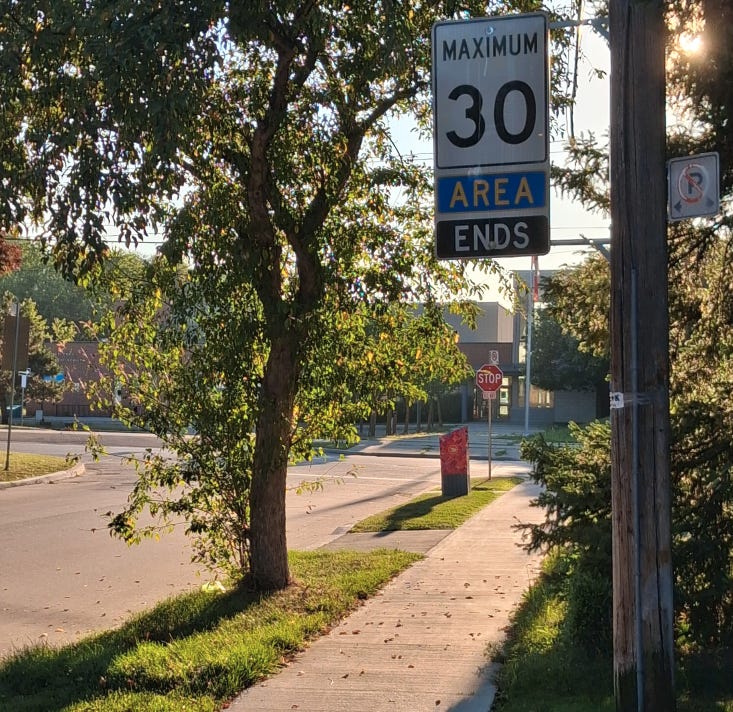
Did you notice the public elementary school just 150 feet past the end of that reduced speed zone. That amounts to an official invitation to accelerate as you approach a place where a few hundred small children regularly gather.
All that isn’t quite as crazy as it seems. Ontario’s Highway Traffic Act sets the default, unposted statutory speed limit for any road within a municipality in Ontario to 50 km/h. Until recently, cities had no legal right to make any changes to those limits. So when Toronto originally decided reduce speeds on residential streets, a simple declaration wasn’t an option: without explicit signage, any new laws would be unenforceable.
Since then, however, the province amended the Highway Traffic Act to permit designated-area speed limits. This happened all the way back in 2017. Which means that the kind of local block-by-block signage you’re seeing in those images is no longer necessary. All Toronto has to do is post area speed limits at neighborhood entrances.
All that sounds like multiple levels of government cooperating with each other to get stuff done. Great. And those signs in my pictures? They’re leftovers from the period between the initial policy decision and 2027. Right?
Wrong. Those signs were actually installed - at great cost - some time in the last couple of years. The reason I know that is because mowing my front lawn was much easier three years ago. And the only thing that’s changed (besides the density of weeds) was the unexpected appearance of one of those signs.
Which means that the city has been implementing an expensive and, in many ways, irrational policy for no good reason. By the time their policy hit my street, they could have just as easily installed a far smaller number of area signs.
My guess is that the team responsible for sending out sign crews has no contact with the office that coordinates with the provincial government. Or, at the very least they’ve had no contact since 2017.
Not inspiring.
Keep reading:
Inside the Quiet Power of the Ontario College of Teachers

As we’ve already discovered, professional regulatory associations are critical parts of any functioning society, but they don’t always deliver ideal results. This post - in what I hope will eventually become a series - will look at another professional group.
How Much Will Your Family Have to Pay for New Municipal Recycling Programs?

I won’t be the first guy you’ll hear complaining about all the money and effort that goes into municipal recycling programs. It sure doesn’t feel like those efforts are accomplishing their goals. Unless, of course, those goals included funding the recycling contractors.
Municipal Planning: Where Housing Policy Hits the Street

Sometimes the general can be understood only by looking at the particular. Ongoing national debates over housing aren’t about Parliament Hill in Ottawa or various provincial legislatures. They’re about homes on streets in actual communities.
Perhaps the section of roadway between "Maximum 30 Area Ends" and the stop sign is intended to be a launch runway for future flying cars. :P
As a former municipal councilor in a small town on Northern Vancouver Island, upon returning from provincial municipal AGMs / conventions, I suffered mental damage lasting several days. These were the farm teams of future senior government Jacobins and Bolsheviks. most had no clue how their own municipal sewage systems worked but "knew" how to save the planet.
Speaking of road signs, Vancouver has recently started replacing signs named after dead white males (the bane of cultural Marxists everywhere) with unpronounceable in any language - script created by academics (with a sadistic sense of humor) a couple of decades ago and foisted off as indigenous writing for people who had no written language until coming into contact with English.