

If, like me, you’ve been mercifully spared direct exposure to the legal system, coming face to face with the costs of typical litigation will be a shock. Hiring a lawyer is pretty much the only cost that’s even theoretically optional, so it makes sense that the budget-conscious will consider going the “self-represented litigant” (SRL) route.
For better or for worse, the numbers of Canadians who choose SRL has been growing for decades. To find out just how much, I used the CanLII database to search all cases across all courts in all provinces for phrases like “self-represented” or “without counsel”. That won’t give me an exact result, but as they say, it’ll be close enough for data. Here’s what I got:
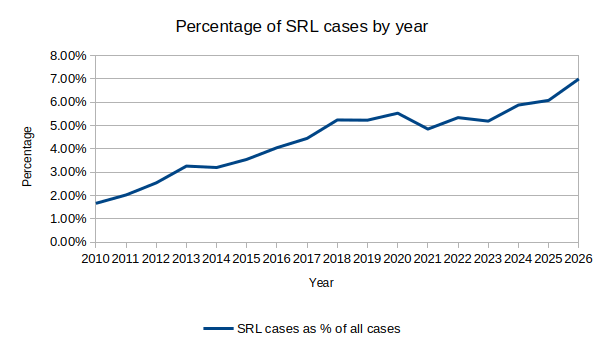
That echoes much more dramatic findings in a Government of Canada report from back in 2016. So we’re on the right track.
As you can see, the percentage of SRL cases has grown from less than two percent to seven percent in just 15 years. So far, I’m not looking at how often AI models are getting involved. But there simply weren’t models even remotely capable of helping before 2020 or so in any case.
We can get some sense of how (un)successful SRLs are in comparison with regular cases by searching for cases whose files included the word “dismissed”. Now I should be careful here, because “dismissed” can have very different meanings depending on context. For someone representing himself in a criminal case, “dismissed” is a great success. But for lawsuits or family law proceedings, it’ll often mean failure.
For this search, I assumed that self-represented criminal cases are relatively rare. In fact, it looks like criminal or statutory infractions generally make up less than two percent of all the cases in the CanLII database, so that’s probably not a bad assumption.
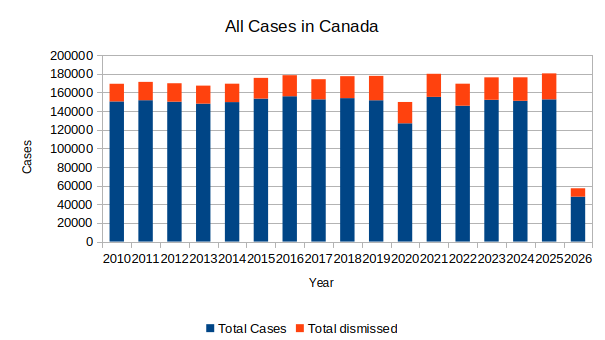
As you can see from the next graph, the total number of dismissals for all cases grew steadily from 12.59 percent to 18.67 percent between 2010 and 2026:
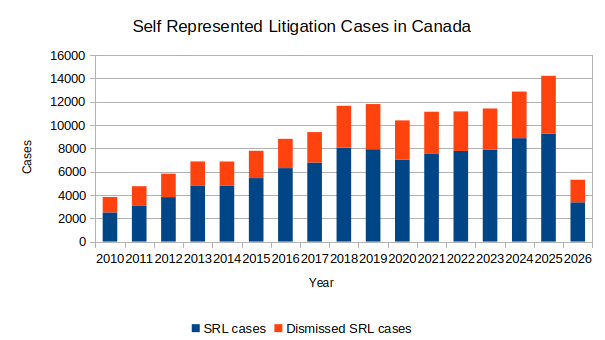
But when I focused on the dismissal rates specifically for SRL cases, success for SRLs was far less frequent (with dismissal rates as high as 57 percent):
To get some idea of how many SRLs are using AI as part of their court preparations, I searched cases with evidence of being SRL and containing phrases like “generative AI” or “artificial intelligence”. This is certainly a crude metric, but it nevertheless shows a clear pattern:
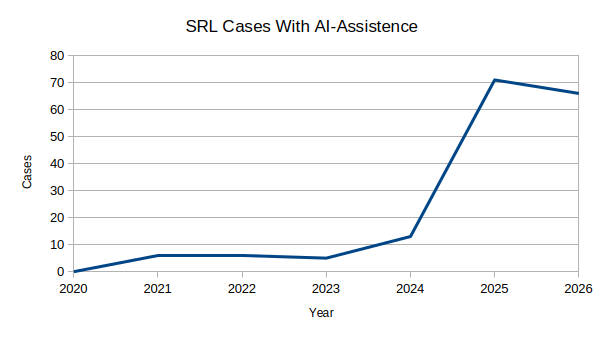
Keep in mind that data from 2026 is obviously incomplete, so the usage rate is definitely still climbing.
If you ask me, once people have made the decision to represent themselves, they’d be negligent in not consulting AI. When it comes to drafting and filing documents and mapping out strategies, I doubt even the most experiences human lawyers can compete with an intelligently-prompted AI.
However, you should never ever rely blindly on an AI for fine details like legal precedent. Too many litigants (not to mention lawyers who should know better) have suffered serious consequences when reprimanded by courts after submitting utter gibberish.
Police vs the Courts

This is one of those posts that start out as one thing and end up somewhere entirely different.
What's Really Going On in Canada's Criminal Courts?

Last week’s post on the disturbing mismatch between Toronto Police Services arrest rates and provincial criminal court caseloads seems to have hit a nerve. Why devote so much funding and manpower to tracking and arresting criminal suspects when you know 95 percent of their cases will never reach trial?
Shifting Incentives in Criminal Courts

The vast majority of violent crimes are apparently committed by a very small number of repeat offenders. Keeping such offenders in prison could sharply reduce violent crime rates. That’s hardly breaking news.
In a civil suit, I used an online site that connected me to a lawyer who walked me through the details of a settlement. Cost less than $100 for the consultation. I can't recall the name of the site, but was a cost-effective way to save money but not make gross errors.