


It’s been a while since I last wrote about higher education in Canada but the industry’s steady clamor for more public funding hasn’t gone anywhere. Universities Canada and the Canadian Association of University Business Officers just released a new report on the desperate state of academic finances.
The industry claims that they’re facing an existential crisis. Although, as I wrote last year, the strength of that claim will largely depend on exactly how you define “crisis”. Long story short: as a rule, universities are among the wealthiest institutions in the country.
Now, you might recall my previous discussion of Universities Canada from the deep, distant past. This time around, they’re highlighting sector-wide revenue losses (via declining government support and sharp reductions in foreign students), aging infrastructure, and rising operating costs.
Those are all very real challenges. But I’m really not convinced that all of the report’s fine details are in especially close contact with reality. Take this whopper:
“By 2040, projections suggest hundreds of thousands of additional students may seek university education.”
Projections! Expert projections! Well then what more is there to say?
Perhaps we could take just a wee peek at how Statistics Canada sees that population-related stuff:
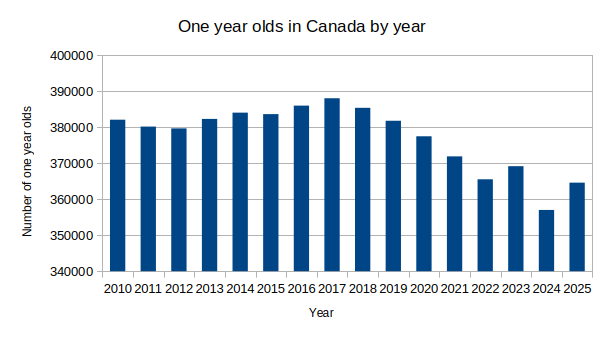
The thing is, for “hundreds of thousands of additional students” to demand an education in 2040, they’ll need to have existed already from 2020 or so. That 2017 “baby boom” you see in the chart above? It represents just 2,300 kids above the 2016 crop. And the odds are those kids will have graduated from university well before we reach 2040. (Unless they come to their senses and choose more direct routes to the career world.)
Perhaps those expert projections are relying on growing immigration rates and expansions to the student visa program. What’s that you say? Those programs have been cut back and there’s no political will to reverse the decision any time soon? Oh. So I guess the projection is just another plain ole’ fashioned higher ed self-own.1
But there’s lots more fun where that came from. Here’s another quote from the report:
“inflation-adjusted public funding declined by 4.6% while enrolment grew by more than 21%.”
Sometimes to ask the question is to answer it.
The report presents those numbers from the perspective of passive victims, as if those two factors lay completely beyond their control. But you could just as easily turn it around and ask why universities decided to permit - and even encourage - out-of-control growth when they knew they couldn’t afford it.
In fact, universities have no mandate to accept everyone who applies. They’ve always set admissions standards based on both student skills and faculty/facility capacity. There was nothing stopping institutions from further tightening their standards so they could remain within their budgets.
Different choices could also have largely prevented other bad outcomes identified in the report:
“A significant share of expenditures — particularly compensation, which accounts for roughly three-quarters of spending — is fixed in the short term, limiting institutions’ ability to adjust.”
But those aren’t really “fixed” costs, are they? Compensation liabilities are products of variables like administration growth, tenure structures, and program duplication. And enrolment. Don’t forget enrolment.
“As government funding declined, universities increasingly relied on tuition revenues to stabilize their finances. However, provincial tuition restrictions have significantly limited this flexibility.”
Besides their desire for more government funding, the report also complains about how mandated tuition ceilings cut off their primary alternative income source. While the basic point is legitimate, it’s presented without critical context.
Raising tuition could, for example, price many students out of the market and actually reduce revenue. The claim also ignores the genuine political and social pressures that led to the tuition ceilings in the first place. The report’s framing fails to acknowledge the damage that could come from lifting the ceilings.
The report also notes the impact of the decline in the number of student visas for issued.
“Early evidence suggests measurable impacts, with international student numbers declining across multiple provinces in 2024-25, in some cases by double digits. This has resulted in significant revenue losses across the country, affecting institutional budgets, program delivery and student services.”
First of all, they’re saying the quiet part out loud: foreign students are actually welcomed by Canadian schools because of the money they bring. It’s not primarily about education at all. But this also suggests that the existing model was never really sustainable. After all, if a university can only survive through such unstable revenue streams, then perhaps its choices weren’t great to begin with.
Finally, the report contains some interesting assumptions about the value of university programs:
“…the economy is being reshaped by artificial intelligence and other advanced technologies. This is increasing demand not only for technical expertise, but also for the research, policy and ethical frameworks needed to guide their responsible use.”
Snark aside, I’m honestly not sure what makes universities uniquely capable of producing the people best qualified to provide the “policy and ethical frameworks needed to guide” the responsible use of AI.
Sure, cutting edge AI research can’t happen without knowledge of cutting edge physics, mathematics, and engineering. But policy and - especially - ethics? Those domains aren’t built on formal curricula. I have no idea how one should go about training effective and trustworthy ethicists, but I don’t think universities have earned any kind of monopoly on their production.
Keep reading:
How Wealthy Are Canadian Universities?

Between rising costs, federal and provincial funding cutbacks, dropping immigration quotas, and declining school-aged populations, Canada’s universities are racing headlong into a devastating financial crisis.
Inside the Quiet Power of the Ontario College of Teachers

As we’ve already discovered, professional regulatory associations are critical parts of any functioning society, but they don’t always deliver ideal results. This post - in what I hope will eventually become a series - will look at another professional group.
I think there’s a pattern here. My previous reading of a Universities Canada’s report also came up against some wild claims based on seriously bad math.
Key Findings on Administrative Cost Increases (as of 2025/2026):
Top 25 University Trend: At Canada’s Top 25 universities, "Other Salaries & Wages in Central Administration" surged by 175% since 2001 and by 52% since 2010 (adjusted for inflation).
Administration vs. Instruction: Expenditure on Central Administration has grown at roughly double the rate of instruction costs (40% vs. 22%) at the top 25 universities since 2011.
Rising Costs Per Faculty Dollar: Across the top 25 universities, the cost of administrative support rose from 51.1 cents per dollar of faculty salaries in 2010 to 59.7 cents in 2024.
Specific Examples:
Research has shown administrative positions growing at high rates, such as a 73% increase in administrative positions at several Nova Scotia universities over ten years, compared to just 5% faculty growth.
Recent Trends: Between 2016 and 2022, spending on "Administration" nationwide grew by 15 percent.
Universities are now (un-manageable?) state appendages captured by guild socialism, cultural Marxism, and its various pathologies such as DEI, ESG, CRT, and of course, the indigenous grievance industry. The humanities faculties should have been replaced with library cards well before the internet which could replace almost everything else. Why should mediocrity be replicated in medieval lecture theatres at numerous institutions when the best of the best could be put online at a small fraction of the cost. The professions should be liberated from their state monopoly right to practice guilds allowing competing non-state-corrupted governing bodies to offer quality in practitioners within the free marketpllace. One look at the numbers of current administrators to students ratio should answer the question of the viability of potential private and or non-profit alternative viability.