

I’ve previously written about measurable declines in institutional trust among Canadians. Not only are Canadians far less likely to find governments and media providers reliable, but there’s a growing sense that authorities of one sort or another aren’t even interested in serving us.
If major international measures of corruption are any indication, Canadians are justified in their mistrust. The Corruption Perceptions Index (CPI) published by Transparency International combines assessments from multiple organizations, including the Worldwide Governance Indicators of the World Bank, the Economist Intelligence Unit, and the World Economic Forum’s Executive Opinion Survey.
Those assessments are designed to measure countries’ susceptibility to bribery, diversion of public funds, use of public office for private gain, and the relative effectiveness of their anti-corruption enforcement.
The numbers aren’t direct representations of corruption. Instead, they’re useful proxies for how well societies are working and how they’re changing. Here are Canada’s CPI scores since 2012 (higher scores indicate less corruption):
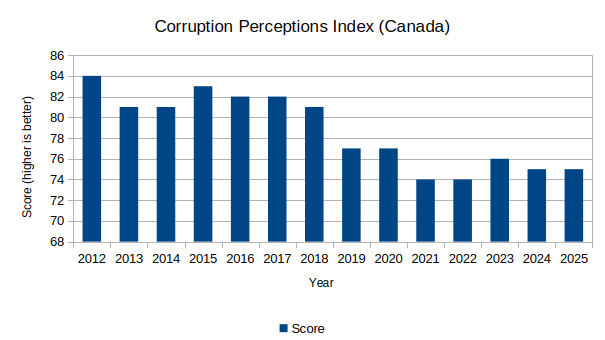
The steady decline is obvious. For context, Canada’s international CPI ranking fell from ninth place in 2012 to 16th in 2025. So the decline isn’t just following along with a global phenomenon. In fact, according to Transparency International’s notes, “31 countries have significantly reduced their corruption levels since 2012.”
I created my own index that included Canada’s CPI scores, but also the Basel Anti–Money Laundering (AML) Index, IMF / Schneider “shadow economy” estimates, changes to Canadian government lobbying intensity numbers, and an incomplete tracking of the number of flags reported by the Auditor General.
Let me just explain that lobbying intensity metric. Numbers from the official Registry of Lobbyists show that the number of federal lobbyists has grown from 16.14 per 100,000 in 2020 to 20.33 per 100,000 in 2026. That doesn’t prove the presence of corruption, but it does suggest that professional activists and corporate interests have increased the volume of their voices inside government - at the expense of the rest of us. I’ve written previously about the impact of lobbying and related industries.
After normalizing all those values, here’s how my full index looked. In this case, the higher the score, the greater the measure of corruption.
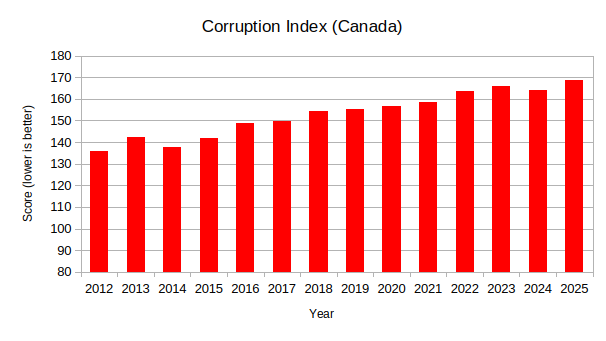
While it’s pretty clear that things are moving in the wrong direction, we shouldn’t take those charts too seriously. After all, they’re just abstract numbers.
If you’d ask journalist Sam Cooper of The Bureau, he’d probably tell you that the real measure of corruption is in how many Canadian politicians (and parties) are “owned” by the Chinese Communist Party, how deeply our real estate and banking industries are controlled by organized crime cartels and their drug trade, and how many Canadians are harassed or even murdered by foreign threat actors willfully ignored by Canadian law enforcement agencies.
Others would point to claims that unaddressed conflicts of interest between Mark Carney and his financial entanglements are unduly influencing policy. I haven’t personally seen proof that such conflicts have ever been exploited. I’m not even sure how I’d go about looking for evidence. But the perception that there’s a problem would certainly demand some transparency and at least a robust official response.
In a way, that’s the story behind so much of public life in Canada. Stuff just happens and none of us ever finds out whether it was by design or innocent accident. And then other stuff happens and the first stuff just disappears under the radar.
Don’t stop here:
The End of Institutional Trust?

A delicate and unspoken contract between governments and their people seems to be breaking. Justified or not, millions of citizens in Western countries are convinced that their governments are driven by incentives unconnected from the public good. With their wealth, communities, and lifestyles crumbling around them, individuals increasingly see themselv…
Can We Finally Talk About United Nations Funding?

No area touched by government policy should be off-limits for open discussion. It’s our money, after all, and we have the right to wonder how it’s being spent. Nevertheless, there’s no shortage of topics that, well, aren’t appreciated in more polite company. Until quite recently, I somehow assumed that Canada’s commitments to the United Nations and its …
What Happens When Ministries Go Rogue?

This is an older (and longer) version of an article just published by the Macdonald-Laurier Institute.
When I think of corruption in Canada not only do I wonder about the influence of foreign agencies in particular the CCP but I also wonder about all the tax dollars that government has delivered into the hands of FNs. They both concern me as the potential for corruption is huge and largely unexplored and unexposed. I can’t help but believe it exists though.
I would equate corruption with the growth of leviathan in size and scope. The state has a monopoly in the use of force in society. We have moved from a government that was relatively permissive in allowing economic growth and cultural development to one that is obstructionist and culturally nihilistic reflecting the evolution of a complex of Orwellian named NGOs with incestuous links to the state and a necessity of cronyism in what remains of a market economy. Rent seeking has replaced competitive advantage in business schools as the level of statism now is roughly equal parts socialism and fascism. When the only free market is increasingly the underground economy, where else would the corruption meter go.
“Government is not reason; it is not eloquence. It is force. And force, like fire, is a dangerous servant and a fearful master.”―George Washington