

Matt Gurney recently suggested that growing numbers of wealthy Canadians are “stealth emigrating”. In other words, despairing of domestic prospects, they’re using their resources to quietly move as much of their money and property as possible out of the country. That way, they’re reducing their exposure to heavy tax loads, unpredictable social policies, and growing crime - all while preparing new homes elsewhere in case they become necessary.
Gurney admitted that there isn’t any hard data confirming these trends. But this is something he’s hearing from his contacts. The truth is that even I’ve been throwing around the idea of packing up for some time now. I mentioned it to my lawyer last week and he replied “Well we’re all thinking about that.”
But none of that qualifies as reliable population-level evidence. Gurney did point to disturbing net business formation numbers as a possible indicator. Indeed, according to Statistics Canada, business exits (i.e., businesses that stopped paying employees) have outnumbered business entries (new business that employ at least one person) each and every month since November 2023. As you can see from this chart, that’s a very unusual trend:
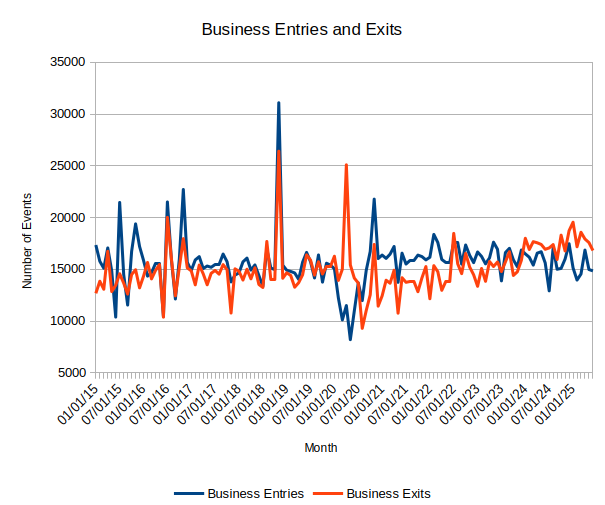
With the brief exception of the first months of the COVID craziness, business entries (blue) have pretty much always outnumbered exits (red)…until mid-2023. Whether thousands of rich Canadians are gradually pulling out or actually placing for-sale signs on their lawns, you’d expect to see more business exits. And we’re definitely seeing them at historic levels.
However there’s something else you’d expect a mass wealth exodus to produce: fewer high-income taxpayers. In fact, according to Individual Income Tax Return Statistics from the Canada Revenue Agency, the exact opposite has been happening. Well, that would be true at least until the 2024 tax year. More recent data isn’t yet available.
That tax data for just Ontario shows us that there were 265,950 taxpayers reporting income of at least $250,000 in 2024, compared with just 232,430 in 2023, 214,750 in 2022, and 105,550 back in 2014. Those increases outran both inflation and population growth.
Specifically, between 2023 and 2024, the number of high earners in Ontario increased by 14.42 percent. During that time, the province’s population “only” grew by 3.28 percent, and the inflation rate was around three percent.
It’s possible that rich Canadians are leaving the country and they’re being replaced by a steady flow of nouveau riche. But frankly that’s unlikely. It’s also possible that 2025 data might show a significant downward trend. I’ll keep an eye out for updates.
There’s more great stuff where that came from:
Have We Lost the Ability to Build Infrastructure?

The Empire State Building was, for its time, monumental. The New York landmark may not be such a big deal these days, but its construction history in often invoked as a sign that we’ve lost the capacity to do big stuff.
How Stable Are Canada's Commercial Lending Institutions?

In the not too distant past, Canada’s banking system was widely admired for its stability. While things aren’t necessarily quite so happy these days, the industry as a whole currently contributes around 3.5 percent of our national GDP. I thought I’d take a quick look at how secure our wealth and property really are in the hands of modern Canadian financ…
Who Owns Canada's Public Debt?

During his recent election campaign, Mark Carney announced plans to add $225 billion (with a “b”) to federal debt over the next four years. That, to put it mildly, is a consequential number. I thought it would be useful to put it into context, both in terms of our existing debt, and of some social and political changes those plans could spark.
The growth of the number of incomes over $250K leads me to ask how many of those are bureaucrats? With the explosion of bureaucracy I predict that the upper management have been duly compensated.
Thanks again very much for the statistically-driven analysis.