

Parliament's Standing Committee on Citizenship and Immigration recently met to discuss the topic of reallocating asylum seekers between provinces to address the disproportional costs faced by just a few cities and provinces. To be honest, the only reason I’m even aware of that meeting is because I was invited to testify.
Should you be so inclined you can view a recording of the session here. My first appearance happens at the 12:23 mark.
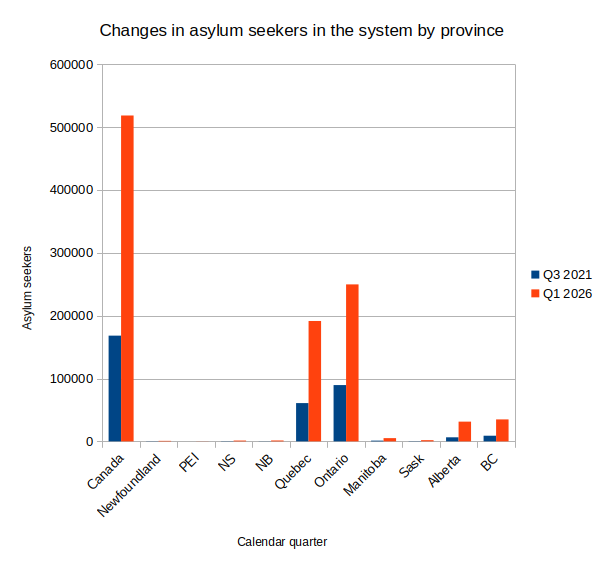
The problems being discussed are real. Nation-wide, the number of asylum seekers who are stuck somewhere in the review system grew from 168,206 in Q3 2021 to 518,489 in Q1 2026. That’s a change of 208 percent. But the change wasn’t uniform throughout the country.
Since most of the overall growth was concentrated in Quebec and Ontario, those provinces are the most visible in this chart. But they actually grew by just 214 percent and 178 percent respectively.
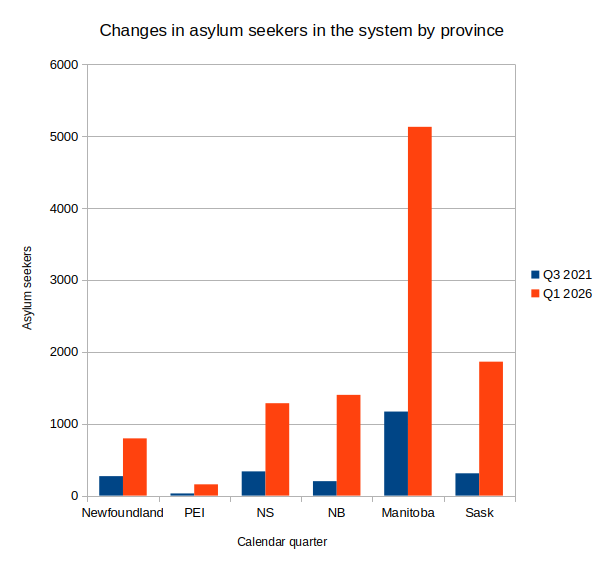
What you can’t see there is the impact on some smaller provinces. However when I remove Canada and the larger provinces from the chart, it’s now possible to see that refugee populations in New Brunswick (597 percent) and Saskatchewan (501 percent) grew far faster than the others. And, in the context of their population, Manitoba is certainly not facing negligible raw numbers.
We can get a sense of how mobile refugee populations are from Statistics Canada data that tracks refugee tax filers between provinces in the years after their admission.
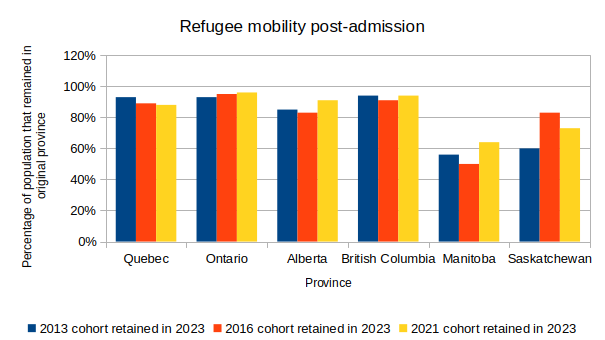
Manitoba loses the highest percentage of their refugee population over time. But overall, the numbers are fairly stable: around 85 percent of new permanent residents tend to stay in their original province.
Those refugees who did leave their “province of admission” were most likely to head west to Alberta. Although, as I’ve previously written, that’s also been the story for many Canadian citizens.

What does all this look like at street level? As of January 2026, there were 3,874 refugee claimants in Toronto shelters - representing 39 percent of all homeless shelter occupants in the city. That’s placing a serious strain on municipal and provincial budgets. But a lot of the costs are indirectly shifted to the federal government, which has spent $1.5–1.7B through the Interim Housing Assistance Program (IHAP), $1.1–1.2B on federally funded hotels, and nearly $900M annually on interim healthcare coverage.
Beyond simple shelter, the crisis is also impacting local social assistance agencies, schools, legal aid, and policing programs.
By far the largest contributor to the scale of the problem is administrative backlogs at the Immigration Refugee Board (IRB). I’ve discussed this already on The Audit:
There are at most 700 or so members of the Immigration Refugee Board (IRB) to screen applicants and around 100 federal judges available to hear judicial reviews…The fact that the IRB faces an impossible task introduces serious real-world consequences…Why the government originally thought it was a good idea to encourage refugee applications at a scale far beyond any realistic ability to manage them is a mystery for the ages.
As I noted in that post, adding more judges would speed up the process. But addressing the serious claims of a whistleblower from inside the agency and tightening up a culture that rewards rubber-stamped approvals would slow it back down again.
Jump-starting the IRB resolution workflow to quickly process those 500,000 pending applications is definitely the most effective single action the government could take. I would be surprised if IRB wasn’t already using AI models to instantly flag cases (for human review) that will likely be either successful or unsuccessful. That’s the thing about AI: it doesn’t get scared by big numbers, and it sees details and patterns humans will miss.
Another task that could be assigned to AI models is to identify applicants with professional credentials. Various levels of government have already claimed to be prioritizing wider recognition of in-demand foreign credentials. Results of those efforts could easily be matched to records in existing IRB databases. (Or, at the very least, failure could deeply embarrass the politicians - and professional colleges - who are responsible for the delays.)
One more thought. As at least a couple of witnesses in that committee session noted, moving claimants from urban shelters and street encampments to permanently funded reception centres (or dorms) can go a long way to both relieve municipal infrastructure and speed up the resolution process. And they could also save money and protect claimant welfare.
Such centres - which have been used in European countries like Germany and the Netherlands - could be expanded to welcome other claimants beyond those suffering from homelessness. One important attraction could be proximity to healthcare, social services, and even purpose-built IRB facilities.
The government is facing serious pressure - mostly resulting from its own awful policy choices. But at least they’re now asking the right questions. I’ll wait for the committee’s final report to Parliament to see whether anything productive comes out of these consultations.
Keep reading:
What Do MPs Actually Do in Committee?

While the comical obstruction and general silliness of Question Period might get most of the public’s attention, much of the real business of the House happens in parliamentary committees. And the formal output of that work can be found in the many reports presented to the House.
Are Parliamentary Committees Underachieving?

We can be forgiven for assuming that the Canadian government exists to spit out legislation that’s poorly planned, overtly political, and often legally dubious.
What Drives Canada's Immigration Policies?

Popular opposition to indiscriminate immigration has been significant and growing in many Western countries. Few in Canada deny our need for more skilled workers, and I think most of us are happy we’re providing a sanctuary for refugees escaping verifiable violence and oppression. We’re also likely united in our support for decent, hard working economic immigrants looking for better lives. But a half million new Canadians a year is widely seen as irresponsible.
Before the evolution of the welfare state, immigration didn't seem excessive nor as troublesome despite years of high immigration. In the long run you can only have one of either open borders (recent levels of immigration) or a welfare state.