

Whenever I read journalism that invokes “experts say” as an authoritative source - especially if they don’t accompany the term with names and credentials - my eyes involuntarily roll. Come on. If there’s substance to your claim, then let me see it. But don’t expect me to trust you.
Now that I have access to the archival resources of the Media Cloud project, I can easily track how much Canadian media outlets have been relying on this cheap (and often dishonest) crutch over time. And boy, does it get nasty.
To see how the market looks, I pulled data for five top-tier mainstream Canadian news publishers since 2008: CBC, CTV News, Global News, the Globe and Mail, and the Toronto Star. Media Cloud doesn’t have reliable data for the National Post.
This graph represents the percentage of total monthly articles in the dataset that contained at least one instance of the word “experts”.
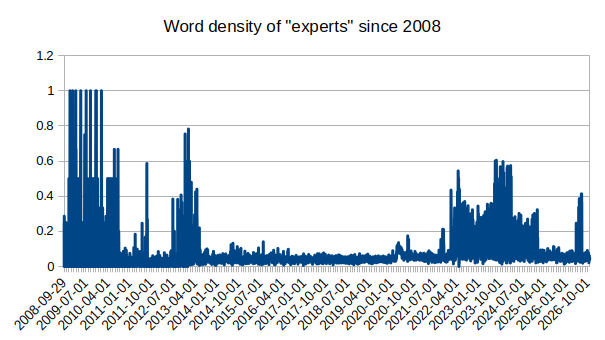
We should probably disregard the very high usage density through the first few years of data. That’s because there were far fewer total articles collected through that time, so the percentages are probably not statistically reliable.
However, between 2020 and 2024 the denominators (i.e., the numbers of total articles in the archive) were high, and yet the density was also consistently high - upwards of six percent. We could at least partially explain 2020-2021 by recalling media attempts to justify government COVID policies in the face of public push back. Shifting policy origins to unnamed “experts” could suggest leave an impression of extra authority.
But what explains 2022-2024? The question is particularly strong because the increase begins abruptly in March 2022, persists throughout 2023 and 2024, and then largely disappears in February 2025 - falling from 11.7 percent to 5.1 percent by March. What was going on through that time?
The uptick could be partly associated with technical challenges Media Cloud was facing with their data collection. The problem there is that the elevated numbers we’re seeing continue long past Media Cloud’s problem resolution.
The uncharitable explanation would be that lazy journalists and editors came to enjoy the easy power that came from invoking “experts” during COVID. It sure beats doing real fact checking and research.
On the other hand, the charitable explanation is…well, I have no clue what it would be. Perhaps you have ideas you can share in the comments.
Either way, from 2025, the incidents of “experts” dropped back to earlier rates. Were internal memos warning that it was only a matter of time before Clinton at The Audit caught on to the game?
One thing I can say is that none of those five outlets has been shy about invoking experts. CTV News is obvious the most serious offender (the word showed up in nearly one of every five of their articles). But as you can see, the practice is fairly widespread:
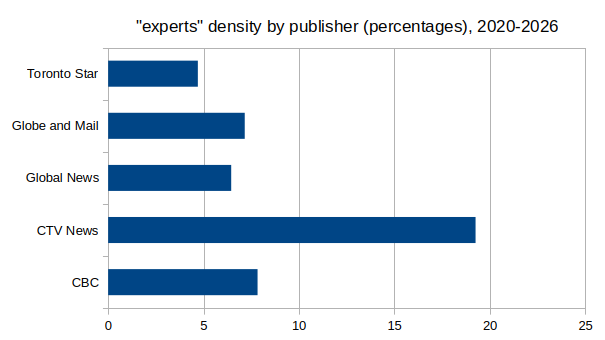
What about peer organizations? Using the limited data (available only up to February 2023), I discovered that the National Post’s density was 4.22 percent, the Ottawa Citizen was 4.6, and the Toronto Sun went for experts only 3.49 percent of the time.
Internationally, the BBC - perhaps because of the sheer scope of their coverage - came in at just 1.93 percent between 2020 and 2026. At the other end of the scale, the New York Times relied on experts 11.78 percent of the time. The Times of London scored 4.6 and the LA Times 7.6.
It’s obvious that there are legitimate reasons to use the word “experts” in journalism. “The minister committed to rejecting the use of outside experts in government decision making” would be one (theoretical) example.
But I can’t help imagining that such justified usage makes up only a tiny minority of what’s out there. Feel free to use this Google search: experts site:thestar.com for evidence.
Does Democracy Need a Healthy Traditional News Media?

I often hear people saying that a "healthy news media industry enhances democracy”. But is there any objective way to measure what "healthy" means, what "enhancing democracy" means, and whether the two are actually correlated?
Is Updating a Few Thousand Readers Worth a Half Million Taxpayer Dollars?

Plenty has been written about the many difficulties faced by legacy news media operations. You might even recall reading about the troubled CBC and the Liberal government’s ill-fated Online News Act in these very pages. Traditional subscription and broadcast models are drying up, and on-line ad-based revenues are in sharp decline.
The End of Institutional Trust?

A delicate and unspoken contract between governments and their people seems to be breaking. Justified or not, millions of citizens in Western countries are convinced that their governments are driven by incentives unconnected from the public good. With their wealth, communities, and lifestyles crumbling around them, individuals increasingly see themselv…