

People haven’t been thinking about this stuff for decades. But now they’re talking about a possible Parti Quebecois sweep in the next provincial election - and of a third referendum that would follow.
So what might a nine-province electoral map look like in 2026? That, of course, would depend on a number of fascinating variables. Here’s how my AI buddy saw a number of ways that it all might play out in the context of a re-imagined 2025 federal election:
This is speculative, but we can base it on the actual results by province and seat-allocation rules.
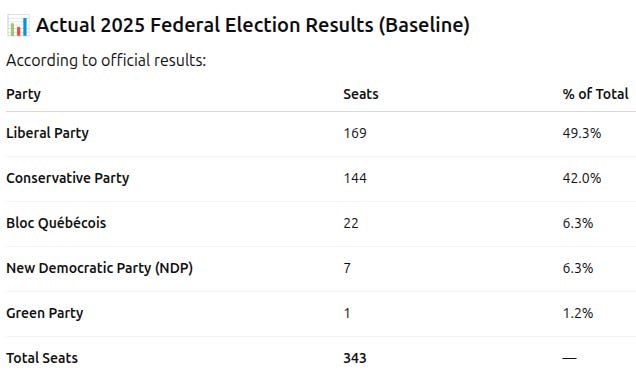
🎯 Step 1 — Remove Quebec Seats
With Quebec seceded:
Quebec’s 78 seats are removed from the House of Commons.
The new hypothetical total would be 343 − 78 = 265 seats.
This assumes that none of the Quebec seats are redistributed pro-rata to other provinces and that they are simply removed from the parliament.
🗳️ Step 2 — Reassign National Seat Results (Ex-Quebec)
We need to approximate how the remaining 265 seats would be distributed among parties. A reasonable approach is:
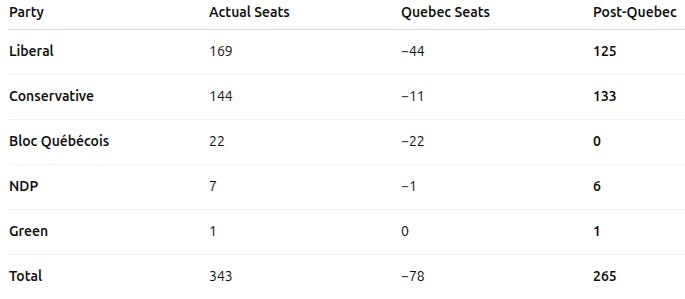
Remove all Quebec seats from each party’s total
Liberals in Quebec: 44 seats
Conservatives in Quebec: 11 seats
Bloc Québécois: All 22 seats (Bloc only runs in Quebec)
NDP in Quebec: 1 seat
Subtract these from the national totals:
🧮 Step 3 — New Majority Threshold
In a 265-seat parliament:
A majority would require 133 seats or more (half + 1).
🧠 Step 4 — Interpret the Hypothetical Outcome
🟦 Conservative Party
With 133 seats, the Conservatives would meet the new majority threshold in this Quebec-free scenario.
Conservatives: 133 seats → Majority (133/265 seats).
Their share of seats among the remaining provinces becomes ~50%.
🟥 Liberal Party
The Liberals would have 125 seats, falling short of a majority:
Liberals: 125 seats → Minority (≈47% of seats).
🟧 NDP & Greens
NDP: 6 seats, still a small caucus.
Greens: 1 seat.
🟪 Bloc Québécois
With Quebec gone, the Bloc would have no federal representation (zero seats), eliminating it from the Commons.
🧩 Important Notes & Assumptions
⚠️ This is a simplified counterfactual that assumes:
Seats are removed, not redistributed proportionally. In reality, if the House of Commons were rebalanced after a province secedes, other provinces might gain seats.
Voters in Quebec do not vote in other provincial jurisdictions; no vote migration is modeled.
Party vote shares outside Quebec remain exactly the same as in the actual 2025 results.
These assumptions are necessary to make a clear comparison based on available data but mean this scenario is illustrative rather than predictive.
I can also model what the popular vote share would look like excluding Quebec, or how different redistribution rules (e.g., shifting Quebec’s seats to other provinces) would change the outcome.
To do this responsibly, I’ll turn the exercise into explicit models, rather than asserting a single “answer.” That lets you see how different assumptions drive different outcomes—and avoids pretending there’s one correct counterfactual.
Model 1 — Seat Redistribution (No Vote Migration)
This asks: What if Parliament kept roughly the same size by reallocating Quebec’s seats to other provinces?
Assumption set
Quebec’s 78 seats are redistributed proportionally to population among remaining provinces
Party performance in each province remains exactly as observed
First-past-the-post distortions remain
Step 1: New House size
Two realistic options:
Option 1A — Keep 343 seats
All 78 Quebec seats are redistributed.
Option 1B — Partial shrink
House reduced but not fully: e.g. 310 seats (common in comparative federations)
I’ll model Option 1A (343 seats) since it’s cleaner.
Likely seat recipients
Most redistributed seats would go to:
Ontario
Alberta
British Columbia
Fast-growing Atlantic ridings
These are Conservative-leaning under FPTP, especially Alberta and rural Ontario.
Conservative advantage mechanism
Conservatives already win many ridings by large margins
Additional seats tend to be created in high-growth suburban/exurban areas
Liberals are more vote-efficient nationally, but less so without Quebec
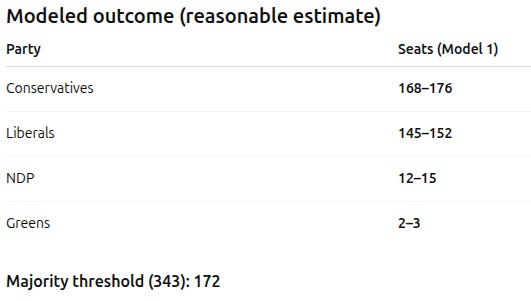
Interpretation
Conservatives likely win a clear majority, not just a technical one
Liberals improve seat count but lose relative leverage
NDP benefits slightly from urban redistribution but not enough to matter
Model 2 — Vote Migration (Psychological & Strategic Effects)
Now we allow voters to react to Quebec’s departure.
This is the most politically realistic scenario.
Key behavioral shifts to model
1. Liberal coalition fracture
Without Quebec:
The Liberals lose their national unity / brokerage identity
Western and Atlantic Liberal voters become more elastic
Some strategic Liberal voters defect to NDP or Conservatives
2. Conservative consolidation
Federalism question disappears
Conservative messaging simplifies
Higher turnout efficiency in Ontario & Prairies
3. NDP vote recovery
Quebec had suppressed NDP strength post-2011
Urban progressive votes outside Quebec consolidate more clearly
Vote-swing assumptions (modest, not extreme)
Outside Quebec:
Liberals: −2.5% to −4% vote share
Conservatives: +1.5% to +2.5%
NDP: +1% to +2%
Greens: flat
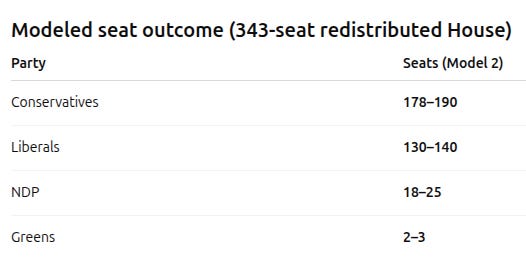
Interpretation
Conservatives win a strong majority
Liberals lose official-opposition dominance in narrative terms
NDP regains relevance but remains structurally capped by FPTP
Model 3 — Constitutional Shock Scenario
This is the high-impact counterfactual.
Assumptions
Quebec secession causes:
Short-term economic uncertainty
Federal institutional renegotiation
National identity shock
Election becomes a stability vs change referendum
Voter reaction pattern (historically consistent)
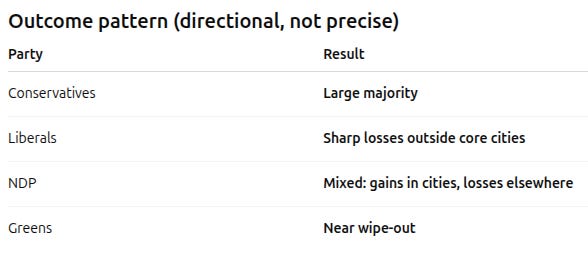
Risk-averse voters consolidate around a single governing alternative
Smaller parties get squeezed
This mirrors:
UK post-Scottish referendum effects (2015)
Spain post-Catalonia crisis
Canada itself post-1995 referendum dynamics
You might also like these:
Is Canada's Federation Fair?

You’ll need to search long and hard to find a Canadian unwilling to help those less fortunate. And, so long as we identify as members of one nation, that feeling stretches from coast to coast.
What Inter-Provincial Migration Trends Can Tell Us About Good Governance

Government policies have consequences. Among them is the possibility that they might so annoy the locals that people actually get up and head for the exit. Given how parting can be such sweet sorrow (and how it’s a pain to lose out on all that revenue from provincial income, property, and sales tax), legislatures generally prefer to keep their citizens …
Ranking Provinces by Mental Wellbeing

Is there a part of the country where people are measurably happier? Is it possible to identify what’s working so we can emulate it elsewhere? Perhaps some Statistics Canada data can help move this important conversation along.
Highly informative, David.
Like many Canadians, I have considered a post-separation landscape and, quite frankly, I cannot come to a definitive interpretation of what such a situation might look like. You have helped expand my thought process.
One of the things that you don't seem to model - and, I don't think that it is possible - is that we on the Prairies (I live in Alberta) have since time immemorial been highly "suspicious" of the centralization of political power in Upper and Lower Canada [I use the old names to indicate how long we have been "suspicious"]. [Further, the word "suspicious" is simply a far, far, far too polite replacement for how we really feel.]
Over the years as we have had this post Quebec thought thingy, it has become clear that to simply keep the same process, etc. for a post Quebec House of Commons would result in MORE relative power for Upper Canada than was had by the Upper/Lower Canada compact. For that reason, I suggest that we in the regions might well be unwilling to accept such a simplistic re-working and would insist on a thorough re-thinking of how things work. That insistence on thorough re-thinking might itself lead to further departures. And so on and so forth.
Nonetheless, an interesting and worthwhile thought exercise.