

The question in the post title is technically misleading. Does licensing restrict access to employment? Of course it does. That’s kind of the point. But we should really be asking these two questions:
Is that a bad thing?
Is the licensing system unbalanced?
Anyone (like me) who’s generally suspicious of government regulatory overreach will instinctively assume we’d benefit from truly open markets. But let’s see what we can actually discover.
Using the Canadian Information Centre for International Credentials (CICIC) database, I selected those occupations - including Red Seal trades - where credentials of some sort provided an exclusive right to practice. That gave me around 85 employment categories. I then manually mapped that list against Statistics Canada’s Labour force characteristics by occupation table.
My mapping was far from precise. The CICIC occupation designations - that were specific to five-digit National Occupational Classification (NOC) codes - didn’t always correlate precisely with Statistics Canada’s designations that used just two or three digits. So there will be occupations that’ll be either over or underrepresented. But at least the vagueness is consistent across the dataset, so it should at least be useful for spotting trends.
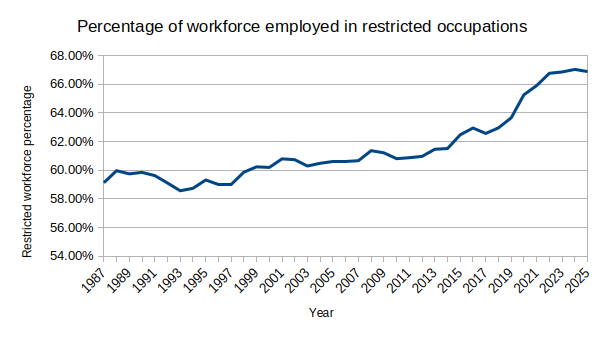
By my estimate there were 7,998,100 Canadians employed in restricted occupations of one kind or another in 1987. The total employment pool that year consisted of 13,526,000 workers. So in that year, 59.13 percent of all workers required some kind of license to perform their work.
By 2025, that number climbed to 66.89 percent (15.1 million licensed workers out of a total of 22.6 million). This graph shows how steadily the portion of the workforce employed in restricted occupations increased since 1987:
Predictably, some categories grew faster than others. The number of Canadians employed in “Professional occupations in applied sciences (excluding engineering)” increased by 516 percent between 1987 and 2025. Through those same years, “Therapy and assessment professionals” increased by 324 percent.
At the other end of the spectrum, the “Supervisors, central control and process operators in processing, manufacturing and utilities and aircraft assemblers and inspectors” category grew by just 17.6 percent - far slower than the growth of the general population.
Still, the case for attributing all that growth to out-of-control occupational regulatory bloat isn’t a slam dunk. For one thing, many - if not most - of the restrictions are perfectly appropriate. I wouldn’t be comfortable flying in a commercial jet being piloted by a teenage hobbyist. And some of the data trends we’re seeing are no doubt the result of an evolving economy (explaining the rise in licensed healthcare professionals) and our increasing reliance on technology (explaining the decline in manual trades).
The truth is that the data we’re using right now isn’t detailed enough to give us as much clarity as we’d prefer. A 2020 study by the CD Howe Institute did discover that increasing occupational regulations leads to higher costs for consumers. And it doesn’t take a think tank study to understand that adding new certification and training requirements creates new barriers to entry for potential workers.
But the data we’ve got access to right now isn’t enough to confidently say that governments and regulators are, as a group, causing economic damage. Right now, in fact, I can’t find anything specific to criticize.
Nevertheless, there are some restricted occupations whose existing restrictions are difficult to justify. Those include:
Hairstylists
Real estate agents
Accountants (CPAs - although auditors should be licensed)
Massage therapists
Kinesiologists
HR professionals
Where there’s abuse in such fields, the bad guys are mostly governing colleges and associations that seem to exist more to guarantee higher pay for existing members than to protect and serve customers.
Why Is Skilled Trades Ontario Making So Many People Angry?

This is another post in our series on regulators in Canada.
Who Regulates the Regulators?

Some of us tend to be deeply suspicious of government regulatory frameworks. There’s generally a non-zero chance they’ll fail to solve the problems they’re targeting and a 100 percent chance they’ll impose expensive restrictions on the free execution of business and life.
Inside the Quiet Power of the Ontario College of Teachers

As we’ve already discovered, professional regulatory associations are critical parts of any functioning society, but they don’t always deliver ideal results. This post - in what I hope will eventually become a series - will look at another professional group.
I've been cutting and styling my own hair* for 30 years without a license. Still have both ears. No permanent disfigurements. Hairstylisting as a red seal trade is absurd.
* shaving my head twice a week