

Here’s something I absolutely did not see coming.
Like it or not, the world is going digital. More and more categories of financial transactions are already electronic-only. And it’s not just your mortgage payments. Cash is increasingly not welcome when paying for things like parking, restaurant meals, Uber rides, sports events, and city services.
You may laugh, but I’ll often go months at a time without even touching notes or coins.
With so little currency in active use, I would have expected that the volume of Canadian cash in circulation would have dropped noticeably in recent years. But I would most definitely have been wrong. Very wrong.
This chart represents the actual dollar value of “currency outside of banks” (using the M2 Gross measure) between 1953 and 2025. Don’t worry if you can’t see the blue “Unadjusted” line: that’s because, over time, there’s been virtually no difference between “Seasonably Adjusted” and “Unadjusted”. What is obvious is that, if anything, we’re holding more cash than ever.
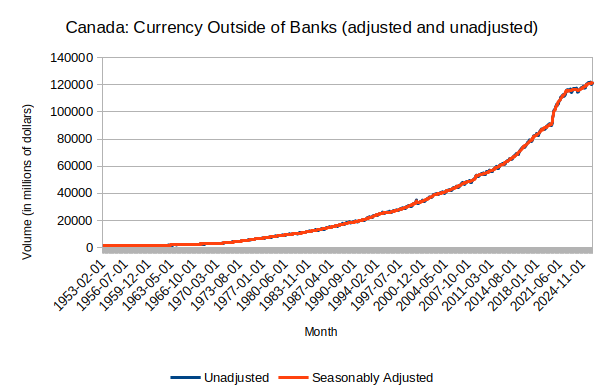
Specifically, there’s currently around $118 billion dollars of cash out there. Compare that with 1946, when there was barely one billion.
Perhaps the reason the value of cash has risen is because inflation means we need so much more money to buy anything. Ok. So take a look at this next chart that compares “Currency Outside of Banks” to the rate of inflation.
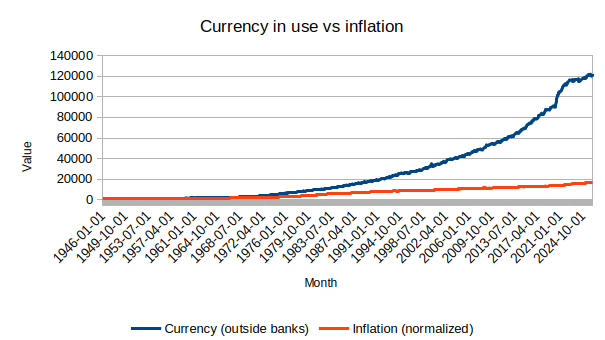
Ok. But perhaps you’ll argue that, because there are so many more Canadians now than in 1946 (around 32 million more), there’s more cash across the system, but each of us holds less of it.
Nope. The amount of per capita cash “Outside of Banks” in 1946 was $84.52. Adjusting that number for inflation would make that worth $1,478.20 in 2025 dollars. But the actual per capita amount in 2025 was $2,834.80. In other words each of us is stuffing our wallets with twice as much hard cash than the inflation rate itself would explain.
What’s going on here? Some of that cash is certainly being used for a tax-avoiding cash economy. But such things existed forty years ago as well, so they wouldn’t explain the more recent growth in cash holdings.
The Bank of Canada is definitely aware of the trend. They note that it’s actually primarily the higher denominations that are being used, rather than coins or low-denomination bills. The Bank suggests that we’re largely looking at Canadians (and foreigners) using such cash as a safe store of value.
The only problem is that cash is a terrible store of value: inflation erases three percent or so of its market worth every year. So why would anyone do this?
Canadians, as a group, aren’t stupid.1 My bet is that most people are well aware of the downsides of holding cash. It seems they’re convinced that the downsides of not holding cash are greater.
It’s possible that many people are worried about the possibility of a bank failure, payment system outage, or serious social disruption.2 Some are also worried about the risk of official (and unofficial) surveillance of their financial activity.
In other words, they’re not trying to store value so much as avoiding the costs of too much digital engagement.
I can’t know whether their concerns are justified, but it does seem like something of a vote of non-confidence in the banking sector and the government that regulates it.
Who Regulates the Regulators?

Some of us tend to be deeply suspicious of government regulatory frameworks. There’s generally a non-zero chance they’ll fail to solve the problems they’re targeting and a 100 percent chance they’ll impose expensive restrictions on the free execution of business and life.
Voting patterns notwithstanding.
It seems that cash in circulation numbers actually rose significantly during the COVID years.
As someone who readily accepts any currency type at my farm stand, I see cash is definitely on the downward trend, but no where near non-use. We recently chose to offer any type of card payment options and also EMTs, but cash is still king be it a small or large order. My transaction summaries show at minimum, 64% up to 91% cash use compared to electronic or card transactions. Customers specifically say to me that they would rather pay me cash in order that we avoid electronic banking charges. (2.5% of a $30 tomato order does add up!)
Another consideration with cash use is to do with outages (as you touched on)...be them banking systems, specific card reader systems, hardware outages, internet and also hydroelectric power outages. These outages are more common in rural areas where business still has to go on, vendors and customers alike know this and are typically prepared, so cash still has a great utility value.
Thanks for the morning read, David!
Victor Davis Hanson briefly mentions a black market in cash during a period in American history with high inflation and high taxation. https://www.youtube.com/watch?v=HkQ3CVfObc0&list=PLEASo__ijSI8
People worked for cash and paid cash when shopping.