

You know those catchy bits about “we’re investing in research and development” that have found their way into every government budget speech since the invention of budget speeches? Well it turns out each bold announcement costs us money. And, as I’ve noted, it’s notoriously difficult to measure the real-world economic and social benefits from all that spending.
I’ve written a lot about government research funding on these pages. Arguably too much. But I haven’t yet broken down where all the money for university-based research comes from. I think it’s about time we took a look. And Statistics Canada’s university revenues dataset is a great place to begin.
Foreign funding
First off, I recently complained about the lack of official data tracking foreign donations to Canadian post secondary institutions. Well perhaps I was just a tad hasty. After all, That Statistics Canada university revenues table lets us break down revenue by source. Here’s what the major categories of foreign funding looked like:
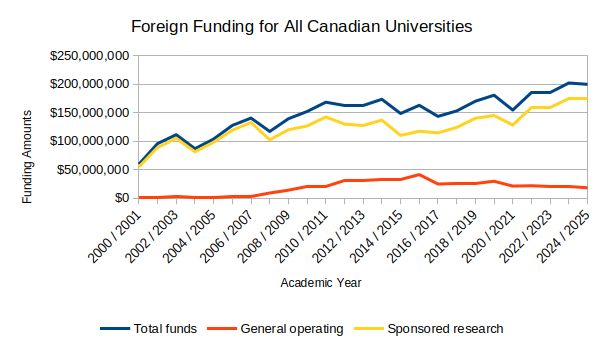
As you can see, the vast majority of foreign funding targeted research rather than operating expenses. Which makes sense: why would you want to pay for drywall repair in some other country’s faculty office space?
Overall, total funding for sponsored research across all Canadian universities grew steadily from $3.3 billion in 2000/2001 to $11.2 billion in 2024/2025 (measured in current Canadian dollars). All funding sectors increased their spending, but some grew far more than others. And the uneven growth will provide us with a fascinating story.
Direct government funding
As you can see from the next chart, domestic funding for sponsored research was dominated by federal government sources.
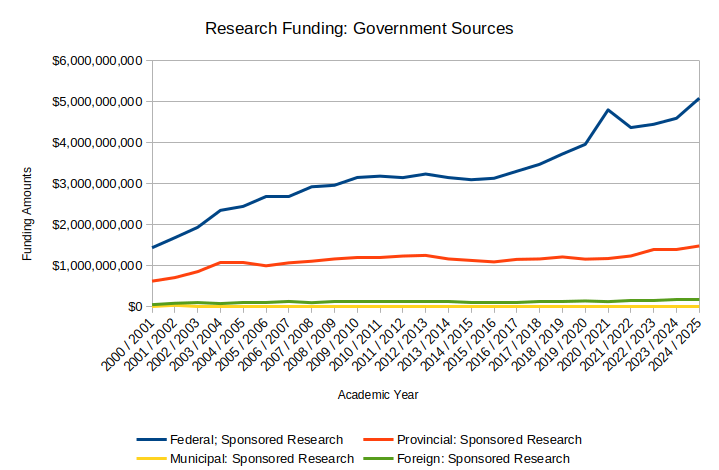
How much of government funding goes for research? Depending on the specific year, between 84 and 95 percent of federal funding for universities went to sponsored research, while that was true for only 8-12 percent of provincial funding. That also makes sense, since provincial responsibilities focus primarily on general educational operations rather than research.
In current Canadian dollar amounts, federal research funding grew by 253 percent over those years (to around $5.4 billion), provincial funding by 137 percent, and municipal funding by 39 percent. Over that time, foreign funding grew from $55 million in 2000/2001 to $174 million in 2024/2025.
Non-government funding
While the dollar value of corporate sponsorship of research grew by 125 percent over the past 25 years (to just over a billion dollars a year), the percentage of total research funding those grants made up dropped over that time from 13.83 to just 9.27 percent.
Who picked up the slack? It wasn’t the federal government: their percentage of all funding moved up and down between 45 percent and 51 percent and currently sits at 46 percent. It certainly wasn’t provincial governments whose share dropped from 19 percent to 13 percent.
So where is the funding increase coming from? The data tells us it was “grants made by not-for-profit organizations” including foundations. NGOs, in other words:
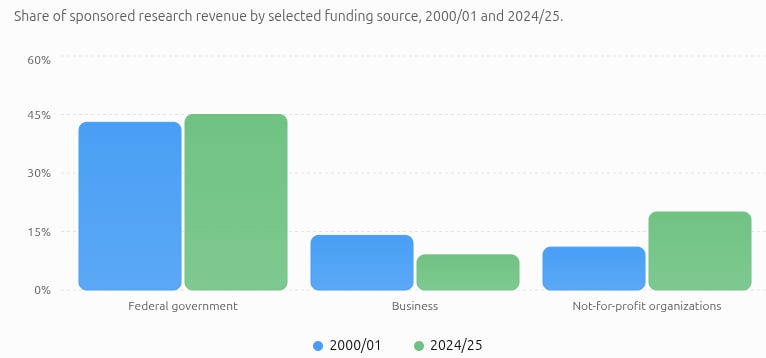
Over the past 25 years, NGO funding for sponsored research went from $373 million a year to $2.2 billion and their overall share grew from 11.2 percent in 2000/2001 to 20.06 percent in 2024/2025.
The question, however, is whose money those NGOs were spending. There’s no doubt that some of them relied on private donors. But there’s also no doubt that many - perhaps most - Canadian NGOs are funded through government grants of one type or another.
We’ve already tracked federal funds through layers of NGOs on their way to destinations that don’t fit federal policy. There’s no reason to think that a lot of this research funding isn’t also moving in odd directions.
Now, it’s true that some of those government-funded NGOs exist because they’re better at managing distribution than their government agency benefactors would have been. But if that was all that was happening here, then we wouldn’t be seeing such a sudden increase in funding from the NGO sector.
What actually lies behind that change would be worthwhile figuring out.
More:
Our Government Sponsors "Transformative" Research

Between 2018 and 2022, the federal government’s New Frontiers in Research Fund (NFRF) paid out 527 million dollars to 6,122 researchers engaged in 880 research projects. The NFRF exists to support:
Tracking Federal Funding Through Layers (and Layers) of Non-Profits

This won’t be the first time I’ve written about how complicated things can get when you try to follow government funding through nested layers of NGOs, charities, and other governments. But every attempt to pull back the curtain helps add a bit more clarity.
Our Government Sponsors "Transformative" Research
Between 2018 and 2022, the federal government’s New Frontiers in Research Fund (NFRF) paid out 527 million dollars to 6,122 researchers engaged in 880 research projects. The NFRF exists to support:
A harder to quantify metric would be to ask who is deciding what research gets funded and why?