


I’ll admit that I’ve rarely given much thought to the Privy Council Office (PCO). In fact, I was never all that clear about what it was, what it did, and what relationship it had with the Clerk of the Privy Council or the King’s Privy Council for Canada.
That, as it turns out, was a serious oversight. Because the 1,335 people employed by the PCO are arguably among the most powerful civil servants in Canada. And they’re certainly among the best paid: the average salary across all federal departments is $91,098, while the PCO average is $104,011. More importantly, PCO is the hub around which just about everything government does spins. Policy ideas originating within any ministry will nearly always pass inspection within the PCO…or fail.
I’m certainly not suggesting that they’ve somehow grabbed more power than is appropriate or that they’re actually a dark cabal plotting to transform the country into some dystopian hellscape. Perish the thought: generating dystopian hellscapes is the exclusive jurisdiction of Global Affairs Canada.
Instead, what fascinates me is how their roles fit in with the countless gears set into motion by all the other government departments.
But we’re getting way ahead of ourselves. First things first. The King's Privy Council for Canada is a largely ceremonial organization made up of current and former cabinet ministers and other prominent Canadians. In theory, they could be called to provide their advice to the King along with the current cabinet, but it’s been many decades since they even met.
By contrast, there’s nothing ceremonial about the PCO. Their original role involved supporting Cabinet in the style of what we might now call an executive secretary. Since 1992, however, the Clerk of the Privy Council - and the PCO more generally - stand at the head of the entire Public Service. This was later formalized within the Public Service Employment Act. The PCO is also now responsible for federal-provincial relations.
But there’s much more to it. As “Cabinet secretariat”, the PCO participates in appointing assistant deputy ministers, preparing ministerial proposals, providing the Prime Minister and Cabinet with strategic context and background, policy implementation, and potential conflicts between new and existing policies and big-picture government objectives.
We could say that, while individual ministries exist to decide what government should do, the PCO exists to tell government how to do it. Or in other words, they’re more likely than anyone else to have their fingerprints all over a government’s policy agenda. That’s not necessarily a bad thing, but it’s certainly a thing.
PCO expenditures in the 2022-23 fiscal year came to just a hair below $243 million. By far, the largest portion of that went to personnel expenses - which for the 2022 calendar year totaled more than $187 million. Around $17 million of external contracts was tendered in 2023, with the largest PCO-specific contracts going for infrastructure security to the Commissionaires and to SynerSolutions for IT security. Neither of which should surprise anyone.
But if we want to really understand what goes on in the PCO, we’ll need to know how their funding is divided between top-level program areas. Fortunately, that’s something easily available through the government’s Report Builder. Here’s how that looks:
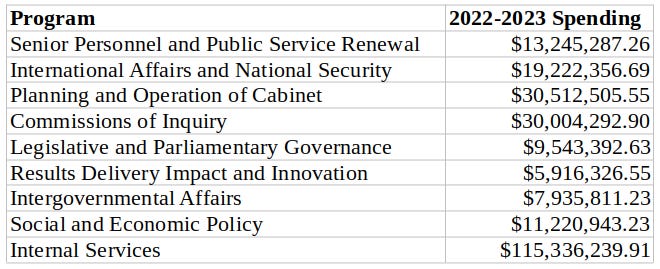
It’s true that the largest line item for each of those programs involves salary expenses. But there were a few notable second-place finishers. In fiscal 2022-23, Commissions of Inquiry spent a whopping $14 million on Professional and Special Services. Internal Services was responsible for $23 million for its own Professional and Special Services and $9 million for Acquisition of Machinery and Equipment.
My guess is that most of the Commissions of Inquiry money went to lawyers for Justice Paul Rouleau's Public Order Emergency Commission. Internal Services spending might be for administration activities like HR, accounting, IT support, communications, legal services, and planning. I guess I’d need an insider to know whether $115 million worth of annual administration is a number that makes sense for an organization of 1,335 employees.
Let’s take just one more example. The Social and Economic Policy program would, by my estimate, employ around 60 people tasked with the research and analysis that would inform all related decisions by the Prime Minister and Cabinet. That’s a heavy responsibility. But it also represents a great deal of power.
And that brings us back to the main topic of this post. As Cabinet secretariat, the PCO isn’t about pencil sharpeners and paper clips anymore. They’re at the very core of policy and legislative development in every corner of government.
Are they doing a good job? Should the responsibility for catastrophic failures rest with the PCO or with their political bosses? I’m guessing the most comprehensive and sophisticated answer to those questions can be found in any episode of Yes Minister.
They are important because they service the Prime Minister and the Cabinet Committee System.
The Cabinet Committees are the bottleneck that all major policy or legislative or regulatory decision must pass through. As the Secretaries they hold the pen for the agendas and the cabinet decisions. They certainly gives them a great deal of influence.
They are also made up from people in the public service who have been talent- spotted and jumped through a number of job hurdles to get there. After four or five years of providing drudge-like service in the PCO, they do well they go on to be Assistant Deputy Ministers and perhaps Deputy Ministers. So they are a bright, ambitious lot.
But that is different then suggesting they have their own agenda. Ultimately they are there to serve Few: the Prime Minister and his staff, a small number of powerful ministers who mostly chair the Committees and the Deputy Ministers and the Clerk of the Privy Council who hold the key to their future job promotions. Power is murky stuff! Not always clear who has it and it moves around.