

Here’s a single data point that I think can give us a useful insight into the larger state of our economy.
Some remarkably detailed Statistics Canada data seems to confirm that economic activity in the public sector is growing a lot faster than in the private sector. The dataset - Building permits, by type of structure and type of work - gives us the monthly value of building permits issued across the country since 2018. But that’s relevant to much more than just construction.
After all, construction isn’t just about the trades who will do the building, but about the people who will eventually work in those locations.
The data is broken down by building types and what kinds of work are being undertaken. I selected just “Total commercial” and “Total institutional and governmental” and requested the full value of all permits. That value represents the estimated construction costs that permit applicants expect their projects will face.
What’s interesting about this particular view of the data is that we can compare trends in economic sectors. Here’s a graph of the construction activity undertaken across Canada:
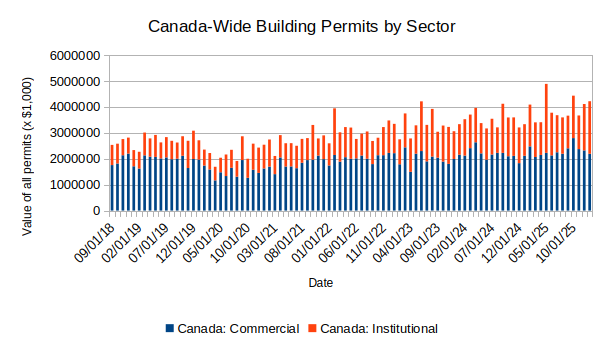
You can see how the value of all commercial projects has remained more or less stable (growing by just 24.88 percent) while the value of institutional construction increased by 160.16 percent over the same time. Institutional construction now makes up nearly 50 percent of all activity.
The “institutional and governmental” sector includes schools, hospitals, churches, and government buildings like legislative facilities and police stations. But the vast majority of that institutional construction is paid for with public funds.
It turns out that the dataset contains no numbers at all that are specific to “government buildings”. That means the real “institutional” numbers are actually much higher.
When I narrow down the data to just census metropolitan areas (CMAs), I get this:
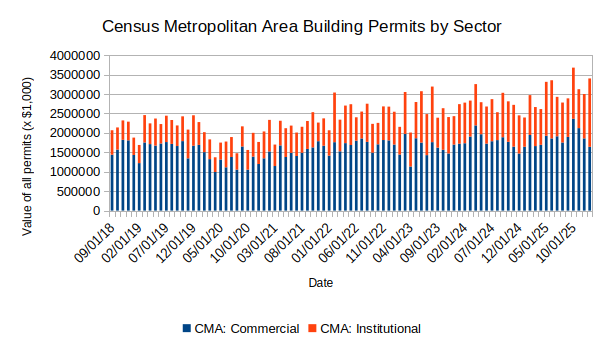
Private sector construction here grew by just 14.16 percent since 2018, while the institutional numbers jumped by 179.11 percent. While commercial projects are still comfortably in the majority within CMAs, their 10-month average share of the market dropped from 74 percent around 2018 to 62 percent over the past 10 months.
All of which tells us that economic activity in the public sector is far stronger than what’s going on in the for-profit world. And 15 years from now, if current trends continue, commercial activity in the country will have dropped below 50 percent.
What’s driving the change?
Governments at all levels are spending more than ever on health care, education, and public facilities. (Alberta apparently lead the way in 2025.) At the same time, higher interest rates, regulatory complexity, and soft demand for office space have depressed commercial construction activity.
Why is that a bad news?
All that public sector spending relies on taxpayer or borrowed funds. Canada’s already dangerously high government debt levels mean sustained high spending could pressure budgets, leading to higher taxes, cuts elsewhere, or elevated borrowing costs. Once governments are forced to cut back (as will almost certainly happen sooner or later) fiscal policy will tighten, and the resulting transition will create volatility. And pain.
Government spending decisions - because they’re not led by market signals - are vulnerable to misallocation. That can happen through overbuilding in politically prioritized sectors, underbuilding in high-demand commercial segments, or infrastructure that doesn’t match economic geography. This can reduce overall economic efficiency.
The construction sector already faces tight labour markets and material constraints. Heavier public spending will push up costs for concrete, steel, and skilled trades. This will likely deepen Canada’s housing supply crunch and can slow business expansion in offices, retail, or logistics.
Commercial construction (offices, logistics, retail, industrial space) is tightly linked to business formation, productivity, and private-sector expansion. Social programs are important, but they can’t replace those critical economic drivers.
Governments appear to be increasing their role in Canada’s overall economy. Perhaps that’s intended to replace commercial investment lost to over-regulation and taxation or perhaps it’s about implementing a big-government ideology. But our data seems to be hinting to us about where all this could end.


