

When the Liberal’s Online News Act (Bill C-18) became law back in June 2023, I was among many who predicted catastrophic consequences. There was no way the online giants, Google (Alphabet) and Facebook (Meta) would give in to Canada’s posturing and agree to pay Canadian news media outlets for the privilege of sending them more traffic.
In the end, Facebook chose to comply with the law by removing all Canadian news links from their platforms - deftly sidestepping the need to pay anything to anyone. And Google worked out an agreement that generated only marginally more cash than what they’d been paying previously.
The law was, indeed, a hot, messy failure.
And what wasn’t there to love here? We all got to feel good about a smug, arrogant, and out-of-touch government bringing disaster on the heads of a smug, arrogant, and out-of-touch industry.
Now, however, I have to acknowledge that things really haven’t worked out the way we expected. Oh, the law itself was a master class in bad legislation, and boy did Big Tech play ‘em all for fools. And The Hub just published a breathless piece about how online engagement for both local and national news outlets has tanked since Bill C-18 became law. Specifically, there was a 24 percent engagement drop for national news and 58 percent for local.
But.
Either The Hub has made a (rare) mistake, or I don’t know how to read numbers. I’ll let you decide.
You see, the news industry doesn’t actually need social media engagement to survive. Instead, they used to rely on social media engagement to drive traffic back to their own websites. Why? Because that was where they could post ads on which their users could click. More clicks, more income. As far as I can tell, their Meta accounts never directly generated a single dollar.
So from a revenue perspective it doesn’t matter how many people there are spitting their hatred and outrage at each other on CBC’s Instagram page. All that matters is how many eyeballs visit cbc.ca. And - surprise, surprise - that number has been unambiguously rising (for the big players at least…shame about all those small media outlets). Take a look at the monthly data for CBC, CTV, the Globe and Mail, the Toronto Star, Global News, and the National Post (underlying data courtesy of SimilarWeb):
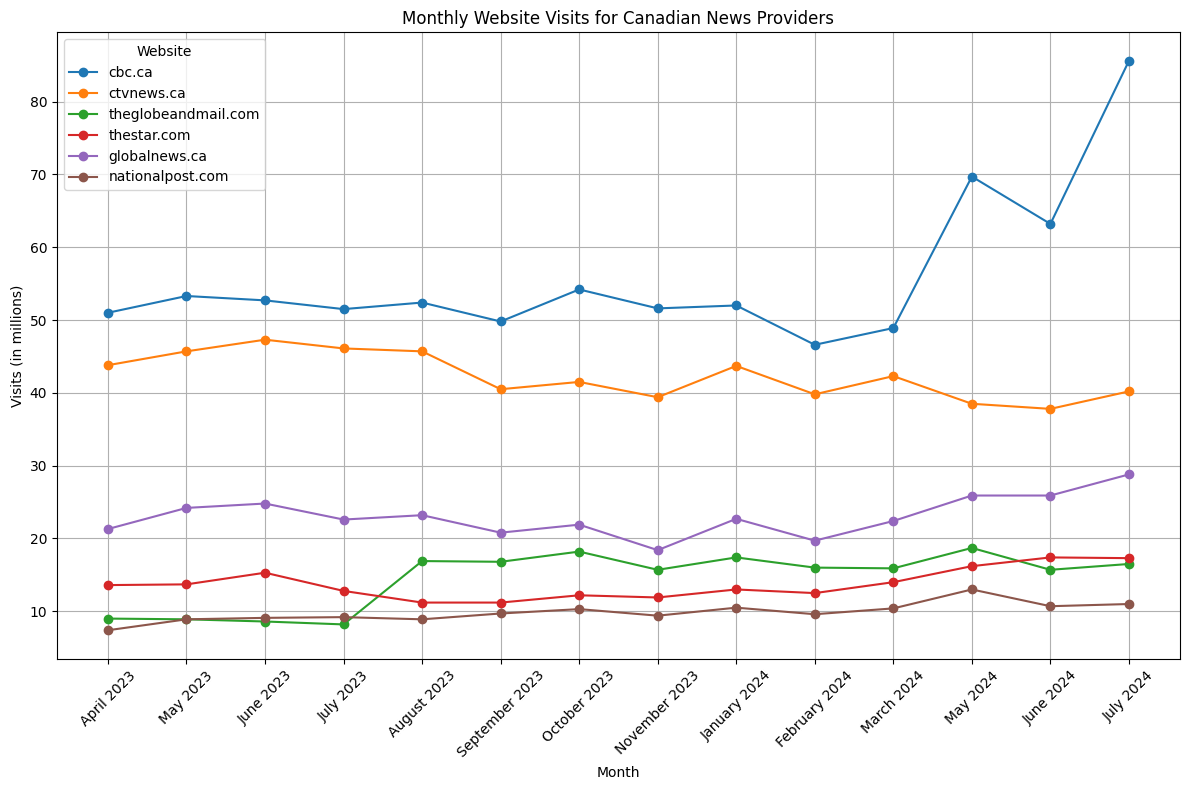
Monthly website visits for those six Canadian news outlets have, on average, increased 31.6 percent since Bill C-18 became law in June, 2023. I’ll say that again: monthly visits didn’t go down after all those Meta links were blocked, they went up. A lot. CBC and the Globe were the big winners (62 percent and 92 percent respectively), and CTV was the only loser (their visits dropped 15 percent).
My guess is that most of the Canadian news-hungry traffic simply moved from Facebook and Instagram back to the content producers’ home websites.
Has that whole sorry exercise solved Big Media’s financial problems? I’m sure it has not. Most Canadians still have no compelling reason to consume the product that traditional news media are offering.
But if I’m right C-18 hasn’t made things worse, either. Although I do strongly believe that it does at least demonstrate that the social media giants were never the problem in the first place.
I (quelle surprise!) stand by my previous comment but something else has occurred to me that I wish to query with you.
You checked the visits with the various major news sites and found what you found which, of course, led you to your conclusion. My query is a bit long winded but, here goes. It is my understanding that many Canadian - please pardon the expression - minor sites got a lot of traffic and ultimately subscriptions due to people who started out through the major media sites. It is my further understanding from reading comments from many proprietors of such sites that they have experienced significant drops in traffic since the Facebook et al withdrawal of links So, can you comment on that?
As always, thank you for your statistical efforts on my (you are doing this exclusively for me, right?) behalf.
Sir, your concluding sentence is, "... I do strongly believe that it does at least demonstrate that the social media giants were never the problem in the first place."
Therefore, one could further conclude that the attempts by the federal government to extort monies from Google et al was a) silly; b) stupid; c) criminal (extortion being a criminal offence, after all); or, d) all of the foregoing.