

Government regulations suffer from some nasty press. For one thing, it’s not hard for people to imagine how much government capacity is consumed creating and implementing regulations. But more than that, anyone who’s ever tried to do business in a modern state knows how frustrating and expensive it can be to identify and understand all the relevant rules. Compliance, in other words, costs us all.
I’ve written about some of the costs of over-regulation in Canada, but I haven’t spent much time thinking about regulations on their own terms. This is a complex and poorly understood world.
For example, did you know that, for the most part, governments may only impose regulations as legislative instruments made or approved under an Act of the Legislature (i.e., a statute)? Or that statutes often authorize a Lieutenant Governor in Council or a cabinet minister to create new regulations without the need for further approval in the legislature?
Because there are probably millions of individual regulations across all layers of government in Canada, I’ll focus here on the Province of Ontario. The province’s e-Laws database currently lists 857 consolidated laws.
A consolidated law is a combination of a statute passed by the legislature and any regulations and amendments that were subsequently added to the law. The database currently contains exactly 6,479 individual regulations, of which 2,865 are still active (meaning: they’re neither “spent” nor “revoked”).
803 of those active regulations are associated with the three Planning Acts.1 The Education Act (R.S.O. 1990, c. E.2) has 125 active regulations, and the Highway Traffic Act (R.S.O. 1990, c. H.8) has 99.
29 of the Planning Act regulations are entitled “ZONING ORDER - CITY OF TORONTO”, seven were identified by “ZONING ORDER - CITY OF VAUGHAN, REGIONAL MUNICIPALITY OF YORK”, and another seven were “ZONING ORDER - CITY OF MISSISSAUGA, REGIONAL MUNICIPALITY OF PEEL”.
Those don’t sound like micro-managing, entrepreneurship-stifling regulations to me.2 I’m sure there are some of those among the rest of those active regulations, but the regulatory system as a whole isn’t obviously evil. As it turns out, the Canadian Federation of Independent Business awarded an A grade to Ontario’s government for their regulatory reform.
So if Ontario’s regulations aren’t evil, are they at perhaps unnecessarily obstructive? That’s an answer I would love to be able to answer. I would, for instance, love to track how regulations move through each of their key milestones:
Are certain ministries more likely to add complexity than others?
Are certain classes of regulation growing faster than others?
Are average lag times between the introduction, enactment, and commencement stages of new regulations increasing?
Are regulation creation rates growing?
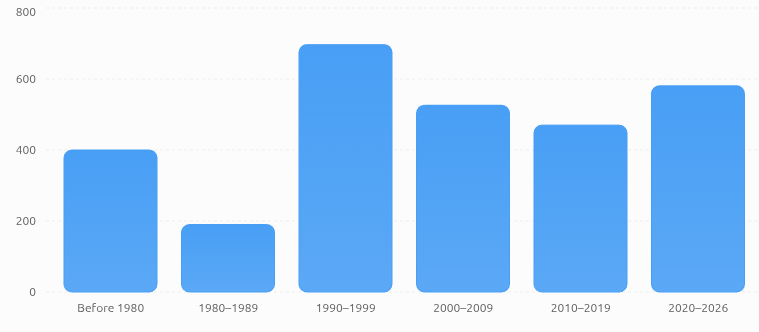
We may be able to at least partially answer that last question from our e-Law database. This graph infers the creation dates of active regulations from their reference citations. That’s not a perfect source, but it does suggest that Ontario’s regulation production growth isn’t exactly spiraling out of control.
But for now, most of those questions will sadly remain unanswered. That’s because the structural limitations of Ontario’s official data makes most big-picture analysis largely impossible.
Which is not to say that the government has made no effort to make their legislative record available to the public. There’s clearly been some serious and helpful work done here. And I’ve seen absolutely no evidence suggesting that anyone is trying to hide anything.
But managing fast-moving, complex, population-scale datasets effectively isn’t something governments do particularly well. This is, after all, the same provincial government that gave us - or, more accurately, didn’t give us - eHealth Ontario (a.k.a. Smart Systems for Health Agency). So it’s hardly surprising that full transparency isn’t yet easily available.
The Planning Acts of 1970 ( c. 349), 1980 (c. 379), and 1990 (c. P.13).
Although, as Hansard Files pointed out, such regulations have been imposing growing control over the planning autonomy of municipalities.
One of the more onerous sources of compliance challenges comes from public consultation processes which allows a wide range of participants to make demands which regulators turn into conditions of project approval. That may add hundreds of additional requirements for proponents to manage not just during construction, but also monitoring and reporting during operations, further burdening economics. Perhaps a more narrow definition of stakeholders directly affected by a project would help.
Does the process have anything to do with bureacrats insatiable need to create more jobs for bureaucrats and build little bureaucratic kingdoms?