

The federal government recently announced its new National Food Security Strategy - along with a commitment to spend another $3.2 billion. The initiative has predictably received mixed reviews. But it at least tries to address a widely acknowledged food affordability problem.
I’m in no position to predict the impact the strategy might have.1 What I can do is take a look back at previous attempts to control food pricing and assess their success.
Just for yuks, let’s go all the way back to Canada’s Anti-Inflation Act of 1975. The Act was passed as an effort to fight a serious run of inflation largely driven by oil prices. Grocery prices were never targeted directly by the Act, but restrictions aimed at large producers were expected to ease consumer prices indirectly.
This chart uses Statistics Canada data to compare Canada’s Consumer Price Index (for all items besides food) with the CPI numbers representing just food. We get the years leading up to the Act and the half-decade that follows:
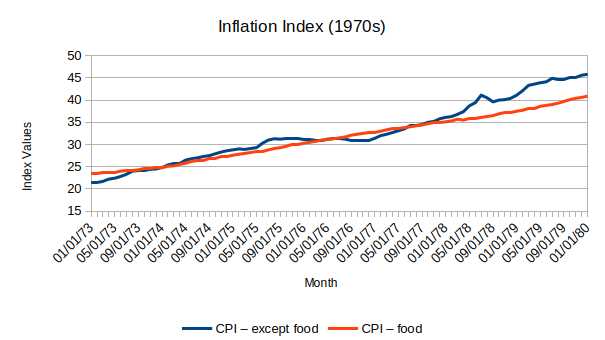
If the measures had been successful, we would have expected to see the inflation experienced by non-food products to slow or even drop, and the rate of food inflation to more or less follow along. In fact, while there was a brief pause in growth for the general CPI, food inflation continued its climb. Over the subsequent year or so (through 1977), food prices clearly rose more quickly than other commodities.
Overall, it would be difficult to call that effort a success. Fortunately, these days there’s no one with serious influence who’s pushing for a repeat of 1975. I hope.
Ok. So how have things been going over the past decade? Here’s how more recent data from the same Statistics Canada table looks:
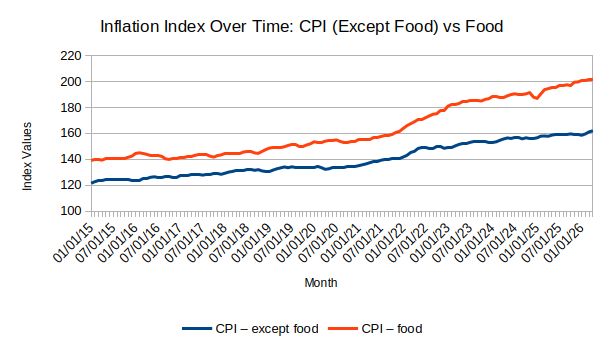
There’s clearly a disconnect between food inflation and the rest of the economy that didn’t exist a half century ago. In fact, the two measures first came unstuck midway through 2008.2
It’s not immediately clear what’s behind this disconnect. Triggers from those years could have included destabilizing fluctuations in the Canadian dollar; oil pricing (along with related food-production cost increases); global price increases for wheat, corn, and other staples; transition to biofuels in the U.S.; and growing demand in China and India. But the economies of other nations didn’t react quite like Canada’s.
The fact that the regular CPI seems to have come permanently unstuck from food costs suggest that there’s something structural going on. That could include unsustainable agricultural costs, broken food supply chains, strange consumer demand patterns, or general productivity growth that somehow missed food production and grocery sectors. No one knows for sure.
Recent government moves - like the one-time grocery rebate in 2023 and the temporary GST/HST holiday at the end of 2024 - have had no measurable impact on costs. And they didn’t provide meaningful assistance where it was most needed. For a low-income couple with two children, the 2026 enhancement to the GST rebate would add just $22 a month over and above the original Credit.
What could actually make a difference? Well how about:
Eliminating GST/HST on all foods. There are valid arguments for taxing snack and restaurant food. But there are way too many exceptions (like seniors and people living alone who have no choice but to buy food in small packages) to justify the policy.
Eliminating industrial carbon taxes. No hand-waving and clever accounting theories can cover the reality that taxing food production and transportation will drive up food prices for consumers (although, realistically, the pass-through premium might not amount to more than $100 a year for a typical family).
Eliminating (or replacing) supply management for dairy, chicken, turkey, and eggs. Supply management programs - which also happen to be a major trade irritant with the U.S. - likely add between $500 and $1,000 to a typical low income family’s annual food costs.
The elimination of interprovincial trade barriers - which have remained largely unchanged despite Liberal election-themed hopes - would increase efficiency and competition and reduce compliance costs. Such changes could likely add another $250 or so in annual household savings.
None of those appear to be even aspirational targets in the government’s National Food Security Strategy. So my guess is that we’re in for more of the same.
Although it’s no secret around these parts that I’m not a fan of government subsidies and interventions. At best it’s rare when such endeavors return measurable and positive outcomes.
Sadly, this means it’ll be difficult to exclusively blame the Liberal Party for the underlying problem.
That virtually every politician in Canada pledges everlasting love and support for supply management is inexcusable and embarrassing.
Why do governments and this one in particular think announcing some great spend of non existent dollars amount to any form of tactic or strategy. It’s just piling inefficiency on inefficiency, creating more bureaucratic bloat, and just plan BS because no one has any idea where the money is going to come from, how it would be used or how it would generate any type of positive net good. Makes for good headlines though and gets the hands out crowd continuing to vote Liberal.